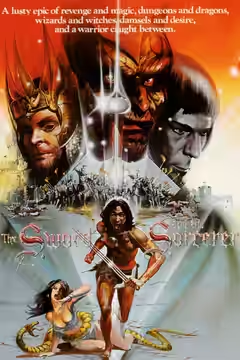
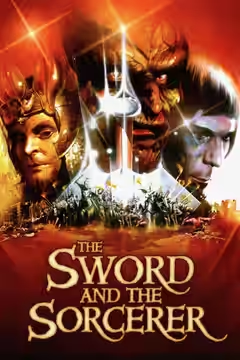
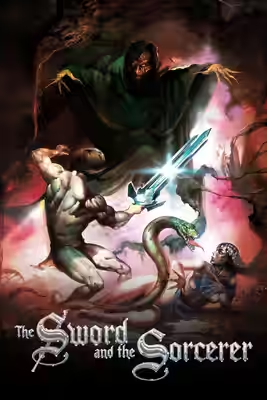
Albert Pyun’s bloody fantasy offers some crude entertainment, but stiff acting and laborious dialogue make it difficult to recommend. The music helps more than the writing, which is not much of a contest.
Albert Pyun’s The Sword and the Sorcerer is a cumbersome fantasy adventure with a taste for gore and too little pleasure in its characters. At 100 minutes, it ought to be a fairly painless proposition for anyone willing to accept an evil kingdom and a warrior driven by justice. The blood supplies some crude entertainment, but the dialogue and performances make the stretches between those pleasures feel longer than they should. There is enough enthusiasm to make its shortcomings disappointing rather than merely predictable.
The screenplay, credited to John V. Stuckmeyer, Tom Karnowski and Albert Pyun, mistakes cumbersome speech for a convincing fantasy setting. There is nothing inherently wrong with characters speaking formally in an invented kingdom; the difficulty is making those words sound as though someone might choose to say them. Here, too much of the dialogue advertises its own importance. It takes concentration to get through lines that ought to be helping a simple adventure along.
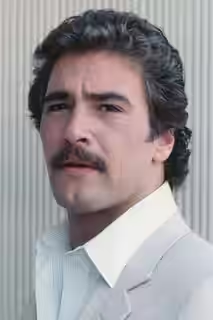
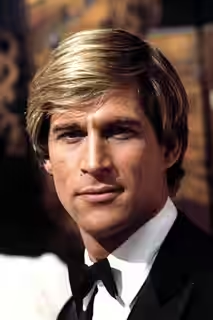
Lee Horsley is a less engaging Talon than this sort of adventure needs, although the script gives him an awkward task. Heroic declarations need either conviction or a little humour, and the acting too often supplies neither. Kathleen Beller’s Alana and Simon MacCorkindale’s Mikah are similarly hampered by lines that sound laborious rather than grand. We kept wishing the characters would say what they meant without making such a performance of it.
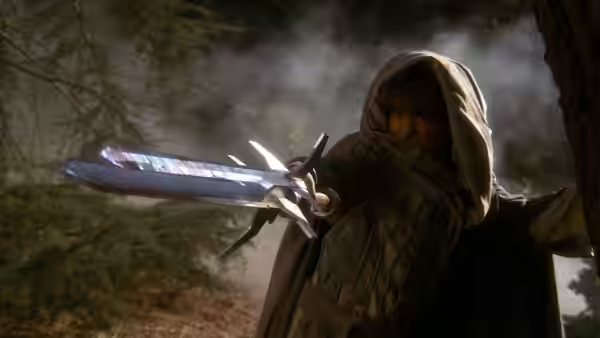
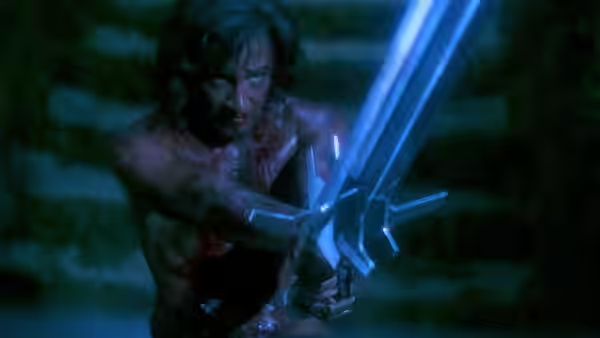
Joseph Mangine’s cinematography is more convincing when serving the horror than when trying to sustain the adventure. The gore makes an impression, and at least the film does not seem embarrassed by its nastier interests. That willingness to be unpleasant gives it some force when the acting threatens to flatten everything. Too often, though, the violence becomes the principal reason to pay attention, with little interest surviving once the characters resume their exchanges.
Marshall Harvey’s editing does not solve the problem of pace. The dialogue feels slow because it is uninteresting, and cutting around it can only do so much. We grew impatient with the medieval phrasing: it makes the characters sound alike when they ought to be establishing their differences. The action-adventure element needs a briskness that the writing repeatedly denies it, leaving the film dependent on its bloodier attractions to restore our interest.
David Whitaker’s music is a more agreeable contribution, giving the fantasy some of the enthusiasm missing from the exchanges between the actors. There is an effort here to make the material feel worth taking seriously. That effort deserves acknowledgement, even when the words do not. The music encourages us to accept the imaginary kingdom, but the film still needs to give its inhabitants something more engaging to say.
Against the modest requirements of a sword-and-sorcery adventure, the failure is fairly basic. We need a hero worth following, danger with some force and enough momentum to carry us past the nonsense. Pyun understands the attraction of the bloodier material, but his film spends too much time struggling with speech. Try it only if gore is your chief interest; the adventure is harder to enjoy.