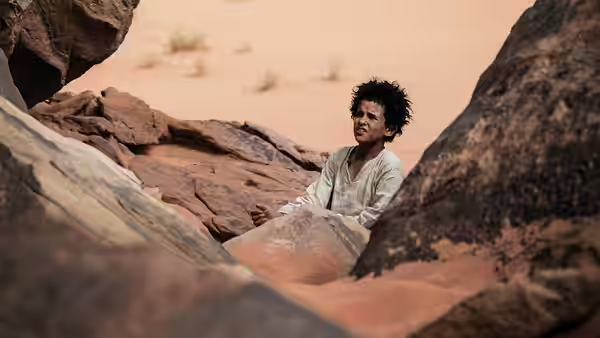
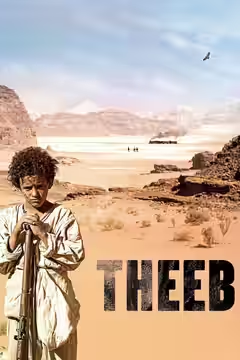
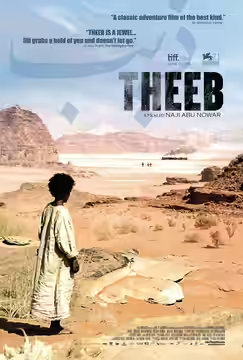
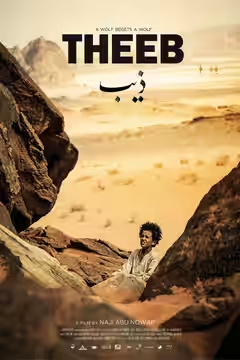
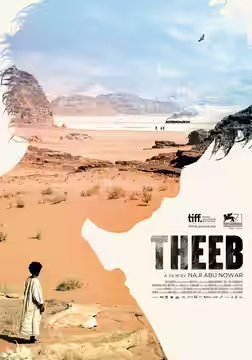
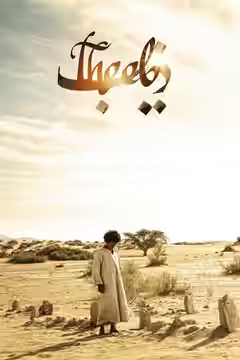
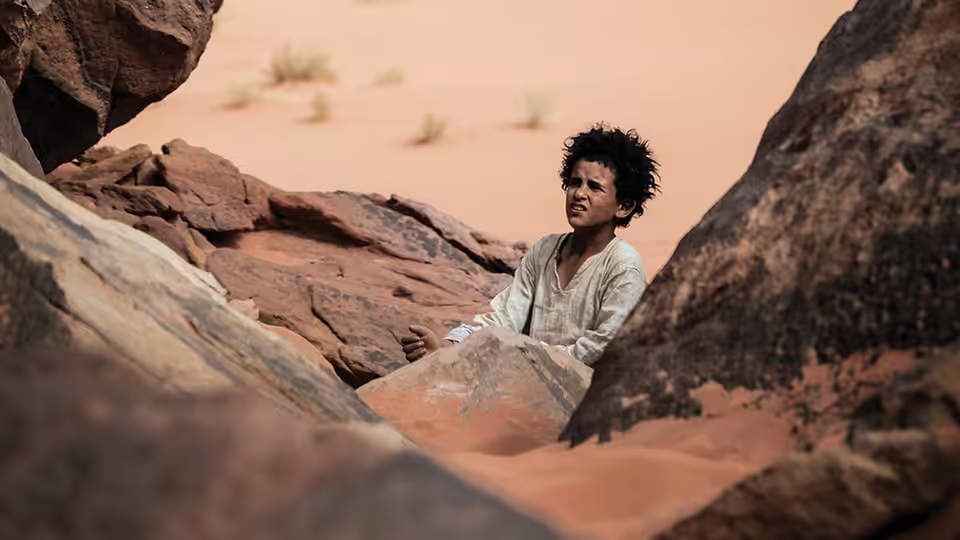
Theeb (Jacir Eid Al-Hwietat) sits among rocks in the desert
Film review

Theeb

2014 · Directed by Naji Abu Nowar · 1h 40m

In a sentenceLawrence of Arabia from the point of view of the kid nobody thought to ask

The Ottoman desert, 1916, in the middle of the First World War. Theeb (Jacir Eid Al-Hwietat), a Bedouin boy whose father, the tribe’s sheikh, has recently died, is being raised by his older brother Hussein (Hussein Salameh Al-Sweilhiyeen), who is teaching him to shoot and to draw water. One night a British officer, Edward (Jack Fox), arrives at the camp with an Arab companion (Marji Audeh) and a locked wooden box he will not open, asking for a guide to a well on the old pilgrims’ road to Mecca, close to the new railway. Hussein is told to take them. Theeb, forbidden to come, follows on foot and is found too far out to be sent back. The road has been empty since the railway came, and the men who once guided pilgrims along it have had to find other work.

Fi1m review

Naji Abu Nowar’s first feature is a desert adventure seen from the height of a Bedouin boy, and it is tense, plain and well made. It dawdles in the middle and the score sounds borrowed, but the boy is worth the trip.

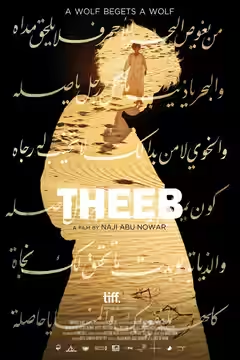
Most desert films are about the men who cross it. Naji Abu Nowar’s first feature is about the child who tags along, and it stays at his height for the whole hundred minutes. Theeb, whose name is Arabic for wolf, is a Bedouin boy in the Ottoman desert in 1916, the youngest son of a dead sheikh, and when a British officer arrives at the camp wanting a guide to a well on the old pilgrim road, his brother Hussein goes and Theeb follows. Much of what he sees he does not understand. Neither, for a while, do we, and Abu Nowar and his co-writer Bassel Ghandour are right not to help.

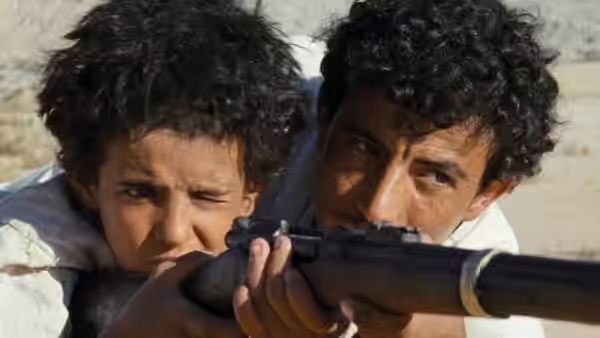
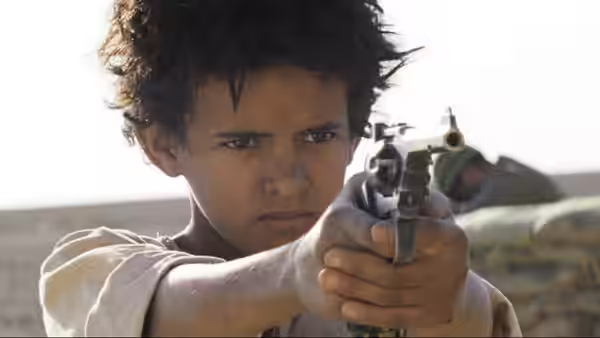
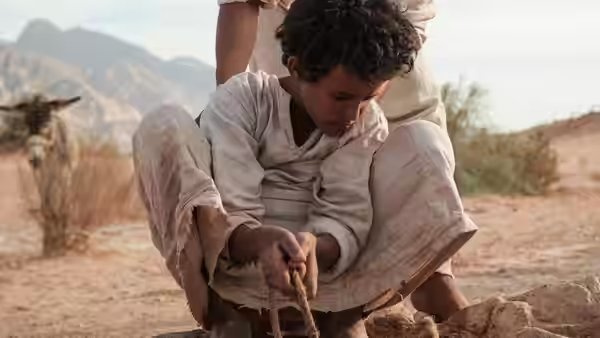
The cast are not professional actors, and Jacir Eid Al-Hwietat, as Theeb, is the kind of child you only get that way. He does not do anything. He watches his brother, he watches the officer’s locked wooden box, he watches the men who come later, and the film trusts the watching to carry it. Hussein Salameh Al-Sweilhiyeen’s Hussein is gentle and a little exasperated, lowering the boy into a well on a rope so he learns where the water is, and the early scenes between them are the warmest in the film.

Wolfgang Thaler shoots the Jordanian desert as somewhere people live and work. There are wide shots, because there is no avoiding them, but the camera is more often low and close: a rope going down into dark water, a camel’s leg, the boy’s face lit by a fire while the adults argue above him.

What they find at the well we will leave to the film, except to say it is the moment the outing becomes a thriller, and a good one. There is a night sequence in which the boy is alone among rocks with gunfire somewhere beyond them, and Thaler keeps the frame nearly black with only the child’s eyes in it, and Jerry Lane’s score stops. We were frightened for him in a way films with children in danger rarely manage, because nothing in the staging promised he would be all right. It is done with a rifle, a rock face and a boy who does not know where his brother is.

The second half is a two-hander, and we will not say how it comes about. Hassan Mutlag Al-Maraiyeh, credited only as the Stranger, is the other half of it, a man Theeb has every reason to fear and no way to do without, and the two circle each other in close quarters for a long time. Al-Maraiyeh plays him with neither menace nor charm, which is more unnerving than either, and most of their scenes are played at a murmur over a few feet of sand.

It does dawdle. Rupert Lloyd, who edited as well as produced, is patient to a fault in the middle third, and there is a run of walking, resting and looking at the horizon in which the film seems to be waiting for something it has already told us is coming. Lane’s score is the other borrowed thing: slow strings and guitar in the manner of the American western, telling us where the film learned its shape at moments when the pictures were managing on their own.

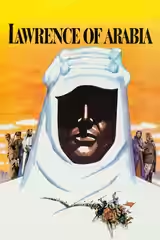
The obvious ancestor is Lawrence of Arabia, which is set in the same war and the same sand, and Abu Nowar knows it: the railway, the officer with a mission he will not explain, the Arabs who are useful to him. What he has done is turn the camera round. The Englishman passes through the frame, and the people he was hired to look past are the ones we stay with. The box is just a box, until a child asks what is in it and nobody answers.

It is a 12 certificate, and a child of Theeb’s age could watch it, though there are two or three moments they will not forget quickly. See it on as large a screen as you can find; on a sofa the long walks are longer and the dark scenes darker. The last twenty minutes are as good as anything in it, and they end without a speech, which we were glad of.
Critical consensus AI synthesised

76
Positive
12
Mixed
2
Negative
1

Most critics like Theeb, and they like it for the same things. The reviews lean positive by a clear margin, and the praise settles on the desert: Wolfgang Thaler’s cinematography is named again and again, and several critics note that the landscape is shot plainly rather than as a postcard. Jacir Eid’s performance as the boy draws almost as much approval, usually described as natural or expressive. Many reviews call it an old-fashioned adventure, and the First World War setting and the passing of Bedouin life are treated as the film’s real subject.

The reservations are about pace and story. A handful of critics find the narrative thin or meandering; The AV Club calls it simplistic and poorly paced, and Consequence finds it underdeveloped despite its beauty. Variety’s one complaint is that the score sounds too Western, and Eye for Film thinks viewers could use more context. The spread is fairly narrow: most scores sit in the high seventies and eighties, with a single outright dissenter.

Empire
23 July 2015 · David Parkinson
85*

Parkinson finds the film smart, enthralling and intelligently exciting. He particularly praises its confident exploration of the passing Bedouin nomadic way of life.

Read the full review →
Variety
10 September 2014 · festival review · Jay Weissberg
85*

Weissberg calls the film a classic adventure and praises its well-told story and vivid performances. He especially singles out the stunning Jordanian landscapes, while noting that the score feels a little too Western.

Read the full review →
IndieWire
6 November 2015 · B+ · Nikola Grozdanovic
83

The critic praises Theeb as a reverent, accomplished coming-of-age story and an arthouse gem. They single out the cinematography, score, and lead performance for making its desert setting and young protagonist compelling.

Read the full review →
Little White Lies
14 August 2015 · 4/4/4 · Bekzhan Sarsenbay
80

The critic finds the film austere and beautiful, praising its rare subaltern perspective and empathetic treatment of its characters. They also single out its subtle, nuanced handling of cultural contrasts and the frontier setting.

Read the full review →
Los Angeles Times
26 November 2015 · Robert Abele
80*

Abele calls the film a winning, tense coming-of-age adventure. He especially praises its desert cinematography and sound design, along with Jacir Eid’s natural performance.

Read the full review →
Time Out
9 August 2015 · ★★★★ · Trevor Johnston
80

The critic presents the film as a classic adventure, praising its eye-searing landscapes and fascinating historical setting. The review highlights the tale of innocence lost, with a young boy escorting a British officer through the Jordan desert during the First World War.

Read the full review →

Straight answers AI written, from our review

Is Theeb worth watching?
Theeb is worth watching for anyone who likes a desert adventure told plainly and with nerve, and we scored it 80. Naji Abu Nowar keeps the camera at a Bedouin boy's height for a hundred minutes, and Jacir Eid Al-Hwietat's watchful, unforced performance carries it. It dawdles in the middle third and the western-style score sounds borrowed, but the last twenty minutes are as good as anything in it.
How long is Theeb, and what is it rated?
Theeb runs 1h 40m. It is an adventure and thriller film.
Where can I watch Theeb in Austria?
Theeb is not on any streaming or rental service in Austria at the moment. It is available in 5 other countries; change your country at the top of the page to see where. Availability is checked daily.
How violent or frightening is Theeb, and is it suitable for children?
Theeb is a UK 12 certificate, and a child of its hero's age could watch it, though two or three moments will stay with them. The fear comes less from what is shown than from a boy alone among rocks with gunfire somewhere beyond, and the film never promises he will be all right. Squeamish adults will cope; younger children may not.
How does Theeb compare to Lawrence of Arabia?
Theeb is the same war and the same sand as Lawrence of Arabia, seen from the Bedouin boy's side rather than the British officer's. Lean's film is the larger and grander of the two, built on scale and Peter O'Toole's unsettling performance; Abu Nowar's is small, close and quiet, and the better choice for a tense evening rather than a long one. We recommend both, but they are different kinds of film.
What should I watch after Theeb?
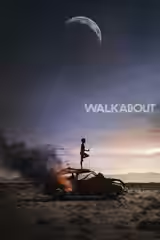
After Theeb, try Lawrence of Arabia (1962, Fi1m 90): The same war and sand, seen from the officer’s side rather than the boy’s. Then Walkabout (1971, Fi1m 85): Two children, one desert and a guide they cannot read; Roeg is stranger and crueller; and Wadjda (2012, Fi1m 80): A Saudi girl wants a bicycle; another child’s-eye film that trusts its lead to look.

Cast

Awards

Academy Awards, 2016

Nominated
Best International Feature Film

International Submission to the Academy Awards, 2016

Nominated
International Submission to the Academy Awards

If you liked this, try…

  1. Lawrence of Arabia (1962, Fi1m 90)The same war and sand, seen from the officer’s side rather than the boy’s.

  2. Walkabout (1971, Fi1m 85)Two children, one desert and a guide they cannot read; Roeg is stranger and crueller.

  3. Wadjda (2012, Fi1m 80)A Saudi girl wants a bicycle; another child’s-eye film that trusts its lead to look.

  4. Timbuktu (2014, Fi1m 88)Sissako’s desert is modern and armed, and his patience with faces is much the same.

  5. The Proposition (2005) · not reviewed yetAn outback western with the same flies, heat and refusal to make the frontier pretty.