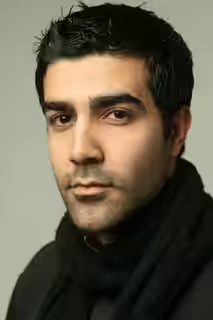
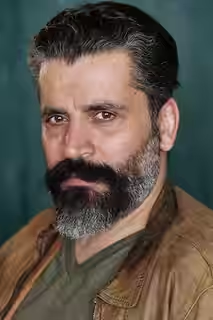
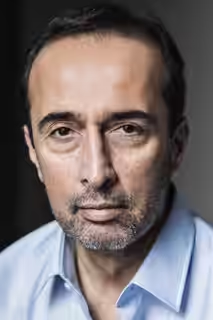
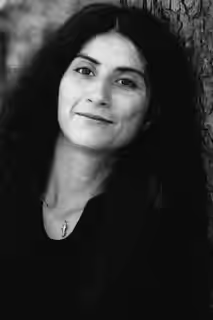
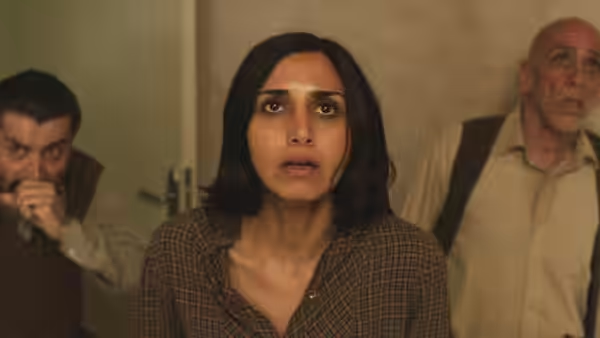
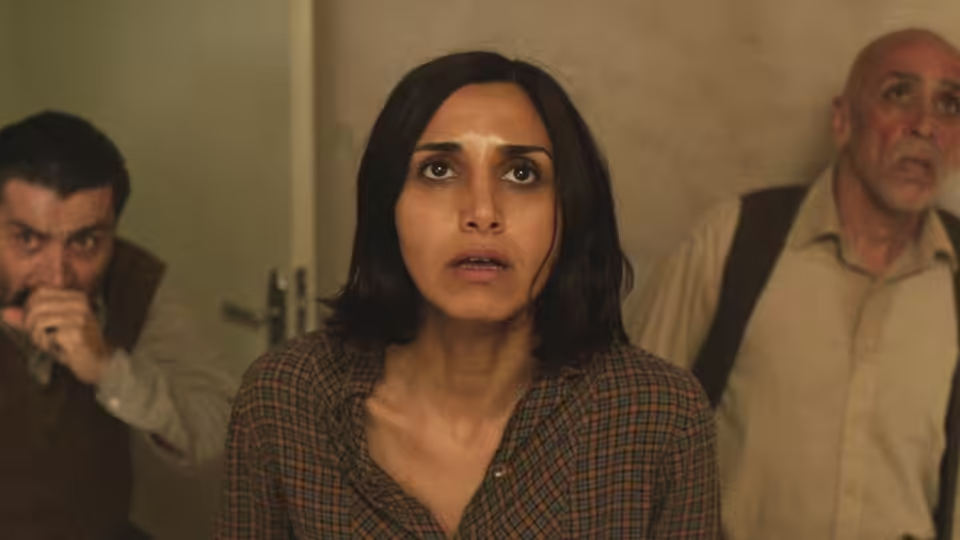
Shideh (Narges Rashidi) and two men look upward inside an apartment
Film review

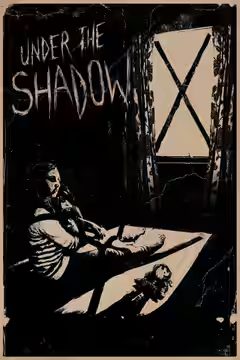
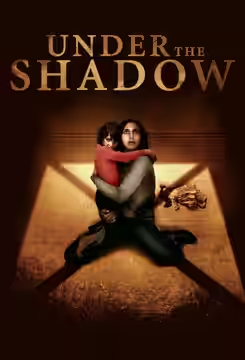
Under the Shadow

2016 · Directed by Babak Anvari · 1h 24m

In a sentenceA ghost story in which the most frightening thing to come through the ceiling is the one that does not go off

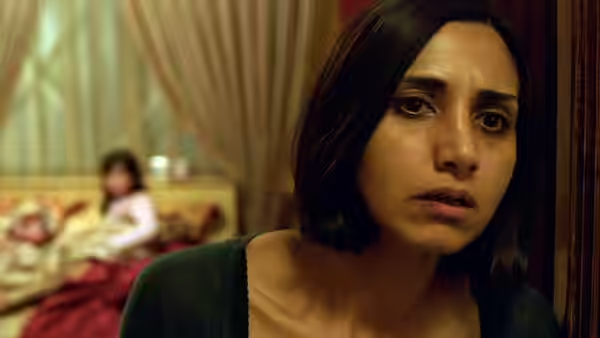
Tehran, 1988. Iraqi missiles are falling on the city, and Shideh (Narges Rashidi) has just been told, in an office at the medical school, that she will not be allowed to finish her degree; the politics she got up to as a student have caught up with her. Her husband Iraj (Bobby Naderi), a doctor, is posted to the front, leaving her in their flat with their daughter Dorsa (Avin Manshadi), a banned video recorder and a Jane Fonda workout tape. The neighbours pack up one by one. Then a missile comes through the roof, lodges in the Ebrahimis’ flat upstairs and fails to explode. Dorsa’s doll disappears, a small boy talks about djinn, and Shideh, who believes in none of it, has to decide whether to run or to stay.

Plays from YouTube when you press play; nothing loads from them until then.

Fi1m review

Babak Anvari’s first film sets a haunting in a Tehran flat during the Iran–Iraq War, and the taped windows and sirens frighten as much as the djinn. Tight, well acted and properly unsettling, though the final stretch reaches for scares we have met before.

Babak Anvari wrote and directed his first feature, and it runs 84 minutes wasting few of them. It is a ghost story set in a Tehran flat in 1988, in the last year of the Iran–Iraq War, with missiles landing on the city. Shideh (Narges Rashidi) has lost her place at medical school and her husband Iraj (Bobby Naderi) to the front in the same week, and is left with their daughter Dorsa (Avin Manshadi) and something that may have come into the building with the bomb. We recommend it, with one caveat: after seventy minutes of avoiding the standard bag of scares, the last quarter of an hour reaches into it.

Rashidi carries the film, and she does it by being angry rather than frightened. Shideh slams the car door on Iraj, exercises to a Jane Fonda tape on a video recorder she is not supposed to own, and treats the neighbours’ talk of djinn as one more thing said to her by people who think she should be at home. Nasser Zoubi’s production design gives her a flat of brown furniture and yellowed walls with tape crosses on every window, and Kit Fraser lights it with table lamps and the television’s glow, so the dark corners are dark corners for a long time. Phaedra Dahdaleh puts Shideh in a tracksuit indoors and a headscarf she resents at the front door.

The moment that frightened us most is not supernatural. A missile comes through the roof and does not detonate. Anvari holds on a crack spreading across Shideh’s ceiling, then takes us upstairs to the Ebrahimis’ flat, where the thing has lodged in the floor and the neighbours are standing round it as though it were a piece of furniture nobody ordered. We were properly unsettled, and it was the ordinariness that did it: the dust, the wallpaper, a family who cannot leave because the building is all they have. Everything Anvari does afterwards with the djinn depends on that image.

The djinn, when it comes, is mostly cloth: a sheet moving where there is no draught, a shape in a doorway that is either a woman covered head to foot or nothing at all. Gavin Cullen and Will McGillivray’s score is low and sparse and stays out of the raids, so the sirens and the distant thumps are the loudest sounds. Christopher Barwell cuts the haunting scenes long, letting us look at an empty hallway until we have decided nothing is there. The scene most critics single out, in which cloth wraps itself over Shideh’s face, deserves the attention. We could not breathe either.

The film’s best scene has no ghost in it. Shideh ends up outside at night, dressed for her own front room rather than for the street, and the people who stop her are not spirits. We will say no more, except that Anvari lets it land without a speech.

Elsewhere he is less patient. Twice Iraj rings from the front to tell Shideh she should be a better mother, and the film has already shown us what he is saying. A small boy staying with the Fakurs downstairs exists to explain djinn to Dorsa and to look sinister. Manshadi is good when Dorsa is sulking and less good when she is screaming, and the script gives her more of the second. The final stretch drops the wind and the cloth for things lunging out of the dark with a bang. They work, in the way a hand on the shoulder works. They are also the only part of the film that could have come from any other one.

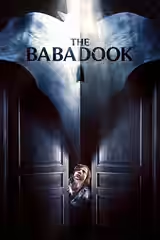
The comparison most critics reach for is The Babadook, another film about a mother alone with a child and something in the house. What Anvari has that Jennifer Kent did not is the war, and he never lets it become wallpaper. Every scare is timed against a siren.

It is in Farsi, with subtitles, and it earns its 15 certificate through dread rather than blood. Watch it at home, late, with the curtains drawn. It is a film about a flat, and it works in one.
Critical consensus AI synthesised

81
Positive
20
Mixed
3
Negative
0
IndieWire
23 January 2016 · A- · Eric Kohn
90

Kohn calls the film a fresh and pointed horror movie, while noting that it eventually leans on familiar scares. He praises how its historical setting and social restrictions deepen the story’s supernatural terror.

Read the full review →
Los Angeles Times
6 October 2016 · Noel Murray
90*

Murray calls the film a gripping, terrifying thriller that also examines a changing society. He praises how the heroine’s anxieties and Tehran’s setting deepen the supernatural horror.

Read the full review →
The Hollywood Reporter
25 January 2016 · festival review · David Rooney
90*

Rooney praises the film as a gripping, assured horror thriller with potent political undertones. He singles out Narges Rashdi’s riveting performance and Anvari’s sustained, stylish tension-building.

Read the full review →
RogerEbert.com
6 October 2016 · ★★★½/4 · Matt Zoller Seitz
88

Seitz gives the film a positive review, finding its horror effective and its setting essential to the tension. He especially praises how the supernatural threat works alongside the characters’ fear amid the Iran–Iraq War.

Read the full review →
Empire
26 September 2016 · Kim Newman
85*

Newman calls it an outstanding slow-burn horror film and a quality ghost story. He praises its potent scares, strong performances and unusual Tehran setting.

Read the full review →
The New Yorker
85*

The critic finds the film a gratifying, deeply unsettling horror story. They single out Rashidi’s commanding performance and the way wartime realities make the terror feel natural.

Read the full review →

Straight answers AI written, from our review

Is Under the Shadow worth watching?
Under the Shadow is worth watching for anyone who likes horror built on dread rather than blood, and we scored it 80. Babak Anvari's Tehran flat, with its taped windows and sirens, frightens as much as the djinn, and Narges Rashidi is angry rather than scared throughout. The last quarter of an hour reaches for scares we have met before.
How long is Under the Shadow, and what is it rated?
Under the Shadow runs 1h 24m. It is a drama and horror film.
Where can I watch Under the Shadow in Chile?
Under the Shadow is streaming on Netflix in Chile, and it is also available to rent from Apple TV from CLF 3490.00. Availability is checked daily; the links above go straight to each service.
How violent or frightening is Under the Shadow, and is it suitable for children?
Under the Shadow is a 15 in the UK and earns it through dread rather than gore: an unexploded missile through a ceiling, cloth moving where there is no draught, a scene in which fabric wraps itself over a woman's face. There is little blood, but the sustained tension and the war make it unsuitable for children. Teenagers who can take slow-burning fear will manage it.
How does Under the Shadow compare to The Babadook?
Under the Shadow and The Babadook both put a mother alone in a house with a child and something else, but Anvari's film adds the Iran–Iraq War and times every scare against a siren, while Kent's makes grief itself the monster. We think the Iranian film is the tighter and less wearing of the two, though The Babadook gives its family more to feel. Both falter when the creature is finally shown.
What should I watch after Under the Shadow?
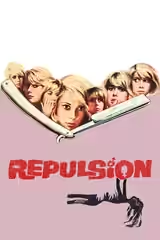
After Under the Shadow, try The Babadook (2014, Fi1m 86): Another mother, another child, another thing in the house; the grief is the monster. Then Repulsion (1965, Fi1m 88): Polanski shuts a woman in a South Kensington flat and lets the walls misbehave.

Cast

Awards

International Submission to the Academy Awards, 2017

Nominated
International Submission to the Academy Awards

If you liked this, try…

  1. The Babadook (2014, Fi1m 86)Another mother, another child, another thing in the house; the grief is the monster.

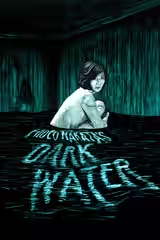
  2. Dark Water (2002) · not on Fi1m yetNakata’s damp Tokyo flat, a custody battle and a stain on the ceiling that grows.

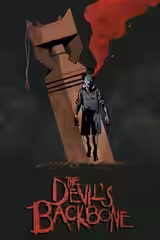
  3. The Devil's Backbone (2001) · not on Fi1m yetDel Toro’s orphanage ghost story with an unexploded bomb standing in the courtyard.

  4. Repulsion (1965, Fi1m 88)Polanski shuts a woman in a South Kensington flat and lets the walls misbehave.

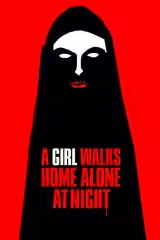
  5. A Girl Walks Home Alone at Night (2014) · not on Fi1m yetA chador-wearing vampire prowls an Iranian ghost town; slower, stranger, in black and white.

Under the Shadow (2016) review: war and djinn in one Tehran flat (Chile) | Fi1m