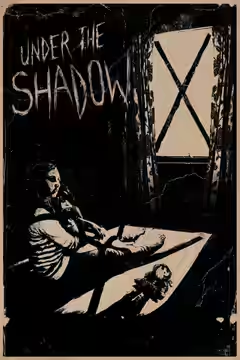
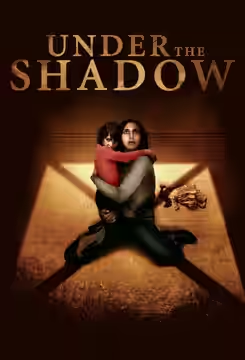
Babak Anvari’s first film sets a haunting in a Tehran flat during the Iran–Iraq War, and the taped windows and sirens frighten as much as the djinn. Tight, well acted and properly unsettling, though the final stretch reaches for scares we have met before.
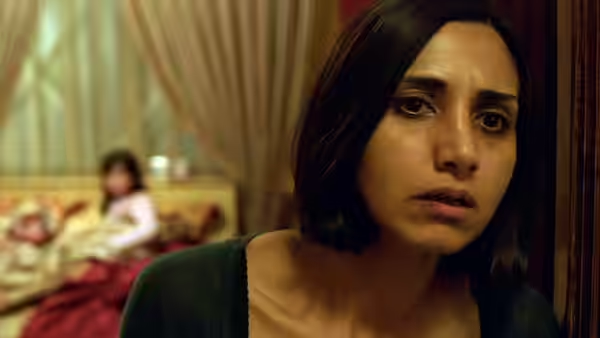
Babak Anvari wrote and directed his first feature, and it runs 84 minutes wasting few of them. It is a ghost story set in a Tehran flat in 1988, in the last year of the Iran–Iraq War, with missiles landing on the city. Shideh (Narges Rashidi) has lost her place at medical school and her husband Iraj (Bobby Naderi) to the front in the same week, and is left with their daughter Dorsa (Avin Manshadi) and something that may have come into the building with the bomb. We recommend it, with one caveat: after seventy minutes of avoiding the standard bag of scares, the last quarter of an hour reaches into it.
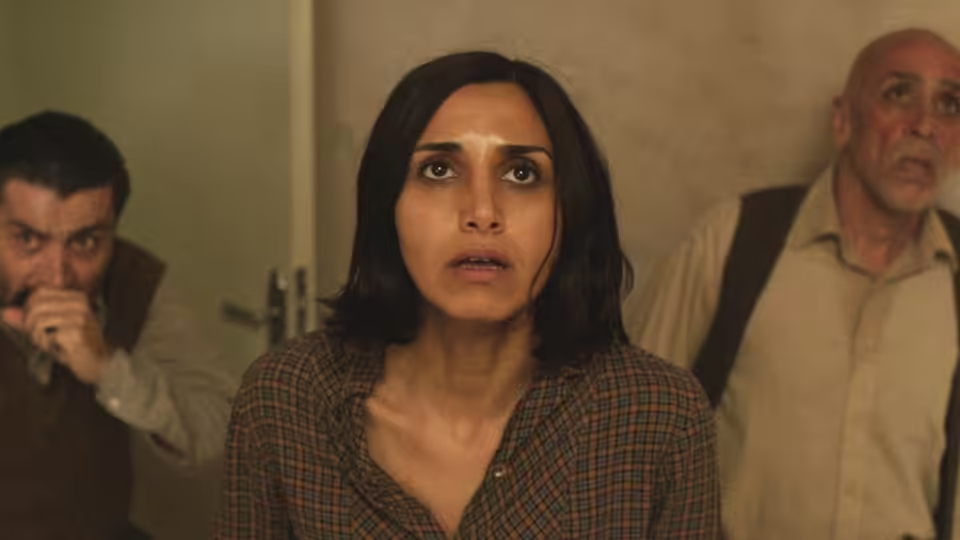
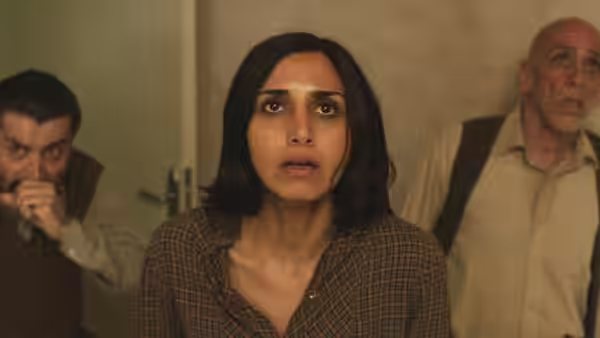
Rashidi carries the film, and she does it by being angry rather than frightened. Shideh slams the car door on Iraj, exercises to a Jane Fonda tape on a video recorder she is not supposed to own, and treats the neighbours’ talk of djinn as one more thing said to her by people who think she should be at home. Nasser Zoubi’s production design gives her a flat of brown furniture and yellowed walls with tape crosses on every window, and Kit Fraser lights it with table lamps and the television’s glow, so the dark corners are dark corners for a long time. Phaedra Dahdaleh puts Shideh in a tracksuit indoors and a headscarf she resents at the front door.
The moment that frightened us most is not supernatural. A missile comes through the roof and does not detonate. Anvari holds on a crack spreading across Shideh’s ceiling, then takes us upstairs to the Ebrahimis’ flat, where the thing has lodged in the floor and the neighbours are standing round it as though it were a piece of furniture nobody ordered. We were properly unsettled, and it was the ordinariness that did it: the dust, the wallpaper, a family who cannot leave because the building is all they have. Everything Anvari does afterwards with the djinn depends on that image.
The djinn, when it comes, is mostly cloth: a sheet moving where there is no draught, a shape in a doorway that is either a woman covered head to foot or nothing at all. Gavin Cullen and Will McGillivray’s score is low and sparse and stays out of the raids, so the sirens and the distant thumps are the loudest sounds. Christopher Barwell cuts the haunting scenes long, letting us look at an empty hallway until we have decided nothing is there. The scene most critics single out, in which cloth wraps itself over Shideh’s face, deserves the attention. We could not breathe either.
The film’s best scene has no ghost in it. Shideh ends up outside at night, dressed for her own front room rather than for the street, and the people who stop her are not spirits. We will say no more, except that Anvari lets it land without a speech.
Elsewhere he is less patient. Twice Iraj rings from the front to tell Shideh she should be a better mother, and the film has already shown us what he is saying. A small boy staying with the Fakurs downstairs exists to explain djinn to Dorsa and to look sinister. Manshadi is good when Dorsa is sulking and less good when she is screaming, and the script gives her more of the second. The final stretch drops the wind and the cloth for things lunging out of the dark with a bang. They work, in the way a hand on the shoulder works. They are also the only part of the film that could have come from any other one.
The comparison most critics reach for is The Babadook, another film about a mother alone with a child and something in the house. What Anvari has that Jennifer Kent did not is the war, and he never lets it become wallpaper. Every scare is timed against a siren.
It is in Farsi, with subtitles, and it earns its 15 certificate through dread rather than blood. Watch it at home, late, with the curtains drawn. It is a film about a flat, and it works in one.