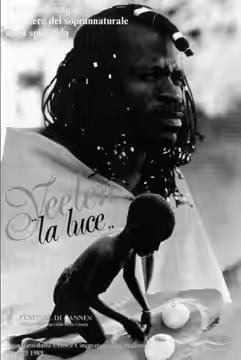
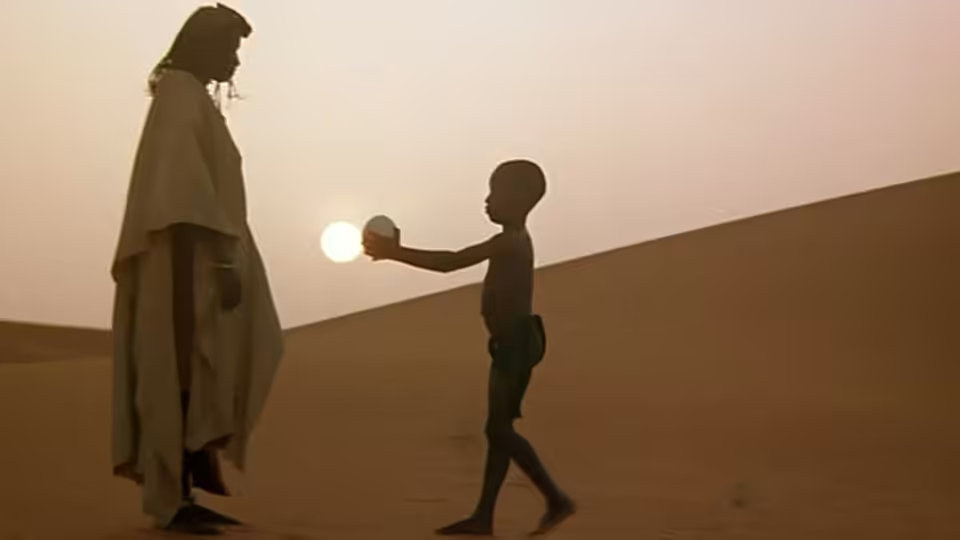
A cloaked adult faces a child holding the setting sun over the desert
Film review

Yeelen

1987 · Directed by Souleymane Cissé · 1h 45m

In a sentenceA father hunts his son across the Sahel with a magic post, and the light does most of the acting

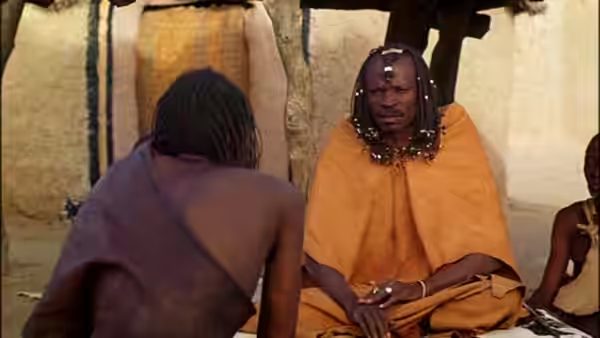
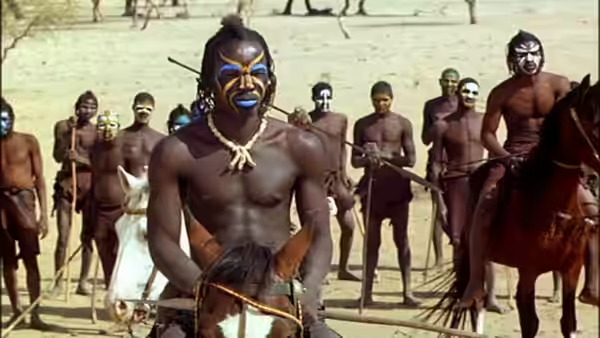
In the dry country of Mali, long ago, the young sorcerer Niankoro (Issiaka Kane) is being hunted by his own father. Soma (Niamanto Sanogo), a master of the Komo brotherhood, believes his son has stolen the family’s power and means to kill him for it; he follows on foot with a sacred wooden post carried ahead of him by two servants, stopping to call on his god at every halt. Niankoro’s mother Mah (Soumba Traore) prays in the river and sends the boy away to find his uncle. On the road, Fulani herders take him for a thief and bring him before their king, Rouma Boll (Balla Moussa Keita), who has raiders on his borders and a young wife, Attou (Aoua Sangare), who has not given him a child. The king wants proof that the stranger’s magic is real.

Fi1m review

Souleymane Cissé’s story of a young Bambara sorcerer fleeing his father across Mali is slow, plain and often astonishing to look at. You will not follow every rite, and it does not matter much; the faces and the landscape carry it.

Somewhere in Mali, a long time ago, a young man’s father wants him dead. Niankoro (Issiaka Kane) has the gift, the family sorcery of the Komo, and his father Soma (Niamanto Sanogo) regards that as theft. Souleymane Cissé, who wrote, produced and directed, follows the son away from home and the father after him, and takes 105 minutes over a chase most films would run in twenty. Nothing here is hurried. The title means light in Bambara, and before it is anything else the film is a record of what the sun does to red earth, white cloth and dark skin.

We think it is a fine film, and we recommend it with one warning: you will not understand everything. The Komo, its oaths, the carved post Soma’s servants carry, the milk Mah (Soumba Traore) pours into the river as she prays, none of it is explained. Cissé assumes an audience that already knows, and for nearly everyone reading this that audience is somebody else. We watched much of the film the way Niankoro watches the Fulani court, as a guest who has not been told the rules. Most of the time we found that a pleasure rather than a barrier.

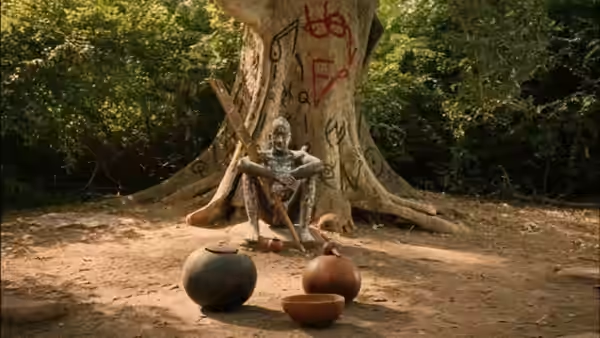
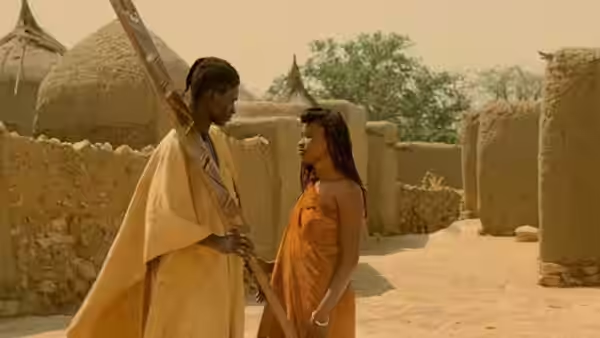
Jean-Noël Ferragut and Jean-Michel Humeau shoot the daylight scenes head-on, in the middle of the day, so shadows go black and the ground burns almost white. At night they light the rituals with fire alone, and the faces come and go in it. Kossa Mody Keita, who designed both the costumes and the sets, keeps the Bambara in rust and brown and dresses the Fulani in indigo and white, so when Niankoro arrives among them he is the wrong colour in every frame, which is the point.

The performances are mostly quiet and mostly by people who had not acted before, and Cissé does not push them. Kane plays Niankoro as a serious boy with no idea of his own strength, and when the king demands a demonstration he looks as surprised by the result as anybody. Balla Moussa Keita’s Rouma Boll is the film’s warmth, a vain, funny, decent man who knows a useful stranger when he sees one. Aoua Sangare, as Attou, is given few lines and does a great deal with her eyes and her silences.

Sanogo’s Soma frightened us more than we expected to be frightened by a man walking. He is not grand. He is small and furious, stamping through the scrub behind his two servants, stopping to raise his arms and mutter his vows to the god he serves, and Cissé keeps cutting to the empty country around him as though it were listening. Nothing happens in these scenes. That is the horror of them: he does not tire and he does not stop, and every time we cut back to him he is closer. Sanogo also plays a second character later, and we will say only that the doubling is not a stunt.

The film has faults, and they are the faults of its method. The long middle among the Fulani drifts; a raid on the herds is staged with a handful of men and a lot of cutaways to dust. Magic is done as plainly as everything else, a man points and another man stops, and once or twice we smiled when we were meant to be awed. And the story’s sense of time is loose. We were never sure whether a journey had taken a night or a season.

As fantasy it has nothing to do with the kind that comes with effects. The gods are spoken to, never shown; the miracles are a gesture and a cut. Its nearest relatives are the folk tales it comes from, where a hero meets a king, a woman and an old man in that order and the land itself is a character. Cissé trusts that shape completely.

The second half heads out onto sand, towards something we will not describe, and ends on an image we have not shaken off. Watch it in one sitting, on the largest screen you have, with the curtains drawn. It is a film about daylight, and it needs darkness around it to work.
Critical consensus AI synthesised

81
Positive
6
Mixed
1
Negative
0

The reviews lean firmly positive. Nearly every critic writes first about how the film looks: the light, the fire, the landscape of Cissé’s Mali, and imagery built from simple means that most find haunting rather than merely handsome. Several also find more than pictures in it, pointing to the story of a father’s abuse of power and the cost of his son’s resistance, and to the sense of a world that moves in cycles. The nonprofessional cast draws specific praise for its sly humour and quiet dignity, and for character relationships that carry as much weight as the visuals.

Where critics hesitate, it is over accessibility. Empire warns that the storytelling and symbolism may be hard going for audiences outside Africa, and the Los Angeles Times allows that it will not be for everyone. Sight and Sound takes the opposite view, finding it compelling despite its culturally specific material. The spread is narrow: six of seven reviews are positive, one is mixed, none is negative, and no critic argues the film fails on its own terms.

Los Angeles Times
18 August 1988 · SHEILA BENSON
90*

Benson finds the film haunting and ravishingly beautiful, though she notes it may not appeal to everyone. She especially praises the nonprofessional actors’ sly humor and self-effacing nobility.

Read the full review →
The New Yorker
90*

The critic calls the film a masterwork, praising its imaginative visual artistry. They also highlight its political focus on patriarchal abuse and the cost of resistance.

Read the full review →
Sight and Sound
20 February 2025
85*

The critic finds the film accessible and compelling despite its culturally specific subject matter. They praise how its vivid imagery is matched by nuanced performances and character relationships.

Read the full review →
Empire
21 July 2006 · David Parkinson
80*

Parkinson views the film as an ambitious, optimistic work, though its storytelling and symbolism can be difficult for non-African audiences. He particularly praises its imaginative vision of light, fire, tradition and landscape.

Read the full review →
Slant Magazine
21 September 2003 · ★★★★ · Ed Gonzalez
80

Gonzalez gives the film a strongly positive review, calling it a wondrous and deeply resonant work. He singles out Cissé’s simple yet powerful imagery and his evocation of a cyclical cosmos.

Read the full review →
Time Out
· WH
80*

The review presents the film as luminous and beautiful. It singles out the film’s setting among the Bambara peoples of Cissé’s Mali homeland.

Read the full review →

Straight answers AI written, from our review

Is Yeelen worth watching?
Yeelen is worth watching for anyone with patience for a slow, plainly told story carried by faces and landscape, and we scored it 84. You will not understand every rite, since Souleymane Cissé explains nothing of the Komo and its oaths, but we found that a pleasure more often than a barrier. The long middle among the Fulani drifts, and the loose sense of time may irritate.
How long is Yeelen, and what is it rated?
Yeelen runs 1h 45m. It is a drama and fantasy film.
Where can I watch Yeelen in the UAE?
Yeelen is not on any streaming or rental service in the UAE at the moment. Availability is checked daily.
How does Yeelen compare to Ugetsu?
Yeelen and Ugetsu both treat the supernatural as an ordinary fact of the world, spoken to and never shown off, but Cissé's film is the harsher and stranger of the two. Mizoguchi builds his ghost story from quiet human detail and its solemnity can slow the drama; Cissé builds his from daylight on red earth and a father who will not stop walking. Start with Ugetsu if you want a story that explains itself.
What should I watch after Yeelen?
After Yeelen, try Ugetsu (1953, Fi1m 89): Mizoguchi’s ghost story treats the supernatural as calmly as a change in the weather. Then Timbuktu (2014, Fi1m 88): Sissako’s modern Mali, the same light, a very different set of men with rules.

Cast

If you liked this, try…

  1. Tilaï (1990) · not on Fi1m yetOuedraogo’s Burkinabé tragedy of a son, a father and a law nobody can bend.

  2. Touki Bouki (1973) · not on Fi1m yetMambéty’s restless Dakar road film, all colour and motorbike, the other side of the coin.

  3. Ugetsu (1953, Fi1m 89)Mizoguchi’s ghost story treats the supernatural as calmly as a change in the weather.

  4. The Color of Pomegranates (1969) · not on Fi1m yetParajanov’s Armenian poet’s life told in tableaux; no plot, unforgettable pictures.

  5. Timbuktu (2014, Fi1m 88)Sissako’s modern Mali, the same light, a very different set of men with rules.