Aline MacMahon made a speciality of the secretary who has seen everything and says so in as few words as possible, usually to the back of a man who is not listening. She did it well enough that Hollywood kept her at it too long.
Fi1m perspective
Watch Edward G. Robinson's back in Five Star Final (1931), because that is where Aline MacMahon delivers most of her lines. She plays Miss Taylor, secretary to Robinson's editor, a man who washes his hands after every decision and talks too fast to hear anyone. She is the conscience of his newsroom, and Mervyn LeRoy lets her be dry about it rather than pious, which is the only way that job is bearable to watch. It was her first film and she has the best throwaway lines in it. We kept waiting for the next one, and were mildly put out every time the plot took the camera off her, which is often.
She had been on stage since 1920, when she made her Broadway debut in The Mirage, and by the time Hollywood found her she had a decade of work behind her, including Beyond the Horizon in 1926. She also had a way of acting most of her new colleagues did not. She had trained from 1923 in what would become the Method, concentration and naturalism rather than projection, and she said later that she was "in the first group to be exposed to what has become the Method". On film this meant she did less than the people around her and was noticed for it. Warner Bros. signed her after Five Star Final and, having worked out what she was good at, gave her a great deal of it: acerbic secretaries, working women with a heart of gold, the friend who has the jokes. Gold Diggers of 1933 (1933), in which she plays Trixie, an out-of-work performer, is the one people remember.
From the mid-1940s the parts changed with her, and she moved into mothers and women in charge. Dragon Seed (1944) has her as Ling Tan's wife in a wartime drama. The Search (1948) casts her as Mrs Murray, helping displaced persons after the war, and it is the film critics reach for when they want to show how little she appeared to be doing beside more theatrical players. The Man from Laramie (1955) gives her Kate Canaday, a supporting part in a western late in her studio years. We have not reviewed any of them and will not pretend to. After that she went back mostly to the stage, with occasional films and television, and stopped in 1975.
The complaint against her career is that it was smaller than it should have been, and the complaint is fair. She arrived in films in her early thirties with a face the studios did not know what to do with, and their answer was to put her behind a desk and hand her the sarcasm. She was good at sarcasm. She was better than the parts, and there are not many of them where she is allowed to prove it for more than a scene at a time. Start with Five Star Final, where the scene is worth it, and count how many of the film's best lines are addressed to a man who is not listening.
Biography
Aline MacMahon (also credited as Aline Laveen MacMahon) was an American actress. Born in McKeesport, Pennsylvania, she graduated from Barnard College and made her Broadway debut in 1920. She worked in theatre, film and television from the early 1920s until her retirement in 1975.
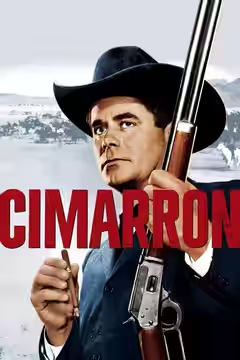
MacMahon made her screen debut in Five Star Final (1931) and appeared in numerous films, including Gold Diggers of 1933 (1933), One Way Passage (1932), The Search (1948), The Flame and the Arrow (1950), The Man from Laramie (1955) and Cimarron (1960), in which she played Mrs. Mavis Pegler. She received an Academy Award nomination for Best Supporting Actress for her performance in Dragon Seed (1944). She was married to architect Clarence Stein from 1928 until his death in 1975.