Anatole Litvak made handsome, well-drilled pictures in four countries and never quite a great one. His camera moves beautifully and his actresses are allowed to look frightened; the films around them have a habit of explaining too much and running too long.
Fi1m perspective
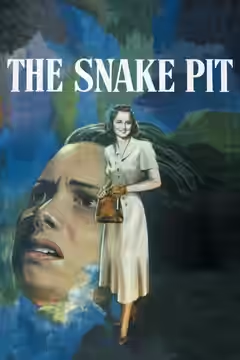
A woman lies on a trolley in a state hospital. There is a rubber gag, a nurse counting, and the next patient already waiting her turn. Leo Tover keeps the camera on Olivia de Havilland's face and lets everything around her go soft, so we get what she gets: a light, a hand, then nothing. That sequence in The Snake Pit (1948) horrified us, and it did so because Anatole Litvak shot it as routine. He does not stage the horror. He schedules it.
By then he had been at work for a quarter of a century. He started in Soviet cinema in 1923, edited for Pabst in Germany, directed features there and in France, and Mayerling (1936) carried him to Hollywood the following year. He became an American citizen in 1940, spent the war co-directing documentaries with Frank Capra, and kept working on both sides of the Atlantic until The Lady in the Car with Glasses and a Gun (1970). Through all of it the camera tracks, pans and rides a crane rather than sitting still, whether the subject is a governess, a spy or a woman on a hospital bench who cannot say how she got there.
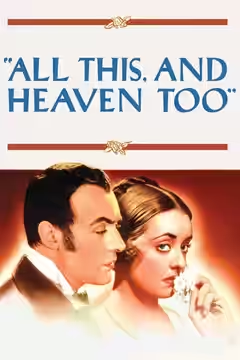
What he did best was leave a leading woman alone in the frame. De Havilland in The Snake Pit has her hair unpinned and her eyes never settle, and she answers the voice in her head in the middle of other people's sentences; there is no vanity in it anywhere. Bette Davis in All This, and Heaven Too (1940) is unusually still, and Litvak gives the shouting to Barbara O'Neil instead. Anastasia (1956) brought Ingrid Bergman back to Hollywood. Some who worked for him found him abrupt and unwilling to bend; the performances he got were rarely mannered.
What he did less well was trust the pictures. The second half of The Snake Pit starts to believe that a person is a lock and the right memory the key, and goes looking for it with a chart and a pointer; the consulting-room scenes, two people in chairs, are the least alive in the film, and Alfred Newman's score swells under every breakthrough where Litvak had kept quiet. All This, and Heaven Too runs 141 minutes and spends about a third of them in doorways. Somewhere past the ninety-minute mark we looked to see how much was left. Critics have long said that Litvak never made a single great film, only many polished ones, and we cannot argue.
He did know what plainness was worth. On Decision Before Dawn (1951), shot in Germany after the war, he kept colour out because, he said, it "takes away from reality in the most horrible way". Start with The Snake Pit, for de Havilland and the wards, and forgive it the doctor. The rest is handsome, careful and long. Bring a drink.
Biography
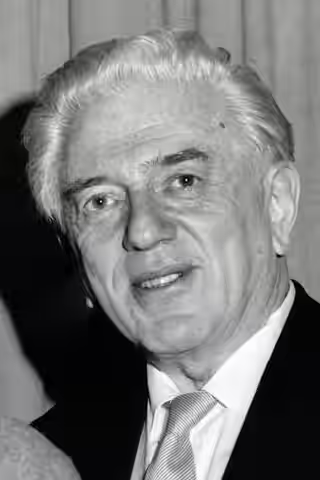
Anatole Litvak was a film director and producer. Born in Kiev in the Russian Empire, he began his career in the Soviet film industry in the early 1920s before moving to Germany and then France. He directed Mayerling (1936) in France.
Litvak moved to Hollywood in the late 1930s and worked at Warner Bros. He directed and produced All This, and Heaven Too (1940). His other credits include The Amazing Dr. Clitterhouse (1938), The Snake Pit (1948), Sorry, Wrong Number (1948), Decision Before Dawn (1951) and Anastasia (1956). He was nominated for an Academy Award for Best Director for The Snake Pit.
Litvak also contributed to the Why We Fight documentary series during the Second World War. He died in 1974.