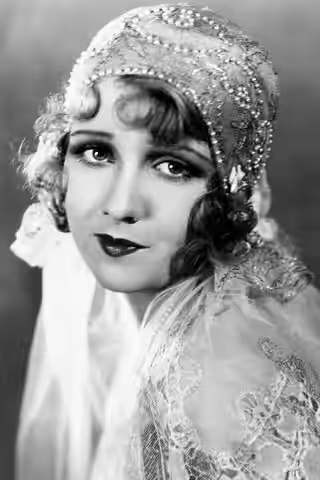
The blonde the camera was pointed at in MGM's Jazz Age pictures, Anita Page was better than the decorative parts she mostly got, and best when nobody asked her to speak. Sound arrived, critics heard a girl reciting, and she was gone by 26.
Fi1m perspective
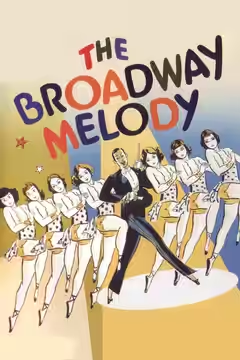
A man sings to Anita Page in a hotel room. It is Charles King, in The Broadway Melody (1929), the song is 'You Were Meant for Me', and he means every word of it, which is the problem, because she does not. Page plays Queenie Mahoney, the pretty sister, the one everybody in the picture wants, as a girl who has worked out too late that being wanted is not the same as being asked. We found ourselves watching her and not him. King is busy with his big voice and his hands; Page is doing the quieter work of a woman deciding how much of this she can afford to hear.
That was her second year at MGM. She had been an extra from 1925, signed with the studio in 1928, and was a star almost at once in Our Dancing Daughters (1928) opposite Joan Crawford. The Jazz Age pictures wanted blondes who looked like trouble, and Page was cast as flappers, gold-diggers and chorus girls for most of what followed. She worked steadily into the early 1930s, opposite Lon Chaney, Buster Keaton, Robert Montgomery and Clark Gable, six films with Montgomery alone, and then in 1936, at 26, she stopped making features. A few stray appearances decades later do not change the shape. The career is eight years long and the best of it is at the front.
What worked was the silent face. Critics found her strongest in dramatic parts, particularly as the rival not to be trusted, and Our Dancing Daughters was singled out for a drunk scene played as if she meant it and for how well she worked with her co-stars. While the City Sleeps (1928), with Chaney, is the other film people point to. We have not reviewed either, so we will not pretend to. What we can say from The Broadway Melody is that her face does the work and her voice is left to catch up.
The voice was the trouble. When sound came in, reviewers heard Page reciting lines rather than speaking them. She had her own view of it. "In my opinion, silents were much better than talkies. One thing you had was mood music, which you could have playing throughout your scene to inspire you." No actor would offer that defence now, but it is an honest account of a performer who had built a method on one set of conditions and then lost them. The studio kept her in second leads, decorative and popular, and she took the parts.
So the record is short and a little sad, and it is worth knowing that before you start. Watch The Broadway Melody for Bessie Love, who is the reason to see it, and then watch it again for what Page does while Love is talking. Then go back to 1928 and see what she looked like when nobody expected her to say anything.
Biography
Anita Page, born Anita Evelyn Pomares, was an American actress. She began her career with uncredited roles in the mid-1920s and signed with MGM in 1928.
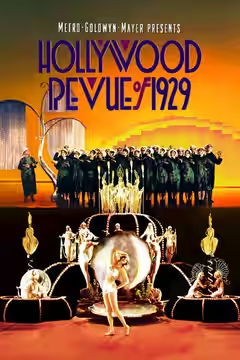
Page appeared in several late silent films and early talkies, including Our Dancing Daughters (1928) and The Broadway Melody (1929), in which she played Queenie Mahoney. She also featured as herself in The Hollywood Revue of 1929 (1929). She retired from acting in 1936 and returned to the screen in 1996, appearing in a small number of later films.