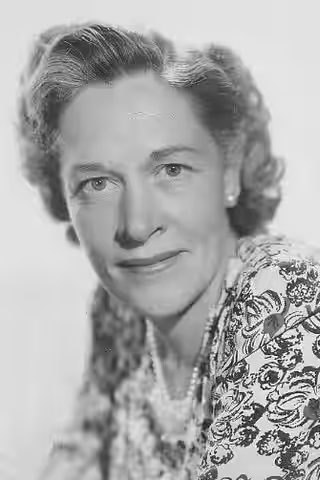
Anne Revere spent the 1940s playing mothers to bigger stars, and she played them as women who had done the sums. She is dry where the part invites tears, and the films around her are usually better for the minutes she is on screen.
Fi1m perspective
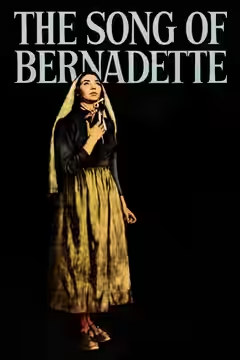
In The Song of Bernadette (1943) the Soubirous family has fallen into poverty and lives in the town's disused jail, and Anne Revere's Louise spends the first half hour counting what is left. Damp on the walls, a husband who goes out each morning to look for work and comes back without it, a daughter who is dull at her lessons. Revere does not weep over any of it. She keeps house in it. That is the thing she does that most Hollywood mothers of the period did not: she plays the woman who has to manage, and she lets the managing show. Arthur Charles Miller lights those scenes in hard grey daylight, and Revere looks, in them, like someone who is cold.
She came from the stage, Broadway from 1931, with a first film in 1934 repeating a stage part, and did not settle in Hollywood until around 1940. She arrived already grown up and was cast accordingly. Through the decade she was mother to Jennifer Jones, to Elizabeth Taylor in National Velvet (1944), to John Garfield in Body and Soul (1947), to Gregory Peck in Gentleman's Agreement (1947) and finally to Montgomery Clift in A Place in the Sun (1951). Nearly three dozen films in about a decade, almost all of them in support. Then the film work stops, and she went back to the theatre, returning to Broadway in Toys in the Attic in 1960, with television and the odd film into the 1970s.
The Kazan film is the one to see her in. Gentleman's Agreement is a lecture with good actors in it, and Revere, as Peck's mother, is dry and unfooled, listening to her son's crusade with the expression of a woman who raised him and knows what he is like. Garfield and Celeste Holm carry the picture, but her scenes with Peck give it a home, and a mother who is not impressed is a useful thing in a film that is otherwise rather impressed with itself. The plain, freckled, careworn face did half the casting for her, frontier or tenement, and the critics of her own day had almost nothing bad to say. The reservation, and it is the only one we can find, is that the parts were small. She is on screen for minutes, not reels, and the studios rarely gave her anything to do but stand a step behind a star and decline to be fooled.
We were more moved by that first half hour in the jail than by anything in the two hours of visions that follow, and it was Revere who did it, sitting at a table counting food. Henry King's film is a good hour too long and she is not in the hour that matters. Start with Gentleman's Agreement, which is shorter and sharper, then go to Bernadette for the opening reel, and do not feel obliged to stay for the miracles.
Biography
Anne Revere (1903–1990) was an American actress, also credited as Ann Revere. Born in New York City, she graduated from Wellesley College and trained at the American Laboratory Theatre. She made her Broadway debut in 1931 in The Great Barrington and her film debut in 1934 in Double Door.
Revere appeared in nearly three dozen films between 1934 and 1951, often as mothers or matriarchs. Her credits include The Song of Bernadette (1943) as Louise Soubirous, National Velvet (1944) as Mrs. Araminty Brown, Gentleman's Agreement (1947) as Mrs. Green, and A Place in the Sun (1951) as Hannah Eastman. She received Academy Award nominations for Best Supporting Actress for The Song of Bernadette and Gentleman's Agreement, and won for National Velvet. She was blacklisted in the early 1950s after her name appeared in Red Channels and she declined to testify before the House Un-American Activities Committee. Revere won a Tony Award for her performance in Toys in the Attic (1960).