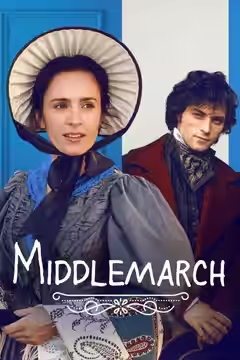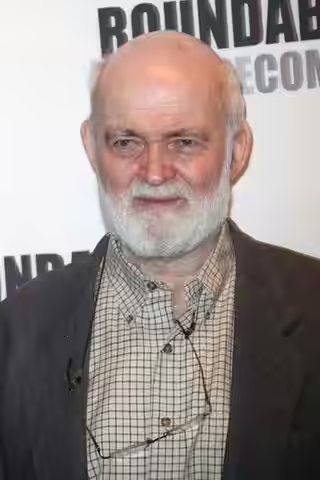
Anthony Page kept the camera at eye level and let his actors finish the thought. A theatre director first and last, he was at his best on screen when the material was good enough to be left alone, as it was in Middlemarch.
Fi1m perspective
Watch any scene in Middlemarch (1994) run on a beat longer than television allows. Page keeps the camera at eye level, cuts sparingly, and waits while an actor changes their mind in the middle of a sentence. In George Eliot that is where the drama is, and Page knew it. He had spent more than thirty years in rehearsal rooms before he made the serial, and it shows: nothing is covered from six angles, nobody is rescued in the edit, and the performances carry the thing because they are allowed to.
He was a theatre director who made films, not the other way round. He joined the Royal Court in 1958, took over its running in 1964, and staged Osborne premieres and early Beckett there, including Not I in 1973 with Billie Whitelaw's mouth lit alone in the dark. His first film, Inadmissible Evidence (1968), was his own stage production with Nicol Williamson brought across intact. A cluster of features followed in the late seventies: I Never Promised You a Rose Garden (1977), Absolution (1978) with Richard Burton, and a remake of The Lady Vanishes (1979) that most critics thought unnecessary. Then a long run of American television films, which he spoke of afterwards without much affection.
Middlemarch brought him back. Andrew Davies did the cutting and Page insisted on keeping to Eliot's words, and the two did not get on over it; the serial is better for the argument. Brian Tufano lit the town from windows and candles and shot it as a working place, and Page let four or five plots turn over without hurrying any of them. The worst marriage in it, played by Juliet Aubrey and Patrick Malahide, is what we carry away. We found it hard to watch, two clever people being courteous across a gap that widens, and we could not decide which of them we felt for more. That is what trusting actors gets you, and people had been saying it of him since the Royal Court.
What he never had was a style you could spot from the back row, and the features suffer for it. The Lady Vanishes has Angela Lansbury, Elliott Gould and Cybill Shepherd and no reason to exist beside Hitchcock's. He went back to the stage, directed six of Edward Albee's plays, and put Janet McTeer in A Doll's House in 1997. His remark about Maggie Smith, that she 'doesn't want to know if things have gone well; only if they have gone badly or could have been better', tells you how he liked to work: the note, not the compliment. His last screen credit was My Zinc Bed in 2008, and he died on 11 September 2026. Start with Middlemarch. Then read the novel, and notice how much of it he refused to let go.
Biography
Anthony Page (21 September 1935 – 11 September 2026) was a British stage and film director. Born in Bangalore, India, he read English at Oxford and trained as a director in New York under Sanford Meisner. He began his career in British theatre, becoming closely associated with the Royal Court Theatre in the 1960s, where he served as joint artistic director from 1969 to 1972.
Page directed numerous television productions, including episodes of Z-Cars (1962) and Play for Today (1970), as well as the acclaimed BBC adaptation of Middlemarch (1994). His feature films include Absolution (1978), The Lady Vanishes (1979) and I Never Promised You a Rose Garden (1977). On stage he directed several Broadway revivals and won the Tony Award for Best Direction of a Play in 1997 for A Doll's House.