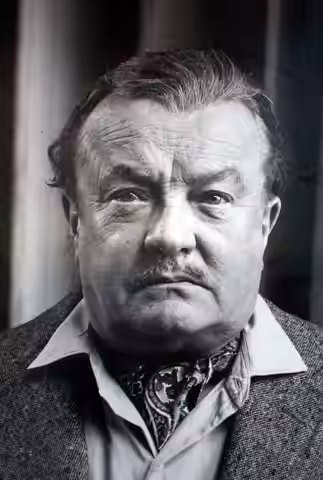
Basil Sydney was the heavy at the table: a broad, sweating, authoritative man who could be the captain you trusted or the king who had done something unforgivable. His Claudius for Olivier is the one to seek out.
Fi1m perspective
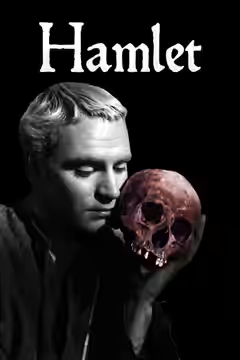
Claudius, in Laurence Olivier's Hamlet (1948), is usually played as a schemer. Basil Sydney plays him as a body. He is heavy, he sweats, and he looks like a man who has done the thing and has known it every hour since. The guilt is not in the lines; it is in the weight he carries through the castle. We believed him at once, and the play needs that: if the king is plainly guilty to us, the prince's delay becomes the question rather than the answer.
There is a private joke in the casting, though nobody on screen is laughing. Sydney had played Hamlet himself, on Broadway in 1923, in a run of classical parts in New York that began with his debut there in 1921. He had started on the London stage in 1915, in Romance with Doris Keane, and spent more than a decade in America before coming home in the early 1930s. A quarter of a century after playing the prince, he was the king the prince wants dead. Few actors get to stand on both sides of that table.
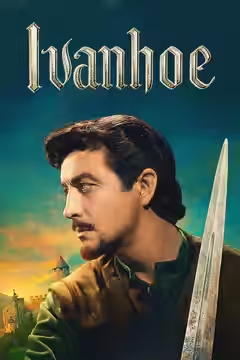
Back in Britain he made more than fifty films from the 1930s on, kept up his stage work, and stayed busy into the early 1960s. The films used him for what he looked like: authority. He was the officer, the public servant, the man behind the desk who would not be moved. Captain Smollett in Treasure Island (1950), Waldemar Fitzurse in Ivanhoe (1952), Air Chief Marshal Sir Arthur Harris in The Dam Busters (1955). The trick, and it is a real one, is that the same burly presence could be turned either way. He could be the man you were glad was in charge, or the man you hoped would leave.
That is also the limit. A character actor of his build is handed the same job many times over, and the reputation that survives is of reliability, which is a compliment that never quite sounds like one. Nobody seems to have complained about him, and nobody seems to have written much about him either. We have not seen the fifty films, and we will not pretend the Smollett or the Harris are as good as the king; we do not know.
What we do know is Claudius. Olivier's film is the one time the two men worked together, and it is where the dependable man and the sinister one turn out to be the same person, in a single sweating face. Start there. If the king unsettles you, and he did us, the rest of the career is a search for the same man in a uniform.
Biography
Basil Sydney (23 April 1894 – 10 January 1968) was an English stage and screen actor. He made his name on the London stage in 1915 in the hit Romance by Edward Sheldon, opposite Doris Keane, and later appeared in the 1920 silent film adaptation. He spent over a decade in New York from the early 1920s, playing classical roles including Mercutio in Romeo and Juliet (1922), the title role in Hamlet (1923), Prince Hal in Henry IV, Part I (1926), and Petruchio in The Taming of the Shrew (1927). In 1937 he starred in the West End production of the murder mystery Blondie White.
Sydney appeared in more than 50 films. He is best known for his performance as Claudius in Laurence Olivier's 1948 film of Hamlet. Other notable screen roles include Captain Smollett in Treasure Island (1950), Waldemar Fitzurse in Ivanhoe (1952), Air Chief Marshal Sir Arthur Harris in The Dam Busters (1955), and a Reform Club Member in Around the World in 80 Days (1956).