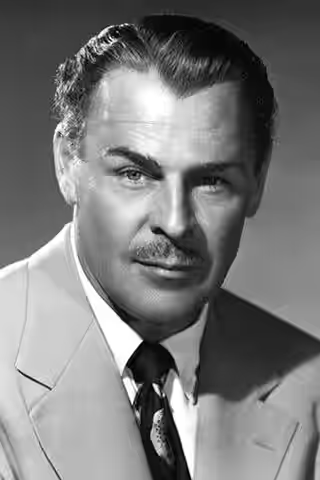
Brian Donlevy was Hollywood's quiet heavy: a saloon boss, a Legion sergeant, a Marine commander who barely raised his voice and made everyone around him fall silent. Typecast for menace, he was best when a script gave him more.
Fi1m perspective
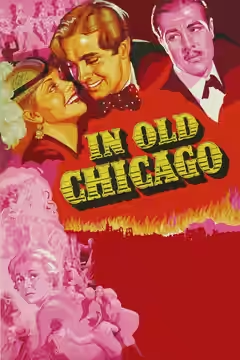
In In Old Chicago (1938) Brian Donlevy runs the saloon that Tyrone Power's hero wants to take from him, and he does it without ever raising his voice. Power grins, Don Ameche pleads, and the crowd carries on around them. Donlevy speaks at conversational pitch and the saloon goes quiet. That is the trick he had, a boss who does not need to shout, and we will admit that after an hour of O'Leary family quarrelling we were waiting for him to come back, and slightly ashamed of how much the film improved when he did.
He came out of New York theatre and silent films in the mid-1920s, and the break arrived with Barbary Coast (1935). The good years followed at Paramount and elsewhere: Sergeant Markoff in Beau Geste (1939), still the part people mean when they call him a heavy; the title role in Preston Sturges's first film as director, The Great McGinty (1940), a political satire that let him be funny without dropping the threat; Paul Madvig in The Glass Key (1942), from Hammett. He and Sturges made two films together, and it says something about Sturges that he saw a comedian in a face other directors used only for menace.
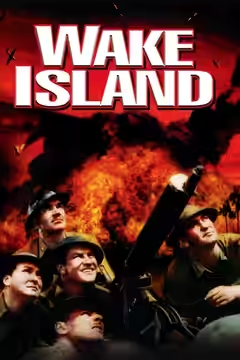
Wake Island (1942), made within months of the events it describes, gives him Maj. Geoffrey Caton, a Marine commander sharing an island with a civilian construction crew whose foreman, Albert Dekker, does not care for him. Dekker is loud and wide; Donlevy plays Caton clipped and quiet, a man who has decided not to raise his voice. The film sets them up as opposites so it can bring them together later. It is not subtle, and it works because Donlevy knows exactly what the part is for. It is the same instrument as the saloon boss, turned on a man we are meant to admire rather than fear, and it plays just as well.
The limitation is the other side of the same coin. Hollywood cast him as tough, dangerous or villainous for most of his working life, in noirs and westerns, and once you had seen him do the stillness you had seen him do it. The later career went where such careers went: a television series, Dangerous Assignment (1952–53), two turns as Prof. Bernard Quatermass for Hammer in The Quatermass Xperiment (1955) and Quatermass 2 (1957), then B-pictures and guest parts until Pit Stop (1969). Nigel Kneale, who created Quatermass, did not care for what Donlevy made of his scientist; we have not reviewed those films, so we note the complaint rather than rule on it.
If you have an evening for him, take Wake Island first, then In Old Chicago for the saloon and the last twenty minutes. He is rarely the reason a film was made and quite often the reason it holds.
Biography
Brian Donlevy was an American actor known for playing tough supporting characters in films from the 1930s to the 1960s. Born Waldo Brian Donlevy on 9 February 1901, he appeared in both leading and supporting roles, often as heavies in film noir and other genres.
His notable performances include Sergeant Markoff in Beau Geste (1939), for which he received an Academy Award nomination for Best Supporting Actor; the title role in The Great McGinty (1940); Paul Madvig in The Glass Key (1942); and Professor Bernard Quatermass in The Quatermass Xperiment (1955) and Quatermass 2 (1957). He also starred as Steve Mitchell in the television series Dangerous Assignment (1952).