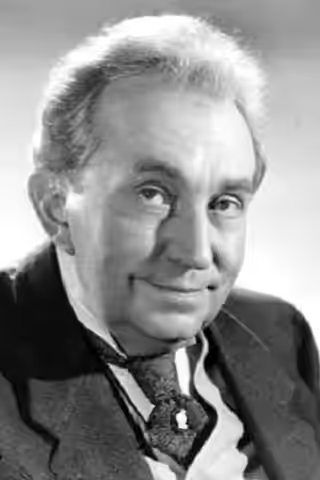
Charles Dingle spent a decade and a half playing men in good suits who would ruin you without raising their voices. He did it best first, as Ben Hubbard in The Little Foxes (1941), and Hollywood asked him to do little else afterwards.
Fi1m perspective
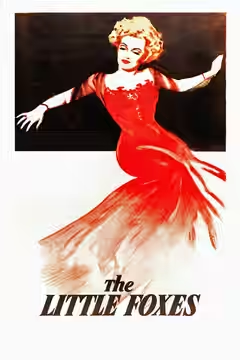
Ben Hubbard is the one who is pleased. Everybody else in The Little Foxes (1941) is angry, or frightened, or drinking, and Ben goes about the business of carving up a Southern town as if it were a good dinner. That is Charles Dingle's whole method, and it is why William Wyler's film needs him. With Bette Davis at the centre of Gregg Toland's frame, somebody has to show what greed looks like when it is comfortable, and Dingle shows it by being cheerful about everything. He had played Ben on Broadway in 1939 before the film brought him to Hollywood at 53, and he arrived with the part worn in.
We found him the person in that house we least wanted to be alone with. Regina wants things and lets you see it; Ben wants the same things and does not appear to mind how he gets them, and the good humour never slips. It is a small, exact piece of acting in a film full of larger ones, and it holds up beside Davis, which is not nothing.
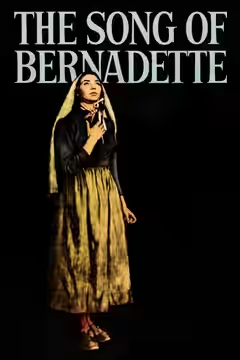
The trouble is what came after. Hollywood saw a villain in respectable clothes and ordered more of him, and Dingle spent the rest of the 1940s and part of the 1950s as the businessman, the official, the senator: Jacomet in The Song of Bernadette (1943), Edge of Darkness the same year, Bill Nolard Hardy in Frank Capra's State of the Union (1948) and, near the end, Senator Fullerton in The Court-Martial of Billy Mitchell (1955). More than fifty features in all, and few of them asked him to be anything but the man on the wrong side of the table. He kept up stage work alongside the pictures, as late as The Immoralist in 1954.
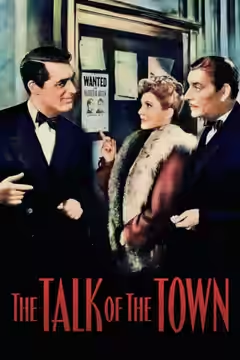
The Talk of the Town (1942) shows what he could do with a handful of scenes in a comedy. Andrew Holmes is one of the men who stand in the streets at night and decide what justice will look like in that town this week, and George Stevens and Ted Tetzlaff keep him in the hard shadows while the house with the professor and the fugitive gets the soft daylight. The film is at its best when it is a farce and at its weakest when it lectures, and Dingle belongs to the part that does not need to lecture. He is what Dilg is running from, and he does not have to say much to make the running look sensible.
Start with The Little Foxes, and in the family scenes watch him rather than Davis for a minute. He was never asked to play a decent man for long, and on the evidence of Ben Hubbard we are not sure the camera would have believed him.
Biography
Charles Dingle was an American stage and film actor. He made his Broadway debut in the 1928 production of Killers and appeared in revivals including A Midsummer Night's Dream (1932) and Let Freedom Ring (1935). He originated the role of Ben Hubbard in the 1939 Broadway production of The Little Foxes and reprised it in the 1941 film adaptation.
Dingle appeared in more than fifty feature films, often portraying businessmen or authority figures. Among his screen credits are The Talk of the Town (1942), The Song of Bernadette (1943), Duel in the Sun (1946) and The Court-Martial of Billy Mitchell (1955). His final Broadway appearance was in The Immoralist (1954). He was married to actress Dorothea White and died in 1956.