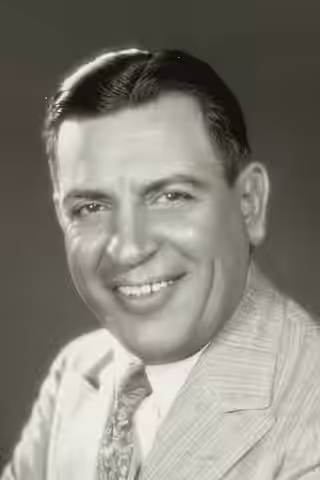
Charles Reisner's name is on a great silent comedy and on the film that lined MGM's stars up in front of a microphone, and in neither is he the reason you are watching. He was a hand for other people's turns, and a steady one.
Fi1m perspective
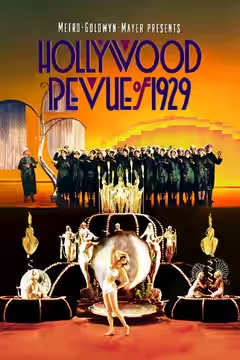
The curtain, the stage, the next famous face. In The Hollywood Revue of 1929 (1929) Charles Reisner has 25 stars and a chorus of 200 to get through and no plot to slow him down, and he runs the evening the way a stage manager runs a benefit: on you go, thank you, next. It is the clearest picture we have of how he worked. He does not shape the material. He gets it on and gets it off.
He came to that job by the back way. Reisner was a prizefighter and a vaudevillian before he was in films, and he went in around 1915 as an actor. Through the mid-1920s he was Charlie Chaplin's assistant director and sometime player, on A Dog's Life (1918) among others, which is as good an education in the timing of a fall as anyone has had. He began directing features in 1925, mostly comedies, and in 1928 his name went on Steamboat Bill, Jr., co-credited with Buster Keaton and remembered for its cyclone. Then MGM put him under contract, and he stayed there through the 1940s, taking on what the studio needed: the revue in 1929, the Marx Brothers' last film for the studio, The Big Store (1941), and sound comedies into the early 1950s.
What he could do was the set piece. The dossier of his career is a list of elaborate physical business that arrived on screen intact, and that is not nothing; a stunt that reads on film has been rehearsed, lit and cut by someone who knows where the laugh is. What he could not do, or was not asked to do, was hold a story together between the falls. Contemporary reviews of Steamboat Bill, Jr. noticed the slack between gags, and the credit for that film has drifted towards Keaton ever since, which tells you how the trade saw him. He was the man who made it happen, not the man who thought of it.
We will own that the Revue bored us for long stretches, and that we still could not stop watching it, because every few minutes another face we knew only in silence opened its mouth. That fascination belongs to 1929 and to the stars, not to Reisner. What belongs to him is that the thing exists at all, in order, with everyone in frame.
There are worse things to have been than the reliable director of other people's talent. If you want Reisner, watch the cyclone and then the revue, in that order, and notice that in both the camera has been put where the performer needs it and left there.
Biography
Charles Reisner (also credited as Charles F. Reisner, Charles Riesner and Chuck Reisner) was an American film director and actor. He directed over 60 films between 1920 and 1950 and appeared in more than 20 films between 1916 and 1929.
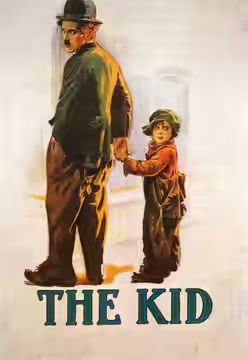
He worked as an assistant director and actor with Charlie Chaplin on A Dog's Life (1918) and The Kid (1921). Reisner directed Steamboat Bill, Jr. (1928), co-directed with Buster Keaton, and later worked under contract at Metro-Goldwyn-Mayer. Among his MGM credits are The Hollywood Revue of 1929, Chasing Rainbows (1930) and The Big Store (1941), the Marx Brothers' final film for the studio. He died of a heart attack in La Jolla, California, in 1962.