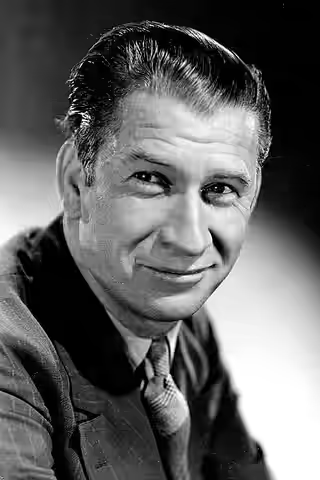
A Texas voice first and an actor second. Chill Wills spent four decades as the large, talkative man at the edge of other people's westerns, and his best work is heard before it is seen; a reliable pleasure, not a revelation.
Fi1m perspective
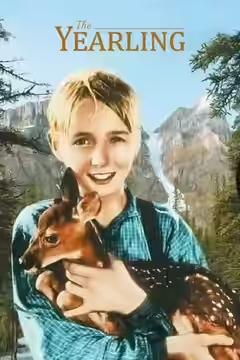
You hear Chill Wills before you see him. The voice is deep and rough, with a Texas drag in it, and it comes from the side of the room where a big man is leaning on something. He is usually talking, usually to a hero who is trying to get somewhere, and the talk is homespun philosophy of a kind that sounds wise for a moment and then turns out to be a joke. In The Yearling (1946) he is Buck Forrester, one of a household of large men up the road who drink, sing and take offence, and he fits the house as if it had been built round him.
The voice was the career. Wills came up through medicine shows and tent shows as a boy, led a singing quartet called the Avalon Boys through the 1930s, and in Way Out West (1937) supplied the uncredited bass when Stan Laurel opened his mouth to sing. He broke the group up in 1938, went solo, and by the 1940s was on contract at MGM in westerns and the odd drama. In the 1950s he was the voice of Francis the Talking Mule, uncredited again, across a run of comedies, and then spent much of the rest of his working life in character parts for John Wayne, four films in all, before a late appearance in Sam Peckinpah's Pat Garrett & Billy the Kid (1973).
What he did well was be a sound. Francis works because the mule is cynical and the voice is cheerful about it; Wills could put a sneer into a drawl without raising it. In The Yearling we laughed at the Forresters more than we expected to, because the film needs a house that is louder than the boy's, and Wills, Forrest Tucker and Clem Bevans make it loud without straining. It is rough comedy and Clarence Brown lets it stay rough.
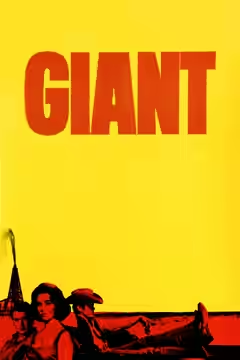
What he did less well was be the centre of anything, and he knew it. He said he had no rules about acting, "only to make a favorable impression and keep the audience from thinking I'm trying to louse up or steal a scene from any big star I happen to be working with." That is a decent working principle for a supporting player and it is also a limit on him. In Giant (1956) he is Uncle Bawley, and in a film that runs an hour too long we did not pick him out. The part is there and he fills it, but George Stevens's film is so busy telling us what it means that a man whose whole method is to stay out of the way goes unnoticed. The homespun sidekick, jovial and now and then sinister, is one part, and he played it for four decades.
Start with The Yearling, where the Forresters are worth the visit. Then, if the voice has got into your head, look for the mule. It usually has.
Biography
Chill Wills was an American actor and singer, also credited as Theodore Childress Wills and associated with the Avalon Boys. Born in Seagoville, Texas, on 18 July 1902, he performed from childhood and formed and led the Avalon Boys singing quartet in the 1930s.
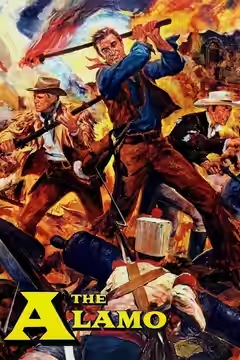
After appearing with the group in films including Way Out West (1937), Wills disbanded it in 1938 and began a solo career as a character actor, mainly in Westerns. He played Buck Forrester in The Yearling (1946) and was nominated for the Academy Award for Best Supporting Actor for his role as Beekeeper in The Alamo (1960). Other credits include Giant (1956), McLintock! (1963) and Pat Garrett & Billy the Kid (1973). Wills died in Encino, California, on 15 December 1978.