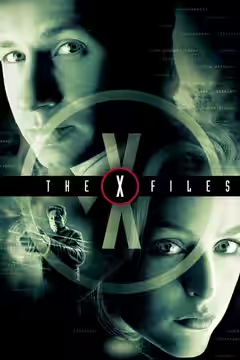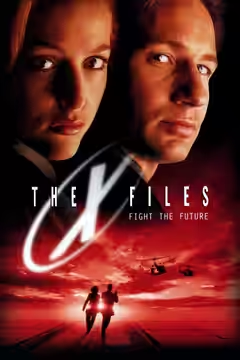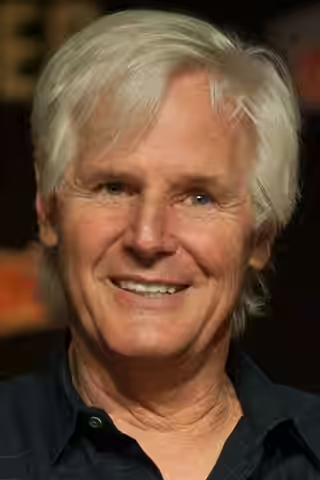
Chris Carter makes uncertainty absorbing when there is a case to investigate and two people worth following. We warmly recommend his The X-Files, though his fondness for secrecy sometimes leaves the investigators waiting for something useful to do.
Fi1m perspective
In the pilot of The X-Files (1993), the investigators have to wonder who might already know the answer and be keeping it from them. We were unsettled by the suggestion that their confusion might be useful to somebody. Carter’s writing keeps the suspicion close to the case, where a question can lead to an investigation rather than a lecture about the programme’s premise. That is where we most value his work: giving people something disturbing to examine, with room left for doubt.
The series remains the clearest reason to follow Carter, despite a career that also includes creating Millennium (1996) and The Lone Gunmen (2001). He wrote the feature The X-Files (1998), then wrote and directed The X-Files: I Want to Believe (2008). The original programme returned for revivals in 2016 and 2018. Across that extended association, we still find the individual investigation a more persuasive reason to return than the promise of a larger explanation.
As a director, he is more willing to experiment than the familiar investigative format might suggest. His episodes use black-and-white photography, long Steadicam takes, strobe effects and split screens, with The Post-Modern Prometheus, Triangle and Duane Barry among the examples. Those changes suit a programme moving between procedural investigation, horror and science fiction, allowing individual instalments to look markedly different. We welcome that willingness to vary the visual approach rather than expect an unfamiliar creature or occurrence to do all the work.
The essential steadiness comes from David Duchovny and Gillian Anderson, whose partnership makes The X-Files such absorbing company. Carter gives belief and scepticism people to speak through, and the pilot lets their relationship develop without settling every question around it. His writing collaborators include Frank Spotnitz, Glen Morgan and James Wong, so any account of his achievements should leave room for other people’s contributions. Our strongest praise for Carter concerns the writing that gives the investigators something immediate to question and lets their doubts matter.
Our reservation concerns his ability to keep the prospect of another secret alive after the original question has lost its interest. Then the investigators have less to do, and suspense becomes delay. It is a substantial weakness in a programme we otherwise recommend warmly for its central pair and its capacity to make uncertainty troubling. We would start with the pilot and leave any plans to finish all eleven series until afterwards.
Biography
Chris Carter (born 13 October 1956) is an American television writer, producer and director. Born in Bellflower, California, he graduated with a degree in journalism from California State University, Long Beach. He spent thirteen years working for Surfing Magazine before beginning his television career with films for Walt Disney Studios.
Carter created the Fox series The X-Files (1993), on which he is credited as writer, director and teleplay. He later created Millennium (1996) and the spin-off The Lone Gunmen (2001). Through his production company Ten Thirteen Productions he wrote the feature films The X-Files (1998) and The X-Files: I Want to Believe (2008), the latter of which he also directed.