Clarence Brown composed and lit his pictures with care, and directed children as he directed adults. When the material can bear that much light the warmth is earned; when it cannot, as in The Human Comedy, it is insisted upon.
Fi1m perspective
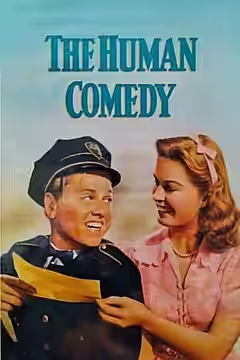
Watch what Clarence Brown does when a child is in the frame. In The Human Comedy (1943) small Ulysses, played by Jackie 'Butch' Jenkins, stands by the tracks and waves at a passing train, freckled and puzzled, and for whole minutes nobody asks him to mean anything. Then an adult walks in and the film goes back to telling us what the war is for. Brown could simply watch. The pictures he made at MGM did not often let him.
He came to films sideways, with engineering degrees from the University of Tennessee and a spell in the motor trade, and in 1915 he became assistant to Maurice Tourneur, whom he treated as a master for the rest of his life. From Tourneur he took the look that marks his work: careful composition, careful light, a fondness for real exteriors. He directed solo features from 1923, joined MGM in the mid-1920s and stayed until the early 1950s, making more than fifty films there. Seven were with Greta Garbo, from Flesh and the Devil (1926) to Anna Karenina (1935); six were with Joan Crawford; at least ten were photographed by William Daniels. Actors spoke of a quiet, collaborative man who got what he wanted without raising his voice. He retired in 1953.
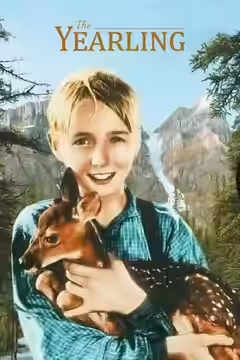
The 1940s turned him towards American small towns and small performers. National Velvet (1944) and The Yearling (1946) are the ones people remember, and he said he directed children exactly as he directed adults, by trying to understand them and earn their trust. Intruder in the Dust (1949), shot on location from Faulkner, is often named as the late high point, and its handling of race is the reason. We have reviewed only The Human Comedy, and it shows both halves of him. When Mickey Rooney carries a telegram to a door and Brown says nothing at all, we were quietly undone; the shot does the whole job. Then Howard Estabrook's script explains it, and the feeling drains away as we are told what we have just felt.
That is the case against him: that the MGM gloss and the studio's taste for reassurance softened a director who did not need softening, and that a long career as a loyal house man has cost him a reputation. There is something in it. A town waiting for casualty lists cannot bear the light he gives a horse or a fawn, and The Human Comedy proves it.
Late in life he said he was a company man who shot the story he was assigned as well as he could and went on to the next thing. He undersold himself. The studio, on the whole, let him.
Biography
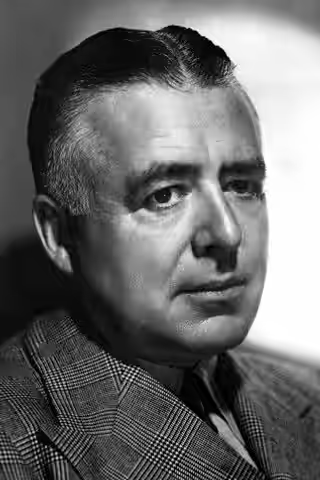
Clarence Brown was an American film director and producer. Born in Clinton, Massachusetts, he graduated from the University of Tennessee with degrees in mechanical and electrical engineering. After working in the automobile industry, he entered films as an assistant to director Maurice Tourneur and served as a fighter pilot and flight instructor during the First World War.
Brown began directing in the silent era and joined Metro-Goldwyn-Mayer in the mid-1920s, remaining there until the mid-1950s. He directed Greta Garbo in seven films and Joan Crawford in six. His credits include Flesh and the Devil (1926), Anna Karenina (1935), Anna Christie (1930), National Velvet (1945), The Yearling (1946) and Intruder in the Dust (1949). He produced and directed The Human Comedy (1943).
Brown received five Academy Award nominations for directing but did not win an Oscar. He won the award for best foreign film at the 1935 Venice International Film Festival for Anna Karenina and a British Academy Award for Intruder in the Dust.