Costa-Gavras makes thrillers out of real abuses of power and cuts them so fast you have no time to argue. That speed is the strength and the limit: the films catch their villains, and they rarely stop to understand them.
Fi1m perspective
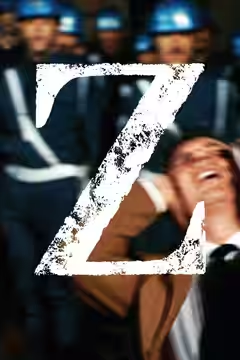
A gendarmerie general stands before a hall of officers and warns them about mildew on the vines. By the end of the sentence the mildew is the left, and the officers are gardeners with spray cans. That is how Z (1969) opens, and it is how Costa-Gavras works: a joke that turns out to be the thesis, spoken by a man in uniform who has no idea he is being laughed at. Then the film starts running, and it does not stop for two hours.
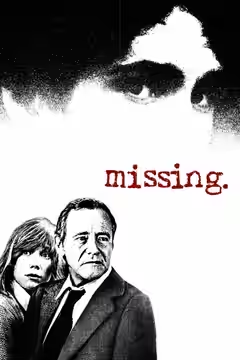
He came to Paris from Greece in 1952, trained at IDHEC and assisted René Clair and Jacques Demy before making his first feature, The Sleeping Car Murders, in 1965. Z, a thriller built on the killing of the Greek deputy Grigoris Lambrakis, was the film that got him noticed everywhere, and he spent the next two decades on variations of it: The Confession (1970), on a show trial under a communist regime; Missing (1982), on Chile after the 1973 coup; Music Box (1989), on the prosecution of a Nazi war criminal in the United States. Later came Amen. (2002), on the Catholic Church during the Holocaust, then Capital (2012) and Adults in the Room (2019). Whoever holds the gun, he is on the other side of it. He has described his subject as people and their relationship with power and politicians, and for once a director's account of himself is accurate.
What works is the pace. In Z, Raoul Coutard's camera and Françoise Bonnot's cutting keep the assassination and the inquiry moving like a chase, so the film makes its case by never letting us sit back from it. Jorge Semprún, his screenwriter on Z and one other film, builds the plot as an investigation, which suits a director who thinks like a prosecutor. Yves Montand, who made three films with him, is the face these stories keep returning to. We came out of Z with our pulse up and our temper up, and the reason is plain: the film makes a cover-up feel like something happening to us, with the clock running and the wrong people winning.
What does not work is the same thing seen from the other side. The generals in Z bluster, contradict each other under questioning and never once seem clever; a subtler film would have handed them a good argument and let us watch it fail. Critics said much the same of The Confession, and the charge holds across the career. He is not trying to understand the men who give the orders, only to catch them. The English-language films are generally thought less focused than the early trilogy, Mad City (1997) most often, and we have seen nothing to make us argue.
Start with Z. If it takes you, The Confession and Missing are the obvious next stops. Do not go looking for a fair hearing for the other side; he has never been in the business of giving one, and at his best he moves too fast for you to notice you wanted it.
Biography
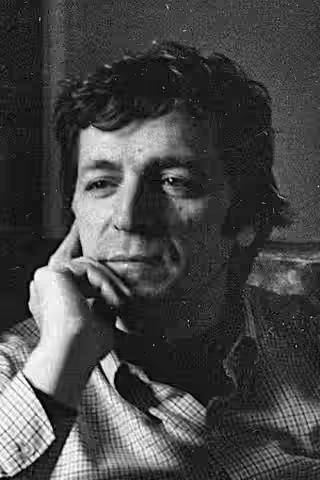
Costa-Gavras (born Konstantinos Gavras) is a Greek-French film director, screenwriter and producer. Born on 12 February 1933 in Loutra-Iraias, Greece, he moved to Paris in the early 1950s, studied literature at the Sorbonne and film at the Institut des Hautes Études Cinématographiques, and worked as an assistant to directors including René Clair and Jacques Demy.
He is best known for his political thrillers. His breakthrough came with Z (1969), which he directed and co-wrote; the film won the Academy Award for Best Foreign Language Film. Later works include Missing (1982), for which he shared the Palme d’Or and an Academy Award for Best Adapted Screenplay, Amen. (2002) and Capital (2012). Most of his films are in French.