Film review

Z

1969 · Directed by Costa-Gavras · 2h 02m · MPA NR

In a sentenceThe generals insist it was a traffic accident, and the film spends two hours calmly making them look ridiculous

ThrillerCrimeDrama

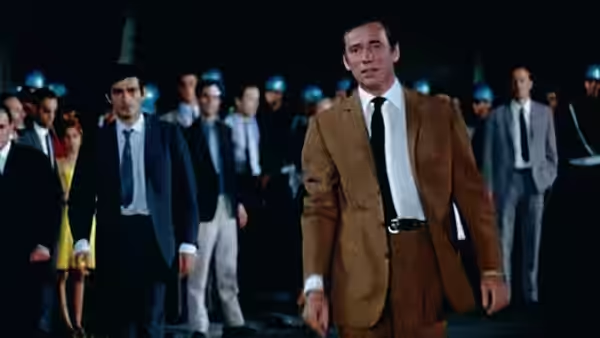
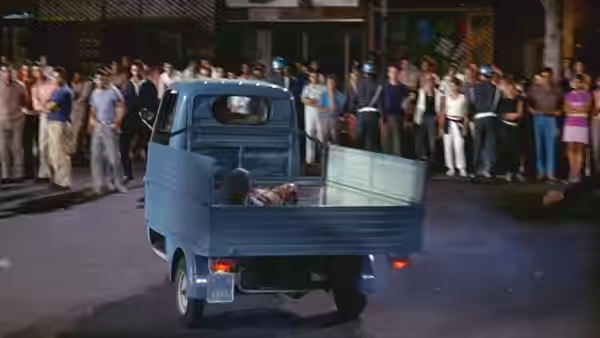
In an unnamed Mediterranean country in the 1960s, a doctor and opposition deputy (Yves Montand), credited only as Z, arrives in a provincial city to speak against nuclear weapons. The hall he was promised is withdrawn; a smaller one is found, and outside it a crowd of hired thugs gathers while the gendarmerie, under General Missou (Pierre Dux), does very little. His organisers, Manuel (Charles Denner) and Matt (Bernard Fresson), try to get him through the crowd. After the speech a three-wheeled van crosses the square and a man in the back swings a club. The authorities announce a drunk driver. The deputy’s wife Hélène (Irene Papas) arrives from the capital, an Examining Magistrate (Jean-Louis Trintignant) is handed the file with instructions to close it, and a Photojournalist (Jacques Perrin) starts asking questions of his own.

Plays from YouTube when you press play; nothing loads from them until then.

Fi1m review

Costa-Gavras turns a real Greek assassination into a thriller that moves like a chase and argues like a prosecutor. Raoul Coutard’s camera and Françoise Bonnot’s cutting still feel modern; the villains are drawn a shade too broad. Worth anyone’s evening.

Z begins with a lecture. A gendarmerie general stands before a hall of officers and warns them about mildew on the vines, and by the end of his sentence the mildew has become the left, an infection to be sprayed. It is a joke, and it also tells you what the next two hours are about: men in uniform who think of themselves as gardeners. The film is set in an unnamed Mediterranean country, and a title card says any resemblance to real events is deliberate. Everyone in 1969 knew that meant Greece and the killing of the deputy Grigoris Lambrakis. Costa-Gavras made a thriller out of it, and the thriller is a good one: fast, plain about its anger, and after more than fifty years still hard to sit still through.

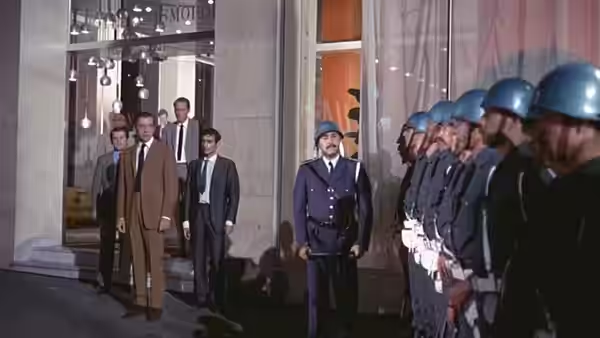
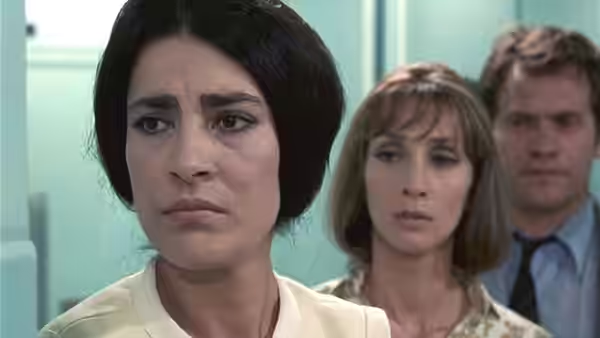
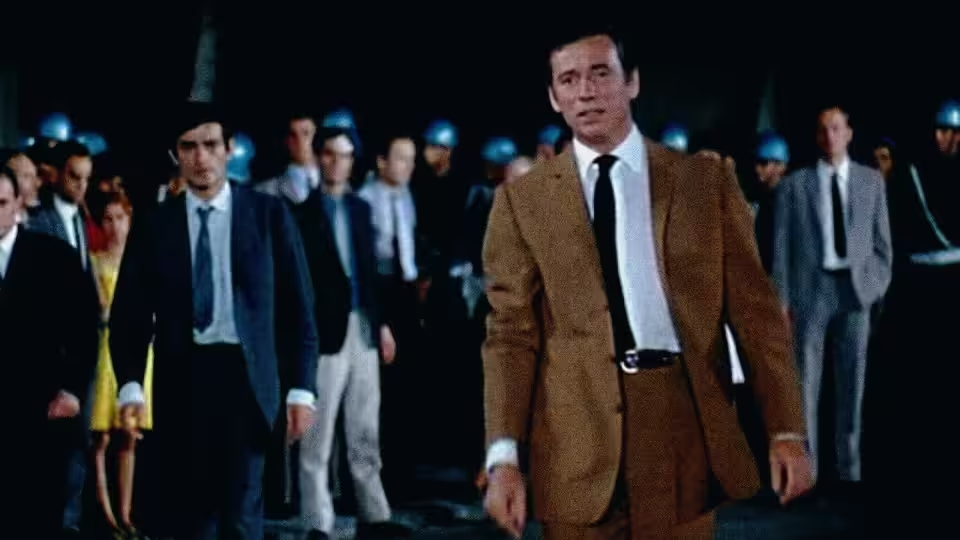
The deputy is played by Yves Montand and credited only as Z. He is a doctor, a pacifist and a man other people are willing to be hit for, and Montand gives him a tired, decent face and not much more than a quarter of an hour of screen time. He arrives to speak against nuclear weapons, the hall he was promised is withdrawn, a smaller one is found, and a crowd of hired thugs waits outside while the police look at their shoes. Then a three-wheeled van comes across the square. Irene Papas, as his wife Hélène, arrives after the fact and barely speaks. She does most of her work sitting on a hospital bench, and it is enough.

Raoul Coutard shoots it as if he had been sent to cover a riot and got lucky. The camera is handheld in the crowds, on long lenses across the square, and the light is whatever was there. Françoise Bonnot cuts it so that memory keeps interrupting testimony: a witness starts a sentence in the magistrate’s office and we are back in the square before he finishes it, and the club comes down again from a slightly different angle. The film returns to that blow perhaps half a dozen times. We flinched at every one, and that is the intention; the officials keep calling it an accident, and the editing keeps showing us that it was not.

The second hour belongs to Jean-Louis Trintignant, as the Examining Magistrate given the case in the expectation that he will close it. He wears dark glasses indoors, says almost nothing and writes everything down, and Trintignant plays him as a man who is not brave so much as tidy. The facts do not add up, and he cannot leave them like that. Jacques Perrin’s Photojournalist, all cheek and flashbulb, does the legwork the police will not. Georges Géret and Marcel Bozzuffi, as the two men in the van, are the film’s best idea. They are not monsters. They are poor, vain and easily flattered, and the film is clear that the people who flattered them are the ones who matter.

Mikis Theodorakis, whose music the Greek junta had banned, supplies a score that is mostly bouzouki and drums and refuses to slow down. It runs under the marches, the chases and the interrogations, and it gives the film a pulse the plot alone would not have. Jacques d’Ovidio’s production design keeps the town anonymous: bare offices, a hospital corridor, a square that could be anywhere on the Mediterranean.

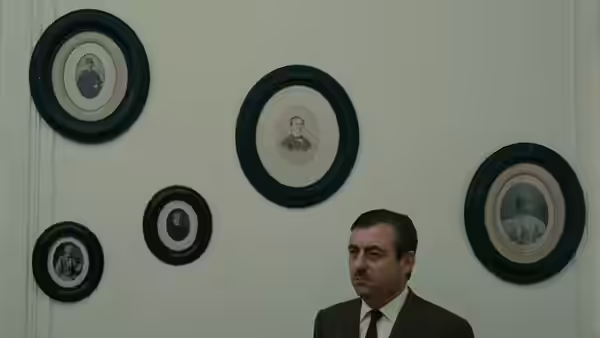
The flaws are in the uniforms. Pierre Dux’s General Missou and Julien Guiomar’s Colonel are drawn thick. They bluster, they contradict each other under questioning, and they never once seem clever. Some critics, then and since, have found the film’s sympathies too easy and its villains too stupid to be frightening, and there is something in that. A subtler film would have given the generals a good argument and let us watch it fail. Costa-Gavras and Jorge Semprún, adapting Vassilis Vassilikos’s novel, are not trying to understand the men who ordered the killing. They are trying to catch them, and the film moves with the impatience of people who know the clock is against them.

The last stretch takes a turn we will not describe, except to say that it is delivered flatly, in a few minutes, and that it made us angrier than anything in the two hours before it. Plenty of political thrillers since have copied the method. Few have been this angry. Watch it with the sound up; Theodorakis will not let you drift, and neither will Bonnot.
Critical consensus AI synthesised

82
Positive
9
Mixed
0
Negative
0

Every one of the nine reviews is positive, and most say much the same thing: Costa-Gavras takes a real Greek political assassination and tells it with the pace and violence of an American thriller, and the result grips. Critics praise Raoul Coutard’s photography, which several describe as having the look of a documentary, and Françoise Bonnot’s editing for the momentum. Mikis Theodorakis’s score is singled out more than once for building tension, and Yves Montand and the supporting cast are credited with giving the film’s anger a human face.

The reservations are about how far to trust that grip. The New York Times, reviewing in 1969, thinks the film manipulates its audience and plays to its prejudices in ways that will be mistaken for fine art; Slant, forty years later, finds the reputation as an uncompromising thriller overstated and parts of it conventional. Even so the spread is narrow, and no critic argues it fails as entertainment.

Los Angeles Times
20 November 1997 · Kevin Thomas
90*

The critic hails it as a 1969 classic that is as exciting as a detective thriller and as authentic-looking as a documentary, plunging viewers into chaos with raw documentary realism and urgent style. It singles out the film's chilling depiction of how quashing dissent leads to a police state and its status as a profound human document with bravura style.

Read the full review →
The New Yorker
6 December 1969 · Pauline Kael
90*

The critic describes it as an almost intolerably exciting political thriller that builds tremendous tension while serving as a purposeful political act in a commercial package. She singles out its dynamic, robust photography and skillful use of melodramatic techniques drawn from American gangster films to expose fascist corruption.

Read the full review →
Time Out
18 April 2012 · DT
90*

Costa-Gavras' crowd-pleasing left-wing thriller recreates the 1965 Lambrakis affair and its uncovering of police and government corruption using American thriller techniques to gripping effect. Though conspiracies are now commonplace, it notes the film's original impact.

Read the full review →
Empire
21 July 2006 · David Parkinson
85*

The critic praises Costa-Gavras's film as a powerful and influential political thriller based on real events. He highlights the outstanding photography by Raoul Coutard and Oscar-winning editing by Françoise Bonnot as key strengths that influenced later thrillers.

Read the full review →
Slant Magazine
26 October 2009 · Bill Weber
70*

The film remains an eye-catching, fast-paced watch forty years on, but its reputation as an uncompromising thriller feels overstated. The critic singles out the core of idealism and fury, embodied in the resistance of ordinary people, as what overcomes its more conventional elements.

Read the full review →
The New York Times
9 December 1969 · Vincent Canby
70*

The critic calls it an immensely entertaining topical melodrama that manipulates emotional responses and appeals to prejudices in satisfying ways, likely to be mistaken for fine art rather than popular movie art. It notes the film's origins as a Jury Prize winner at Cannes and its basis in real Greek political events.

Read the full review →

Cast

If you liked this, try…