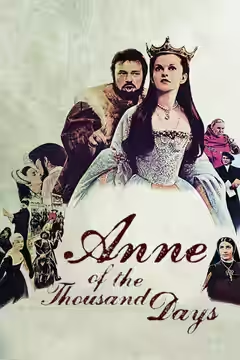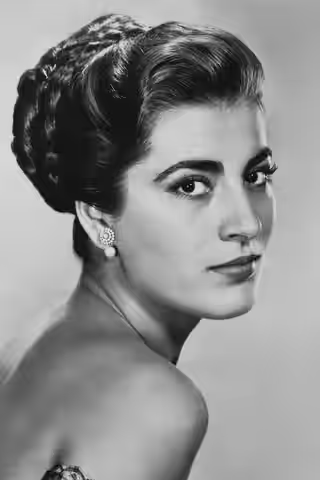
Irene Papas could hold a scene without saying a word in it, and she was at her best when a director let her: still, watchful, and giving the men around her nothing. Cacoyannis knew what to do with that; Hollywood mostly did not.
Fi1m perspective
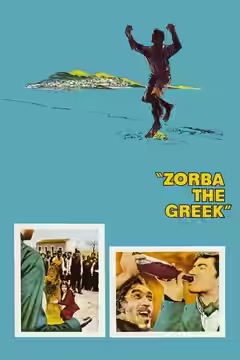
The widow in Zorba the Greek (1964) walks through her village and Michael Cacoyannis does not cut to her. He cuts to the men watching, one face after another, and to the boy following at a distance. Papas has said nothing and done nothing, and we felt sick, because she plays the part in her shoulders and her eyes as a woman who has decided the only defence left to her is to give the village nothing. It is the charged strand in a film otherwise busy watching Anthony Quinn dance, and it is the clearest example of what she could do that most actors cannot: make standing still look like a decision.
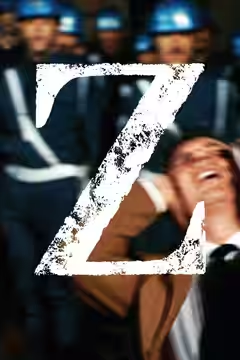
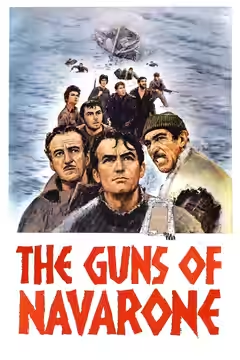
She came out of Greek theatre and film in the late 1940s, trained in Athens, and the wider world noticed her in The Guns of Navarone (1961), as the resistance fighter Maria, looking at the commandos as if she had already buried several like them. Then came the Cacoyannis years. They made five films together, and the ones that matter are the tragedies: Electra (1962), which made her the screen's leading interpreter of the Greek plays, The Trojan Women (1971), in which she is Helen, and Iphigenia (1977), in which she is Clytemnestra. Between them sits Z (1969), a political thriller in which, as Hélène, she does most of her work in close-up with hardly a line to speak.
The tragedies suited her because they ask for exactly what she had: a face that could carry grief without commentary, and the nerve to hold it while the camera waited. The criticism, and it is a fair one, is that the theatre never quite left her, and in Iphigenia the classical manner can tip into declaiming, lines pitched at the back of a house the camera is not sitting in. Hollywood had a different problem with her. The accent and the face that made her unmistakable also narrowed what she was offered, and she spent much of her international career in parts smaller than her talent, watching from the edge of the frame while the stars talked. Her own account of it was simpler than any of ours: "I am those characters . . . That passion is my truth."
Start with Zorba if you want to see what the fuss is about, and watch her strand rather than his; then find Electra, where nobody walks in front of her. She kept working into the early 2000s and died in 2022. The films that show her best are the ones built around her stillness, and there were fewer of those than there should have been.
Biography
Irene Papas was a Greek actress who appeared in more than 70 films over a career of more than five decades. She trained at the National Theatre of Greece Drama School and began working in theatre before making her film debut in 1948.
She gained international recognition for her role as Maria Pappadimos in The Guns of Navarone (1961). Other notable performances include those in Zorba the Greek (1964), Z (1969), Antigone (1961), Electra (1962), The Trojan Women (1971) and Iphigenia (1977). She also recorded albums of Greek songs.
Papas received a Best Actress award at the Berlin International Film Festival for Antigone and a National Board of Review award for The Trojan Women. She died in 2022.