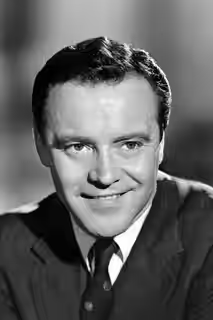
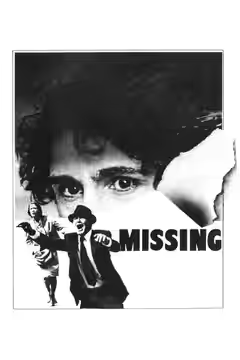
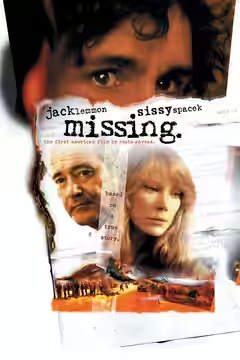
Costa-Gavras’s first American film sends Jack Lemmon into a country under martial law to find his son, and Lemmon is superb: patient, polite and slowly boiling. The staging sometimes overreaches and Vangelis’s theme is played too often, but the anger holds.
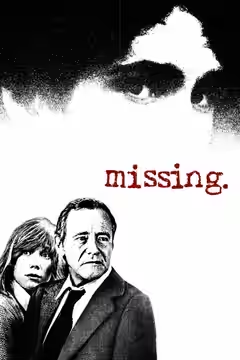
Missing is Costa-Gavras’s first American film, and he has made it about America, from the inside. Ed Horman (Jack Lemmon), a businessman who votes the way his neighbours do, flies into a country under martial law to fetch his son, and the film is the record of everything he believed being taken off him, piece by piece. It is a good film, angry and well made, and it is carried by Lemmon. When it overreaches, and it does, he is usually the one who saves it.
Lemmon is an actor we think of as unable to keep still, and here he barely moves for the first hour. Ed arrives in a suit, shakes hands, thanks people, and assumes the machinery will work because it always has. His early scenes with Beth (Sissy Spacek), Charles’s wife, are the best-written in the film: he tells her the young man’s politics were childish, she tells him he never listened, and both are half right. The moment that got to us comes without music. Ed stops arguing with her because he has realised she is the only person in the country on his side, and Lemmon plays the shift with almost nothing. He stops talking, and then he starts listening.
Spacek has the other half of the film and the sequence we cannot shake. Beth is caught out when curfew falls and spends the night flat in a doorway while trucks pass and shots go off in the dark. Ricardo Aronovich shoots these nights in orange streetlight and black, and at one point a white horse gallops down the empty avenue past the bodies. We were frightened, properly frightened, because nobody had told Beth what the rules were and the film would not tell us either. Françoise Bonnot cuts it slowly, holding on Spacek’s face long enough that we counted the shots with her.
Then the Americans arrive, and Donald E. Stewart’s screenplay, written with Costa-Gavras, is shrewd about them. Consul Phil Putnam (David Clennon) makes phone calls and finds nothing. Captain Ray Tower (Charles Cioffi) is a genial naval man who drinks with the Hormans and tells stories. None of them lies to Ed’s face at first; they offer coffee, forms and assurances that these things take time. Peter Jamison’s production design gives the Americans cool offices with flags and good chairs, and the hospitals and the detention stadium peeling walls and fluorescent tubes. The stadium scene, in which Ed is handed a loudspeaker and calls his son’s name to thousands of men in the stands, moved us more than we expected.
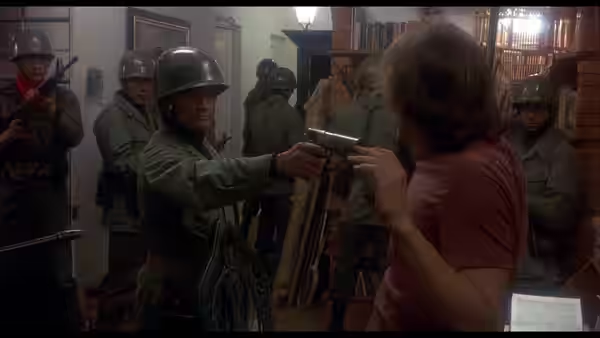
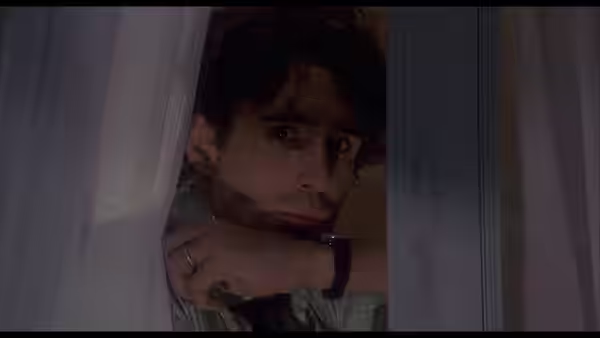
What does not work is the decoration. Vangelis’s piano theme is lovely the first time and is still being played, unchanged, the sixth. The film reconstructs Charles’s last free days from witnesses’ accounts, and Costa-Gavras stages these in a soft, half-remembered light that makes them look less like evidence than a dream, the wrong direction for a film building a case. Charles himself, played with decency by John Shea, is thinner than he needs to be, a nice young man with a notebook, and Terry Simon (Melanie Mayron) is largely there to have been present. The strongest scenes in Missing are the plainest, a desk, a form, a man being told no, and the film does not always trust them.
Joe I. Tompkins keeps Ed in his jacket and tie while everyone around him sweats, and the suit becomes the last certainty he has left. Against Costa-Gavras’s own work this is the warmest thing he has made: for once the machinery grinds down a family rather than an idea. The country is never named. The events are drawn from the disappearance of a real Charles Horman in the Chilean coup of 1973, but the refusal to say so gives the film the manner of a fable, and Costa-Gavras wants both the fable and the indictment.
It runs 123 minutes and carries a 15 certificate, mostly for what is glimpsed rather than shown. The second half goes where we will not describe, and the last quarter of an hour is hard going. Watch it with anyone who still thinks a passport is a promise.