Missing poster

Missing

2023 · Directed by Nicholas D. Johnson, Will Merrick
1h 51mDramaMysteryThriller15
64
Fi1m score
67
Critics · 15
Audience · not yet

Where to watch in the UK

Checked 10 September at 22:29. Prices and availability change; the service’s page is the last word.

Plays from YouTube when you press play; nothing loads from them until then.

Synopsis

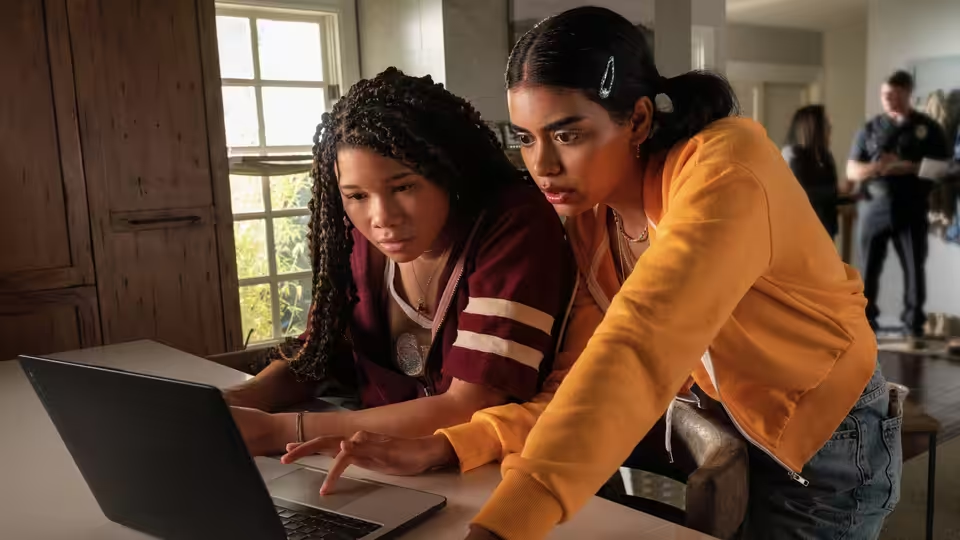
June (Storm Reid) sees her mother Grace (Nia Long) off to Colombia for a week’s holiday with her new boyfriend Kevin (Ken Leung), then goes to the airport to collect them and finds they were never on the flight. With the FBI’s Agent Park (Daniel Henney) moving at the speed of procedure, June starts her own search from her laptop: her mother’s accounts, Kevin’s history, hotel cameras, and Javi (Joaquim de Almeida), a stranger in Cartagena she hires through an app to knock on doors for her. The whole film plays out on screens, a stand-alone follow-up to *Searching* from directors Will Merrick and Nicholas D. Johnson.

Fi1m review

In a sentenceEverything the FBI does in a week, a teenager does in an afternoon with somebody else’s password

The screen-bound follow-up to Searching is quick, clever and, for an hour, properly tense. Then the twists arrive in a queue, and a story that ran on plausibility starts spending it. Storm Reid holds it together longer than the script deserves.

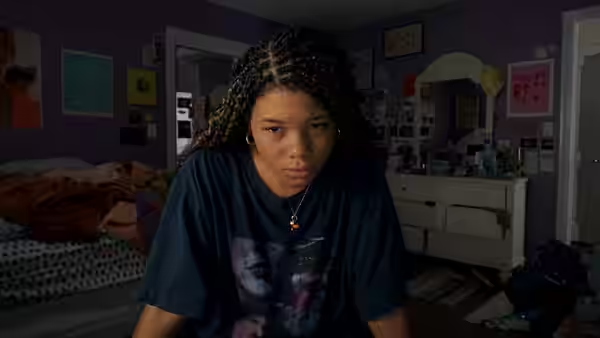
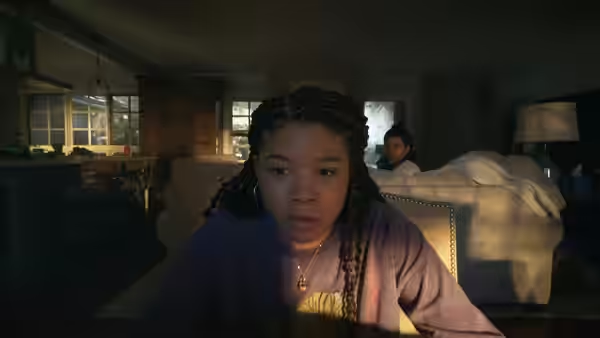
Will Merrick and Nicholas D. Johnson have made a thriller that takes place entirely on screens: a laptop, a phone, a doorbell camera, a hotel’s security feed. It is a stand-alone follow-up to Searching (2018), with a story by that film’s director, Aneesh Chaganty, and his producing partner Sev Ohanian. This time the searcher is a daughter. June (Storm Reid) waves her mother Grace (Nia Long) and Grace’s boyfriend Kevin (Ken Leung) off to Colombia for a week, spends the week as you would expect, and turns up at the airport to collect them. Nobody comes through the gate.

For an hour Missing is a quick, clever, properly tense little film, and then it starts adding twists and does not know when to stop. That is the whole of our complaint, and it is a real one, because the film runs on plausibility and spends most of it in the last forty minutes.

The format is the film, so the craft is where the credit goes. Steven Holleran is the cinematographer of a film with no camera in the usual sense; every image is something a device saw, and he has to make a FaceTime freeze or a grainy doorbell feed do the work a close-up would. Arielle Zakowski and Austin Keeling, the editors, have the harder job and do it well. Suspense here is a cursor hovering over a button, a password typed wrong twice, a text written and deleted, and they time those small movements like gags. Kelly Fallon’s production design is mostly June’s desktop, which is a mess, as it should be.

Reid carries it. June is quick, rude to adults, a little too pleased with herself, and Reid plays all that without asking us to like her, which is why we do. She is better at this than the FBI, and the film knows that is ridiculous and lets Daniel Henney’s Agent Park be politely useless about it. The film’s warmest thread is Joaquim de Almeida as Javi, a man in Cartagena hired through an app for a few dollars an hour to go and look at a hotel. He does the looking on his phone, held out in front of him, and the two of them become something like friends across a bad connection. Amy Landecker, as Grace’s lawyer friend Heather, and Megan Suri, as June’s friend Veena, are useful and underused.

We were tense at the airport, properly tense, watching passengers stream past a girl holding a sign, and we stayed tense through the first hour of digging. The film is sharp about how the internet actually works: the password reused across three accounts, the ex who still has access, the true-crime series playing in a corner of the screen about a case not unlike this one. Then, around the seventy-minute mark, the film reveals something, and then reveals something about the reveal, and then does it again. There was a moment in the last half hour, which we will not describe, when we laughed out loud at something meant to frighten us, and felt a bit sorry for a film that had been so careful up to then.

Julian Scherle’s score does not help; it leans on every reveal to tell us how big it is, when the format’s whole strength is that a notification sound can do that on its own. The script by Merrick and Johnson is best when it is watching June think and worst when it is arranging the next surprise, and by the end it is doing almost nothing else. It also has something to say about our appetite for other people’s disasters, and says it once, well, and then several more times.

Searching had one father, one daughter and one question, and it held its nerve. Missing has a better lead and twice as many twists, and the twists are the problem. There is a joke in it about the earlier film that made us grin, and then made us suspect the writers had noticed the comparison before we did.

Watch it at home, on a laptop if you have one, where the screen in the film and the screen in your hands are the same size and the trick works best. It runs 111 minutes and carries a 15. Stop trusting it at the hour mark and you will have a good time.

Critical consensus AI synthesised

67
Positive
8
Mixed
7
Negative
0

Most critics find Missing an entertaining thriller that stretches its own premise further than it should. The praise clusters in two places: Storm Reid, whose resourceful, extremely online teenager nearly every review singles out, and the screenlife format itself, with reviewers admiring how browser windows, FaceTime calls, Ring footage and smartwatches are turned into sources of suspense. The reservations cluster just as tightly. A large share of the reviews complain that the twists pile up until plausibility gives way, with Slant finding the final act unintentionally funny rather than tense, and IndieWire arguing the escalations never land emotionally. Several also feel it is glib about grief and intimate partner violence, and less fresh than its predecessor Searching. The spread is fairly wide, from Slant’s dismissal to Polygon’s outright enthusiasm, but no review is hostile; the disagreement is over how much nonsense a good ride can carry.

The AV Club
19 January 2023 · B
77

Storm Reid delivers a convincing performance as a teenager navigating crisis, enhanced by innovative screenlife cinematography using browsers, FaceTime, and apps. The film proves a worthy addition to the genre with a tight script and solid execution of its techno-thriller premise.

Read the full review →
Los Angeles Times
19 January 2023 · Katie Walsh
75*

The suspenseful sequel follows digital breadcrumbs in a breakneck pace of shocking twists while reckoning with grief, loss, and intimate partner violence in a realistic way drawn from headlines and true-crime culture. It entertains but explores the terrors and triumphs of tech effectively.

Read the full review →
RogerEbert.com
20 January 2023 · Christy Lemire
70*

The film delivers a zippy screenlife thriller but includes too many twists that erode its realism and novelty compared to the predecessor. It effectively uses modern tech elements like Ring video and comments on true-crime obsession while celebrating technology's possibilities through Storm Reid's resourceful performance.

Read the full review →
Little White Lies
19 April 2023 · 2/3/2 · Alison Rumfitt
60

The critic finds the film an enjoyable but ultimately sour twisty thriller anchored by Storm Reid's performance. They single out the clever use of the screenlife format and social media elements for praise, while complaining about excessive twists and glib handling of serious subject matter.

Read the full review →
Radio Times
★★★ · Dave Golder
60

The critic views it as an entertaining cyber-thriller with clever moments despite a ludicrous plot. They praise its compelling, humorous and immersive qualities while noting contrived storytelling and dated tactics in the climax.

Read the full review →
The New York Times
19 January 2023 · Amy Nicholson
60*

The strenuous techno-thriller relies on a computer-screen gimmick for a teen's search for her missing mother, with relatable online sleuthing giving way to ludicrous twists that the lead parries confidently. It includes a meta-joke referencing the prior film in the series.

Read the full review →

Cast

Stills

If you liked this, try…

Searching poster

Searching

2018 · The first one: a father, a laptop, one question, and the nerve to stay with it.

Host poster

Host

2020 · A séance on a video call, made in lockdown, and it does not waste a minute.

The Vanishing poster

The Vanishing

1988 · Dutch missing-person film where the searching is the horror; do not see the remake.

Locke poster

Locke

2013 · Tom Hardy, one car, one night of phone calls, and it holds.

Rear Window poster

Rear Window

1954 · The original screen thriller: a man, a window and neighbours who might be guilty.