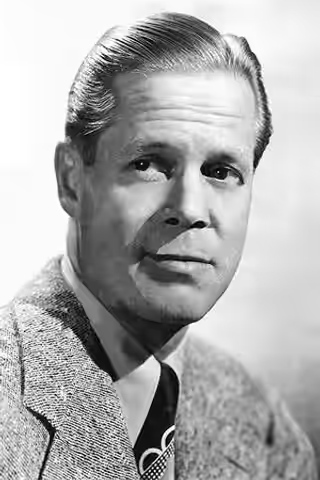
Dan Duryea made a career of men you would not lend money to: the thin nasal voice, the smirk, the hands that never settle. Hollywood decided early that this was all he was for, and he did it better and for longer than anyone had a right to expect.
Fi1m perspective
The voice comes first, thin and nasal, pitched a little too high for a grown man, and then the smirk, and then the fact that his hands are never quite still. Dan Duryea played the man you would not trust with your wallet: blackmailers, pimps, hangers-on, the weak brother, the cheerful thief. He usually stood a few feet from the hero, Gary Cooper or James Stewart, and the hero was a better man for the comparison. Duryea knew that was the job and did it without vanity.
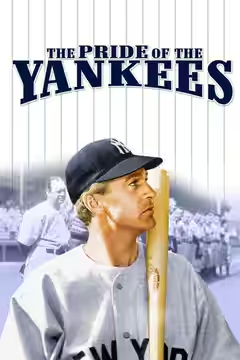
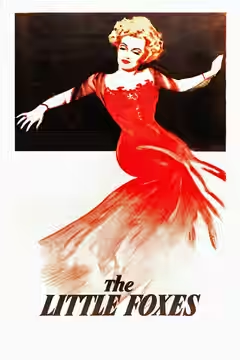
He came to films with the part already worked out. He played Leo Hubbard on Broadway in The Little Foxes in 1939 and filmed it for William Wyler in 1941, and among a cast that had settled into their roles over years he was the one who looked least sure of himself, which was the point. Leo is a weak young man who knows he is weak and hopes nobody else has noticed. We caught ourselves feeling sorry for him, which the film does not ask us to, and it was the hoping that did it; Duryea lets you see the boy waiting to be found out. A year later, in The Pride of the Yankees (1942), he was Hank Hanneman, whose whole function is to sneer at Lou Gehrig so that Walter Brennan can admire him again. The film wearied us in its middle hour, and that arrangement is part of why, but Duryea sneers well.
Then came the heels he is remembered for. Fritz Lang used him twice, in The Woman in the Window (1944) and as Johnny Prince, the scheming pimp of Scarlet Street (1945), opposite Edward G. Robinson and Joan Bennett. He was Slim Dundee against Burt Lancaster in Criss Cross (1949) and Waco Johnnie Dean in Winchester '73 (1950), the Stewart western in which he is, by most accounts, the one having the fun. He made three films with Cooper and three with Stewart, and each time the shape was the same: the decent man in the centre, Duryea at the edge, grinning.
The trouble with being that good at one thing is that nobody wants the other thing. He tried sympathetic parts in the 1950s and audiences did not take to them; producers had a clear idea of what a Duryea part was and declined to revise it. He seems to have understood this before they did. He told Hedda Hopper that he had looked in the mirror, seen a face and a body that would never pass for a leading man, and decided to be the meanest man in films, "strictly against my mild nature." The last stretch of his career was mostly television. If you know him only from the noir shelf, go back to Leo Hubbard: the whole career is in that one weak young man, already beaten and still working out how to win.
Biography
Dan Duryea was an American actor of film, stage and television. Born in White Plains, New York, he graduated from Cornell University in 1928. He worked in advertising before making his Broadway debut in the play Dead End. He gained attention for his performance as Leo Hubbard in the 1939 Broadway production of The Little Foxes and reprised the role in the 1941 film adaptation.
Duryea appeared in numerous films from the 1940s onwards, including Ball of Fire (1941), The Woman in the Window (1944), Scarlet Street (1945), Criss Cross (1949) and Winchester '73 (1950). His later credits include The Flight of the Phoenix (1965). He also worked in television, with guest roles in series such as The Twilight Zone (1959) and Bonanza (1959), and a regular part in Peyton Place (1967–1968). He died in Hollywood, California, in 1968.