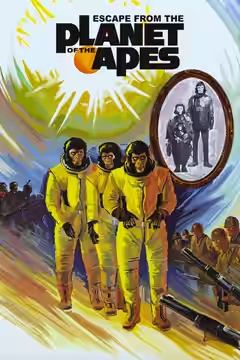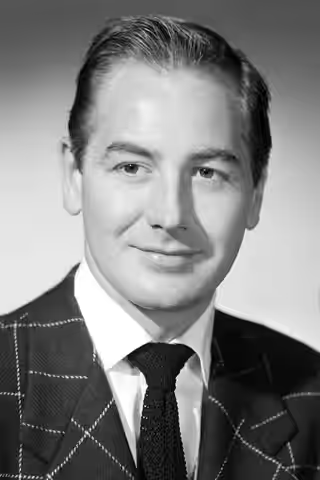
Don Taylor came to directing from acting and spent most of his career on other people's series. Once, in Escape from the Planet of the Apes, he was handed the right script and made the funniest and saddest film in the series.
Fi1m perspective
Two talking chimpanzees land in present-day California and, for a while, Escape from the Planet of the Apes (1971) is a comedy about being famous. Then it stops being one. Don Taylor's handling of that turn is the best thing we have seen from him, and it tells you what kind of director he was: one who kept the story moving and let the actors do the rest. It also shows his weakness. A few of the early gags, a shopping trip, a night at the boxing, run past their laugh, and Taylor does not stop them. He was generous with a scene when a harder man would have cut.
He had been an actor first. He appeared in The Naked City (1948), Father of the Bride (1950) and Stalag 17 (1953), then in the late 1950s went behind the camera and stayed there, on Alfred Hitchcock Presents, The Rifleman, The Big Valley and Night Gallery, with features from the early 1960s. He did not miss the other side of the lens much. 'It is a director's medium,' he said when asked about actors who direct, and he kept at it for thirty years, ending with television films in the late 1980s.
Escape is where the television years pay off. It was made quickly and the budget shows in every frame, and Taylor treats that as a condition of the job rather than an excuse. Roddy McDowall and Kim Hunter carry it, and he trusts them to. The second half moved us more than a third film about talking apes has any business doing, and the credit is theirs as much as his: they play the early scenes for laughs and the later ones for grief, and he has the sense to keep out of the way. Not everything is judged so well. Sal Mineo, as Milo, gets the least to do of the three apes, which is a waste of him, and the human parts are pleasant and nearly empty.
After that he went where the work was: Tom Sawyer (1973), a musical with a Sherman Brothers score; The Island of Dr. Moreau (1977) with Burt Lancaster; Damien: Omen II (1978) with William Holden; The Final Countdown (1980), in which Kirk Douglas and an aircraft carrier travel in time. We have not reviewed them. The consensus on this stretch, then and since, is that Taylor was efficient rather than exciting, that the musical was not his form, and that his endings were weaker than his premises. That is the description of a journeyman, and it is not an insult.
If you see one Taylor film, make it Escape, and see it knowing that the man behind it spent most of his life getting other people's stories in on time. Once, the story was worth the trouble.
Biography
Don Taylor (born Donald Ritchie Taylor) was an American actor and film director. Born in Freeport, Pennsylvania, on 13 December 1920, he began his career as an actor in the 1940s, appearing in films including The Naked City (1948), Battleground (1949), Father of the Bride (1950), Father's Little Dividend (1951) and Stalag 17 (1953).
From the late 1950s he worked primarily as a director of feature films and television. His credits include episodes of Alfred Hitchcock Presents and Night Gallery, and the films Escape from the Planet of the Apes (1971), Tom Sawyer (1973), The Island of Dr. Moreau (1977), Damien: Omen II (1978) and The Final Countdown (1980). He died in Los Angeles on 29 December 1998.