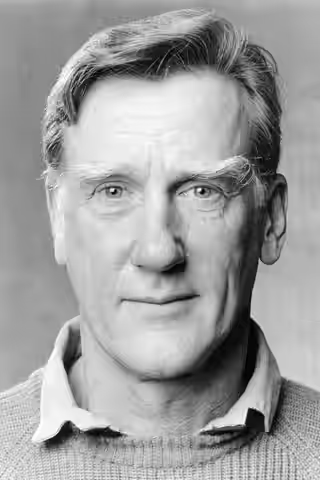
Donald Moffat spent nearly four decades on screen as the man in charge, commanders, presidents and judges, and his gift was to show what the job cost. In The Thing he loses a room's respect one look at a time, and we remember it longer than the effects.
Fi1m perspective
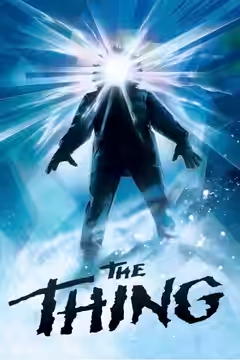
The station commander in The Thing (1982) is the kind of part that usually earns an actor a clipboard and one reaction shot. Moffat plays Garry as a man who has run the place so long he has forgotten it ever took effort, and as the men's trust in him drains away he lets us watch it drain: a question answered a beat late, a glance round to see who is still listening. Our review said he loses his authority by degrees and that Moffat lets us see each degree. We felt Garry's slide more than we expected to, because the film gives him no help at all, no speech and no scene of his own, only a man standing slightly behind the others and noticing that nobody is waiting for his decision any more.
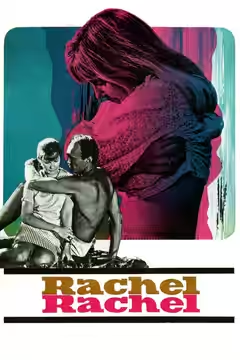
He was a stage actor first and, by his own account, always. RADA, national service and the Old Vic in London, then the United States in the mid-1950s, where he took odd jobs before going back to the theatre, first in the regions and then with the APA repertory company on Broadway. He played O'Neill, Ibsen, Shakespeare and Pirandello, and kept playing them into the 1990s; Larry Slade in The Iceman Cometh (1985) is the stage performance people bring up. Film came late, in his late thirties, as Niall Cameron in Rachel, Rachel (1968), Paul Newman's first film as director. We liked that film and did not single him out, which is roughly how the next four decades went: present, exact and seldom the reason anyone bought the ticket.
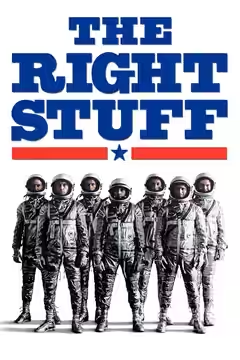
From then on he was Hollywood's idea of an official. Garry in The Thing, Lyndon Johnson in The Right Stuff (1983), President Bennett in Clear and Present Danger (1994), Edgar Halcyon in Tales of the City (1993), and judges and doctors between. The one lead, Sam in On the Nickel (1980), was a recovering alcoholic, and it did not lead to more of them. What he brought to the men in suits was a refusal to make them stupid; his authority figures always seemed to have earned the desk, which is why it hurt when they lost it. He described the method himself: "What I always try to do is find the truth of the person. What makes them tick? Why are they doing things? I try and be very, very specific at every given moment. Then try to not let anybody see what I'm doing."
The reservation, if it counts as one, is that he was a supporting player and nothing else, and a career of that shape lives or dies on other people's films. Carpenter's was good enough to carry him, and he repaid it. His last screen role came in 2005. If you want to see what he did, put on The Thing, ignore the creature for a while, and watch the man who is supposed to be in charge. He will do nothing to draw your eye. That was the job.
Biography
Donald Moffat (also credited as Donald Moffatt) was an English actor. Born in Plymouth, Devon, he trained at the Royal Academy of Dramatic Art in London and began his career with the Old Vic theatre company before moving to the United States in the mid-1950s.
He worked extensively on stage in New York, receiving Tony Award nominations for revivals of The Wild Duck and Right You Are If You Think You Are, and an Obie Award for Painting Churches. His film roles included Garry in The Thing (1982), Lyndon B. Johnson in The Right Stuff (1983) and the President in Clear and Present Danger (1994). He also appeared in television series such as Little House on the Prairie, Columbo, The West Wing and Dr. Quinn, Medicine Woman.
Moffat died in Sleepy Hollow, New York, on 20 December 2018.