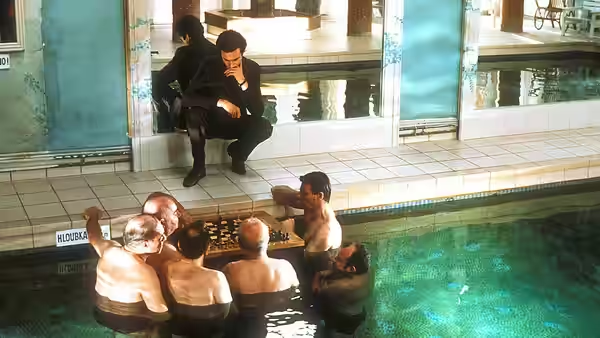
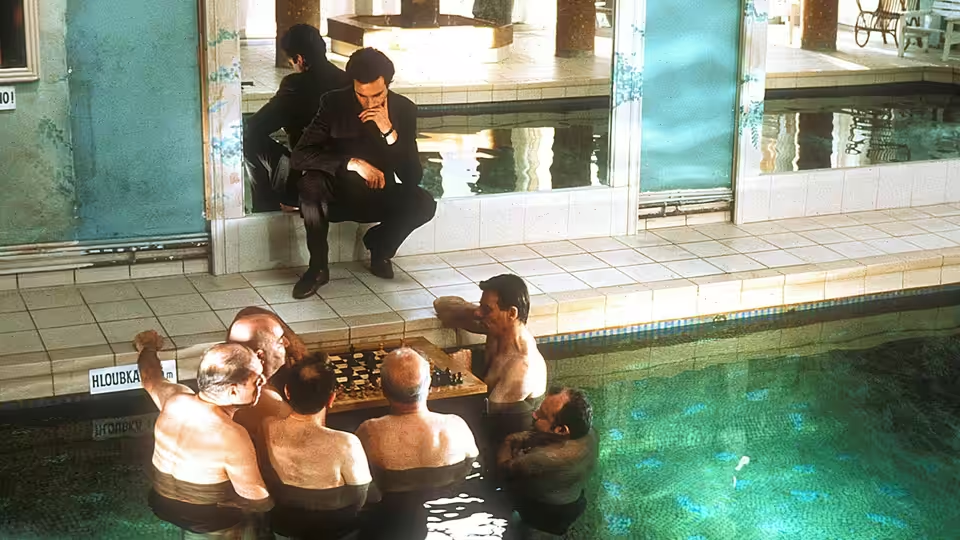
A man sits beside an indoor pool as several men gather in the water
Film review

The Unbearable Lightness of Being

1988 · Directed by Philip Kaufman · 2h 51m · MPA R

In a sentenceDaniel Day-Lewis seduces half of Prague; the tanks arrive on schedule anyway

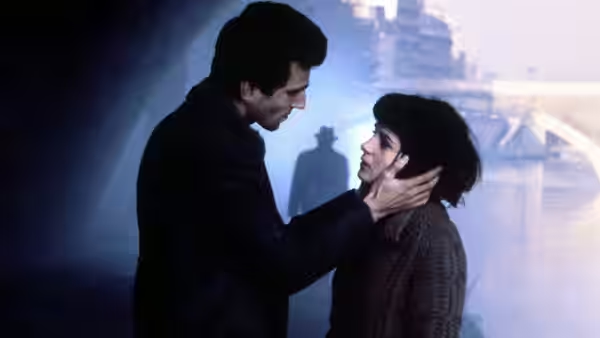
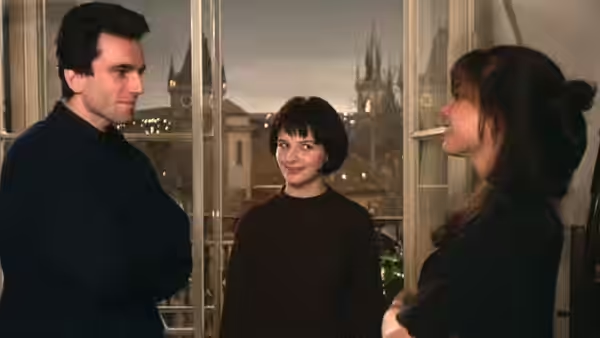
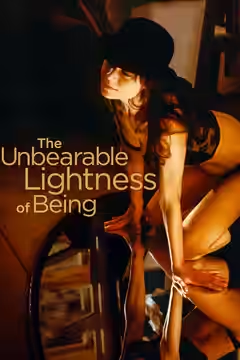
Prague, 1968. Tomas (Daniel Day-Lewis) is a brain surgeon who takes women to bed by instruction, telling each to take off her clothes, and never lets one stay the night. His longest-standing lover is Sabina (Lena Olin), a painter who works in a bowler hat and wants from him exactly what he wants from her, which is nothing permanent. On a trip to a spa town he is served by Tereza (Juliette Binoche), a waitress; days later she turns up at his flat with one suitcase and does not leave. She wants all of him. He wants to change nothing. Then, in August, the Soviet tanks roll into the city, and Tereza goes out into the streets with her camera.

Fi1m review

Philip Kaufman’s film of Milan Kundera’s novel is handsome, adult and, in its best stretches, properly alive, with Juliette Binoche and Lena Olin doing the finest work in it. It is also 171 minutes long, and it loses the book’s voice along the way.

Milan Kundera’s novel is mostly a man thinking aloud: a narrator who interrupts his own lovers to argue about Beethoven and whether anything that happens only once has happened at all. Philip Kaufman and Jean-Claude Carrière have taken the narrator out and kept the people, the beds and the tanks. What is left is a long, handsome, grown-up film about four lovers and one invasion, and it is good without being quite the thing it is adapted from. At 171 minutes it is also too long, and it knows where the slack is and leaves it in.

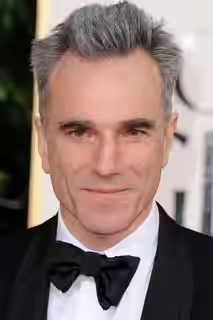
Daniel Day-Lewis plays Tomas, a Prague brain surgeon who tells women to take their clothes off in the voice other men use to ask the time. It is a role that needs a man to be light without trying, and we could see the trying. The accent is a decision he keeps having to remember, and the grin arrives a beat before the line. He is better in the second half, when the film stops asking him to charm and lets him be stubborn, tired and quietly decent; a scene with an official from the Interior Ministry (Daniel Olbrychski) about something he once wrote is the best thing he does.

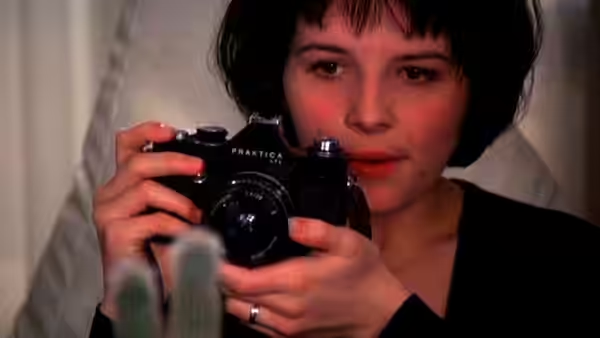
The women carry it. Juliette Binoche’s Tereza arrives from a spa town with one suitcase and no intention of leaving, and Binoche plays her as someone who has decided to be brave and is frightened by how it feels. Lena Olin’s Sabina, a painter in a bowler hat, is the only person on screen as light as Tomas pretends to be, and Olin gives her a wariness around the eyes that the hat is there to hide. The scene in which Tereza comes to photograph Sabina and Sabina turns the camera round on her is the best in the film: funny, sad and erotic at once, and nobody says what it is about. We laughed, and were surprised at ourselves, because the film had not been funny for some time.

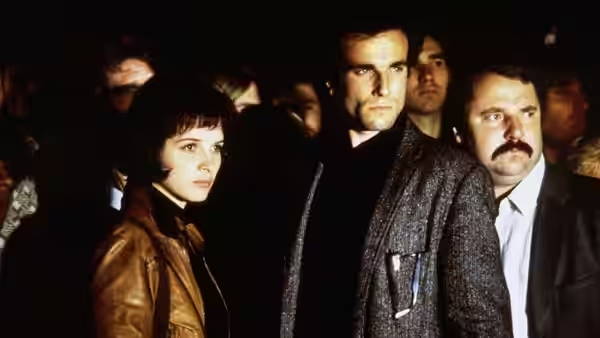
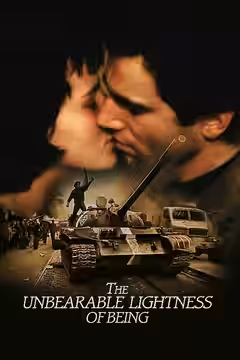
Then the tanks come. Sven Nykvist shoots Prague before the invasion in warm browns and lamplight, flats full of books with a stove in the corner, and for August 1968 the film drops into grainy black-and-white, with Binoche and Day-Lewis cut into the actual newsreel of the day. The editing, by Walter Murch, Vivien Hillgrove and Michael Magill, is so exact that we stopped noticing where the real footage ended. We were horrified, and the thing that did it was small: Tereza keeps taking photographs while a crowd runs the other way, and the camera that was a toy in Sabina’s flat is now the only weapon anyone has. It is the one stretch where the film is plainly better than a book could be.

The rest of the craft is of a piece. Pierre Guffroy’s rooms are lived in down to the ashtrays, and when the story leaves Prague he gives the lovers clean, pale rooms with nothing on the walls, so we feel the loss before anyone mentions it. Ann Roth puts Sabina in black and the hat, Tereza in cardigans a size too big, and Tomas in the same jacket throughout. The music, credited to Mark Adler and leaning hard on Janáček, is piano and strings and almost never swells. It trusts the faces.

What goes missing is the argument. Kundera’s title is a question about whether a life lived lightly weighs anything, and the film reduces it to a line or two and a look. Franz (Derek de Lint), Sabina’s lover in the West, exists so that she has someone to leave, and de Lint is given nothing to play. After the invasion the politics thin out into men in raincoats, and the second half, which we will not describe, is slower than it is sad, with a long rural stretch that could lose twenty minutes and be improved by it. We felt the length.

Kaufman’s previous film, The Right Stuff (1983), was also long and also about men who think they are light, and it moved faster because it had somewhere to be. This one drifts, which is the design, and the design is sometimes an excuse. And yet the final minutes, which depend on a cut and a piece of music and almost nothing else, moved us more than the previous two and three-quarter hours had led us to expect. Watch it in one sitting, late, with the lights off. It is built for that, and it earns its last five minutes even where it has not earned all of its first hundred and sixty-six.
Critical consensus AI synthesised

70
Positive
5
Mixed
2
Negative
1

Most critics find Kaufman’s adaptation comes off far better than a novel this hard to film has any right to. The praise clusters on the cast: Juliette Binoche and Lena Olin are singled out more than once, and several reviews admire how the film moves between erotic comedy and political tragedy without lurching. The actors’ body language and the editing of the final moments are also picked out as things the film does that the page could not.

The reservations are about the book. Several critics feel the film cannot carry the novel’s language or its irony, and that what remains is heavier than the source. Daniel Day-Lewis divides opinion: Variety finds his self-conscious appeal occasionally overdone, while Empire thinks him the best of the casting. Radio Times calls it overlong and eventually short of things to say. The spread is wide, with the Los Angeles Times the one outright dissenter, arguing the adaptation thins the ideas and leaves the characters shallow, though even that review admires Binoche and the photography.

The AV Club
21 February 2006 · Keith Phipps
85*

Phipps praises the film as a thoughtful, moving adaptation whose final moments achieve a remarkable effect through editing. He also singles out the performances’ expressive body language and the film’s handling of intimacy and historical upheaval.

Read the full review →
The New Yorker
1 February 1988 · Pauline Kael
82*

Kael finds the film a playful, emotionally resonant adaptation, though its ending is weakened by the novel’s pull toward conventionality. She praises the actors’ lively performances and the film’s deft blend of erotic comedy and political tragedy.

Read the full review →
Time Out
28 March 2012
80*

The review finds Kaufman’s adaptation remarkably successful despite the novel’s challenges. It singles out his ability to translate the book’s essayistic pondering to the screen.

Read the full review →
Variety
31 December 1987 · Variety Staff
80*

The critic calls the adaptation richly satisfying and praises its buoyant, spirited treatment of sexuality. They single out Juliette Binoche and Lena Olin as enchanting, while finding Daniel Day-Lewis occasionally overdoes his self-conscious appeal.

Read the full review →
Empire
3 March 2006 · Colin Kennedy
70*

Kennedy finds the adaptation strong overall despite its inability to capture the novel’s language and its less successful blend of political themes. He praises the casting, especially Daniel Day-Lewis, and compares the film favorably with Kubrick’s Lolita.

Read the full review →
RogerEbert.com
65*

The page does not reveal the critic’s verdict. Its praise or complaints cannot be determined from the blocked content.

Read the full review →

Straight answers AI written, from our review

Is The Unbearable Lightness of Being worth watching?
The Unbearable Lightness of Being is worth watching for anyone with an evening to give to a long, adult romance set against the Soviet invasion of Prague, and we scored it 74. Juliette Binoche and Lena Olin are the reason to see it, and the invasion sequence is remarkable. At 171 minutes it drifts, and Daniel Day-Lewis is less light than the part needs.
How long is The Unbearable Lightness of Being, and what is it rated?
The Unbearable Lightness of Being runs 2h 51m and is rated R by the MPA in the US. It is a drama and romance film.
Where can I watch The Unbearable Lightness of Being in the US?
The Unbearable Lightness of Being is available to rent from Amazon Prime Video from $3.99. Availability is checked daily; the links above go straight to each service.
How violent or frightening is The Unbearable Lightness of Being, and is it suitable for children?
The Unbearable Lightness of Being is an adult film, rated R in the United States, with a good deal of sex and nudity and no interest in children. The violence is mostly the Soviet invasion of 1968, cut into real newsreel, and it frightens in a documentary way rather than a gory one. Keep it for grown-ups and older teenagers who can sit through nearly three hours.
How does The Unbearable Lightness of Being compare to Closely Watched Trains?
The Unbearable Lightness of Being is the longer, grander and more solemn of the two, while Closely Watched Trains is short, Czech and funny about sex and occupation in ways Kaufman's film only reaches for. The Menzel film is the tighter and, we think, the better one. Choose Kaufman for the romance and the scale, Menzel for wit and economy.
Is The Unbearable Lightness of Being based on a true story or a book?
The Unbearable Lightness of Being is based on Milan Kundera's novel of the same name, not on a true story, though it is set during the real Soviet invasion of Prague in August 1968. Philip Kaufman and Jean-Claude Carrière keep the lovers and the tanks but drop the book's arguing narrator, so much of its voice is lost. You need not have read it, but readers who have will notice what is missing.
What should I watch after The Unbearable Lightness of Being?
After The Unbearable Lightness of Being, try Closely Observed Trains (1966, Fi1m 82): Czech, short, funny about sex and occupation in ways this film reaches for. Then Jules et Jim (1962, Fi1m 88): The three-way love affair that taught every later one how to run; and The Lives of Others (2006, Fi1m 84): What the men in raincoats were doing all day, told from their side.

Cast

Awards

Academy Awards, 1989

Nominated
Best Cinematography
Nominated
Best Writing, Adapted Screenplay

BAFTA Film Awards, 1989

Won
Best Adapted Screenplay

Independent Spirit Awards, 1989

Won
Best Cinematography

Writers Guild of America Award for Best Adapted Screenplay, 1989

Nominated
Writers Guild of America Award for Best Adapted Screenplay

American Society of Cinematographers Award for Outstanding Achievement in Cinematography in Theatrical Releases, 1988

Nominated
American Society of Cinematographers Award for Outstanding Achievement in Cinematography in Theatrical Releases

Boston Society of Film Critics Award for Best Actor, 1988

Won
Boston Society of Film Critics Award for Best Actor

Golden Globes, 1988

Nominated
Best Motion Picture – Drama
Nominated
Best Supporting Actress – Motion Picture

National Society of Film Critics Award for Best Cinematography, 1988

Nominated
National Society of Film Critics Award for Best Cinematography

National Society of Film Critics Award for Best Director, 1988

Won
National Society of Film Critics Award for Best Director

National Society of Film Critics Award for Best Film, 1988

Won
National Society of Film Critics Award for Best Film

National Society of Film Critics Award for Best Supporting Actress, 1988

Nominated
National Society of Film Critics Award for Best Supporting Actress

If you liked this, try…

  1. Closely Observed Trains (1966, Fi1m 82)Czech, short, funny about sex and occupation in ways this film reaches for.

  2. Jules et Jim (1962, Fi1m 88)The three-way love affair that taught every later one how to run.

  3. The Lives of Others (2006, Fi1m 84)What the men in raincoats were doing all day, told from their side.

  4. Cold War (2018, Fi1m 85)Two lovers, one Iron Curtain, under ninety minutes; the discipline this film lacks.

  5. Three Colours: Blue (1993, Fi1m 88)Binoche again, five years on, carrying a whole film with her face.