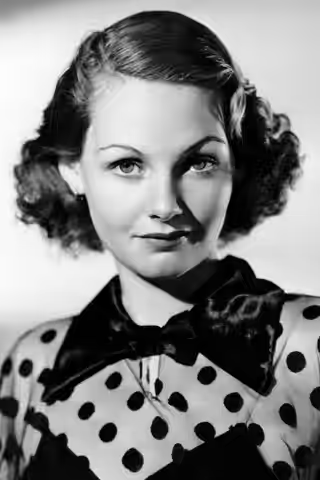
Elizabeth Allan spent her Hollywood years being looked at and wept over, and did both well enough that nobody thought to ask for anything else. Her Clara Copperfield shows what was going spare. The rest of the 1930s mostly let it go.
Fi1m perspective
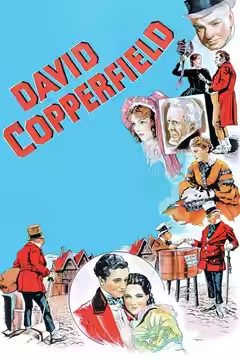
There is a moment early in David Copperfield (1935) when Basil Rathbone's Murdstone stands in the parlour with a hand resting on Elizabeth Allan's shoulder, and the scene belongs to the boy watching them. That is Allan's Hollywood career in a single shot. She is at the centre of the frame, she is the reason everyone else is there, and the camera is looking at somebody else. She plays Clara as a pretty, weak woman who knows she has made a mistake and cannot bring herself to say so, and she does it with less fuss than the part invites. We found her sadder than the film seems to notice. Cukor is busy with Murdstone, rightly, but Allan's face under that hand stayed with us longer than the beating that follows it.
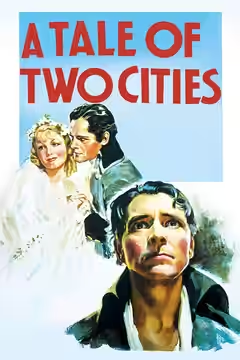
She had come up through the Old Vic, from 1927, and British films from Alibi (1931) before MGM signed her in 1933. Nineteen thirty-five was her year: two Dickens adaptations and Tod Browning's Mark of the Vampire, which she regarded as beneath her. In A Tale of Two Cities (1935) she is Lucie Manette, and the trouble with Lucie is that she exists to be adored. Allan is asked to be looked at and wept over and does both nicely, and every time Jack Conway leaves Ronald Colman for the happy household the temperature drops. That is Dickens's fault before it is hers, but the film does nothing to fix it and neither does she. Camille (1936), in support of Garbo, was more of the same at a smaller size.
She knew exactly what was happening. "Because I was once an English school teacher, and because I'm told I look like a shy, shrinking violet, I seem to be doomed forever to goody-goody roles. I want to be wicked … on the screen–a sort of exotic vamp who lures men to their destruction." She never got the vamp. She lost parts in The Citadel (1938) and Goodbye, Mr. Chips (1939) and was back in Britain by 1938, where the work was steadier and less grand: Went the Day Well? (1942), No Highway in the Sky (1951). By the 1950s she had moved into character parts, and the one that people remember is Louise Scobie, Trevor Howard's brittle wife in The Heart of the Matter (1953). We have not reviewed it and will not judge it here, but it is the part she had been asking for since 1935, arriving twenty years late and in a different country.
Her last feature was The Haunted Strangler (1958), opposite Boris Karloff; after that she was a fixture of British television game shows until the late 1960s. Start with David Copperfield. It is the better film and the better use of her, and if you want to know what MGM saw and then failed to do anything with, it is all there in the parlour, waiting for someone to turn the camera round.
Biography
Elizabeth Allan (also credited as Elizabeth Allen) was an English actress who appeared in stage, film and television productions in Britain and Hollywood.
She made her stage debut at the Old Vic in 1927 and her film debut in Alibi (1931). Allan worked under contract with Metro-Goldwyn-Mayer in the 1930s and is known for roles including Clara Copperfield in David Copperfield (1935), Lucie Manette in A Tale of Two Cities (1935), Irena Borotyn in Mark of the Vampire (1935) and Nichette in Camille (1936). Later film credits include No Highway in the Sky (1951) and Grip of the Strangler (1958).
She appeared as a panellist on the British version of What's My Line? and was named Great Britain's Top Female TV Personality of 1952. Allan was married to theatrical agent Wilfrid J. O'Bryen from 1932 until his death in 1977.