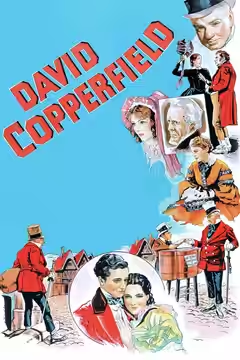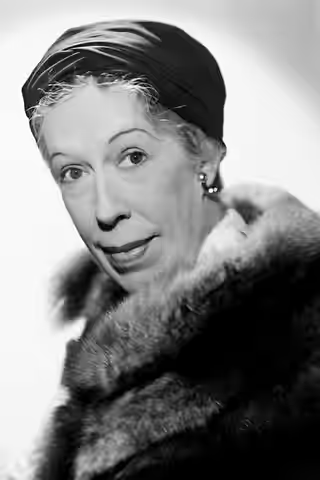
Edna May Oliver played the aunt nobody wanted to cross through most of Hollywood's 1930s literary adaptations, and she played her straight, which is why she was funny. Her Aunt Betsey in David Copperfield (1935) is the one to start with.
Fi1m perspective
The first thing Edna May Oliver does in David Copperfield (1935) is chase donkeys off her patch of green at Dover, and she does it with the seriousness of a woman defending a border. There is no wink. That was her method in every part we can think of: play the absurd woman as though she is entirely in the right and let the audience do the laughing. We laughed out loud at the donkeys, and then watched her take in the ragged boy on her doorstep and turn, over one long look, from a comic turn into a guardian. She and Freddie Bartholomew are the reason the film's first hour is as good as Dickens on screen gets.
She came to films from the stage, and late. Her first Broadway success, in 1917, was as another aunt, Penelope, and she originated Parthy Ann Hawks, another woman with opinions about everyone, in the 1927 Show Boat. Her film debut was Wife in Name Only in 1923, but the 1930s at RKO and MGM were her real career. There were the Hildegarde Withers mysteries, beginning with The Penguin Pool Murder (1932), which gave her a spinster sleuth of her own, and there were the adaptations: Aunt March in Little Women (1933), Aunt Betsey for David O. Selznick and George Cukor, Lady Catherine de Bourgh in Pride and Prejudice (1940). Her last film was Lydia (1941), and she died the following year.
Her appearance was distinctive, and the studios used it. It got her cast as the tart aunt and the prim spinster and not much else, and the one reservation anyone has raised about her is that she was asked to play the same woman too often. We would add that the parts were frequently written thin, and that she fills them by never playing the thinness: nothing she says sounds like a line someone gave her. Dolly Tree's bonnet in David Copperfield, which we said you could defend a coastline with, is a costume department meeting the performance halfway. Her timing was stage timing, which meant she knew how long to hold before speaking and how long to hold after, and the camera did not frighten her out of it.
Start with David Copperfield, where Cukor gives her room and she takes exactly as much as she needs. The Withers films are for the interested. Lady Catherine in Pride and Prejudice is the same woman with a better house. She was rarely the lead in the films people remember, and she is often the reason they remember them.
Biography
Edna May Oliver was an American stage and film actress. Born Edna May Nutter in Malden, Massachusetts, she left school at the age of 14 to pursue a career in the theatre. She achieved success on Broadway in the 1917 production of Oh, Boy! and made her film debut in the early 1920s.
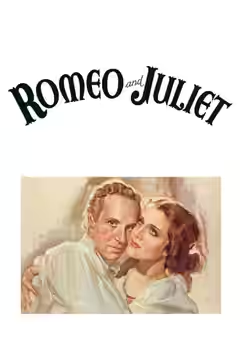
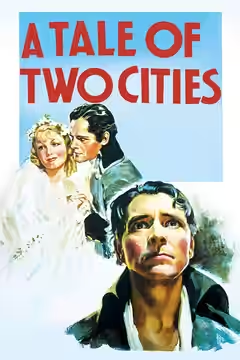
During the 1930s she became one of the better-known character actresses in American films, frequently appearing in adaptations of classic literature. Her credits include Aunt March in Little Women (1933), the Red Queen in Alice in Wonderland (1933), Miss Pross in A Tale of Two Cities (1935), Aunt Betsey Trotwood in David Copperfield (1935), the Nurse in Romeo and Juliet (1936), Mrs McKlennar in Drums Along the Mohawk (1939) and Lady Catherine de Bourgh in Pride and Prejudice (1940). She received an Academy Award nomination for best supporting actress for Drums Along the Mohawk (1939).
Oliver died in 1942.