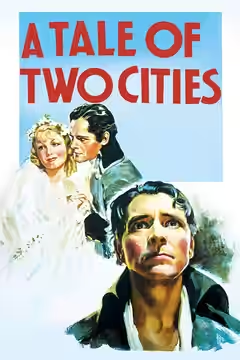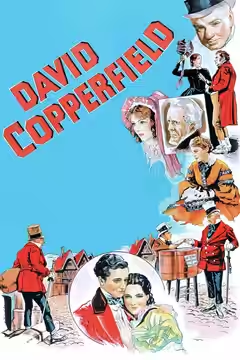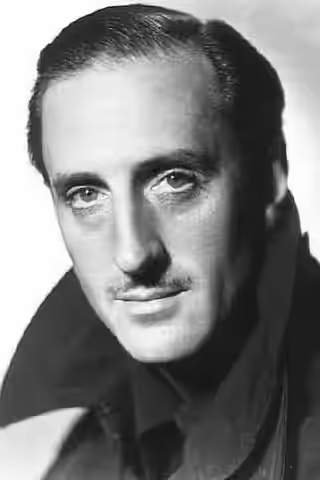
Rathbone's villains do their damage quietly: he lowers the voice where other actors raise it, and he fences well enough to make a hero look good. Fourteen films as Sherlock Holmes fixed his face on the part and hid most of the rest.
Fi1m perspective
Watch what Basil Rathbone does with his hand in David Copperfield (1935). Murdstone stands in the parlour with it resting on Clara's shoulder, and Freddie Bartholomew's face tells us everything the novel takes three pages to say. When the beating comes, George Cukor keeps it on the boy and the door. Rathbone never raises his voice; he lowers it, and it frightened us more than any amount of shouting would have, because he makes Murdstone sound like a man who has already decided what he is going to do.
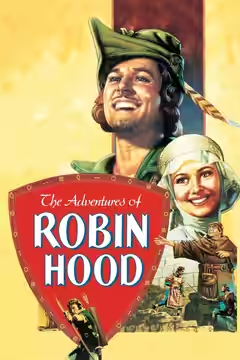
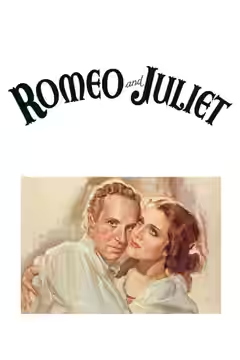
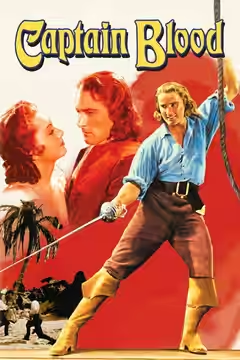
That is the Rathbone method, and Hollywood found it useful. He had come up on the stage, in Shakespeare with Frank Benson's company from 1911, made silent films from 1921 and arrived in the talkies in 1929 with a voice built for period dialogue and a profile built for villainy. The studios cast accordingly. In Captain Blood (1935) he turns up an hour in as Levasseur, a French pirate who is quiet and amused after sixty minutes of Atwill shouting, and the film gets its only villain worth the name. He and Errol Flynn fight on a beach, Ernest Haller and Hal Mohr shooting them in the surf with the light off the water behind them and George Amy cutting so we see every exchange whole. Rathbone is plainly the better fencer and spends the scene making Flynn look good, which is generosity of a rare kind. They made three films together; the best known is The Adventures of Robin Hood (1938), with Rathbone as Sir Guy of Gisbourne, and Tybalt in Romeo and Juliet (1936) sits between them.
Then came The Hound of the Baskervilles (1939), and Holmes. Fourteen films to 1946, eleven of them directed by Roy William Neill, all of them with Nigel Bruce as Watson, and more than two hundred radio broadcasts besides. The hawk's profile, the precise enunciation and the coolness that had made the villains so alarming turned out to be exactly what the detective needed, and the picture of Holmes most people carry in their heads is still Rathbone's. He minded. "I played Holmes for seven years, and nobody thought I could do anything else," he said, and the films he made after leaving the series, cheaper horror and fantasy pictures and parts that sent up his own manner, suggest nobody did.
We have not reviewed the Holmes films, so we will not judge them here. What we can say is that the two performances we have looked at closely, Murdstone and Levasseur, use the same equipment the detective later did: stillness, a lowered voice, a long face that gives nothing away. The part that fixed him was made of the parts that made him. Start with the villains, before 1939, and notice how little he needs to do. Then watch the Holmes films, if you like, and see how much of that he had to keep doing.
Biography
Basil Rathbone (born Philip St. John Basil Rathbone) was an English actor. Born in Johannesburg in 1892 and raised in England, he began his career as a Shakespearean stage actor before moving into film in the 1920s.
He appeared in more than 70 films, often in costume dramas and swashbucklers, frequently playing suave villains. Notable early roles include Mr. Edward Murdstone in David Copperfield (1935) and Levasseur in Captain Blood (1935). He is best known for portraying Sherlock Holmes in fourteen Hollywood films made between 1939 and 1946, as well as in a radio series.
Rathbone also worked in theatre and television. He received a Tony Award in 1948 for Best Actor in a Play. He died in 1967.