Flynn played rebels who found the whole business of rebellion faintly funny, and the grin did what other actors needed a speech for. In the Warner swashbucklers of the late 1930s that was close to perfect; the studio rarely asked him for anything else.
Fi1m perspective
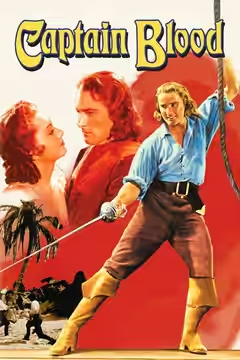
Condemned to hang, Dr Peter Blood looks the judge over and informs him that he is a dying man. It is a small moment about forty minutes into Captain Blood (1935), and it is where Errol Flynn's career starts. He is not defiant and he is not frightened; he finds the proceedings faintly ridiculous and lets us see that he does. Blood is a doctor who never wanted to be a soldier and does not want to be a pirate, and Flynn plays the reluctance as amusement, so the man is charming where another actor would have been a brute. We grinned at him against our better judgement, and we were still grinning when he put on the captain's coat and Korngold's brass came in behind him.
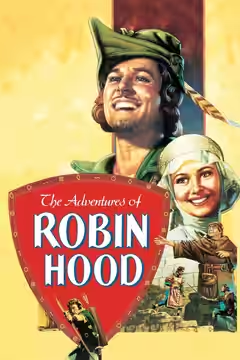
Warner Bros. had cast him in place of Robert Donat, and having found what they had, they used it for a decade. Michael Curtiz directed him ten times, Olivia de Havilland was his romantic lead eight times, and Basil Rathbone was on the other end of his sword three times. The Adventures of Robin Hood (1938) and The Sea Hawk (1940) are the shape of it: a period costume, a rebel with a cause, somebody in authority to defy and a heroine to win while he does it. Raoul Walsh took him on from They Died with Their Boots On (1941), the first of five together, and gave him the boxer James J. Corbett in Gentleman Jim (1942), the film most often produced when someone argues he could do more. At the end there is Mike Campbell in The Sun Also Rises (1957), a man coming apart. We have not reviewed those and will not judge them here.
What he could do was move. He fenced as if it were a dance he had been asked to lead, and in the surf on that beach in Captain Blood, with Ernest Haller and Hal Mohr putting the light on the water behind him and George Amy cutting so we see each exchange whole, it is a pleasure to watch. Rathbone was plainly the better swordsman and made Flynn look good, which is a gift. What Flynn could not always do, early on, was stand still and feel something for the camera; the talky first forty minutes of Captain Blood show it, and The Charge of the Light Brigade (1936) has been accused of the same. The studio noticed and kept him in the coat. He noticed too: "I had by now made about forty-five pictures, but what had I become? I knew all too well: a phallic symbol."
Start with Captain Blood. Doze through the trial and wake for the beach. The grin has not dated; the speeches around it have.
Biography
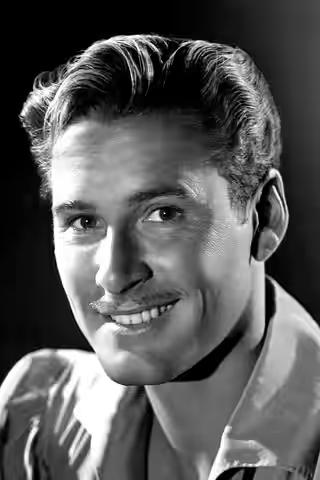
Errol Leslie Thomson Flynn (20 June 1909 – 14 October 1959) was an Australian-American actor. Born in Hobart, Tasmania, he began acting in England with the Northampton Repertory Company and appeared in a few British films before signing with Warner Bros. in 1935.
Flynn’s breakthrough came when he replaced Robert Donat as Dr. Peter Blood in Captain Blood (1935), directed by Michael Curtiz and co-starring Olivia de Havilland. He went on to star in swashbucklers and westerns for the studio, including The Charge of the Light Brigade (1936), The Adventures of Robin Hood (1938), Dodge City (1939), The Sea Hawk (1940) and They Died with Their Boots On (1941). He appeared with de Havilland in eight films.