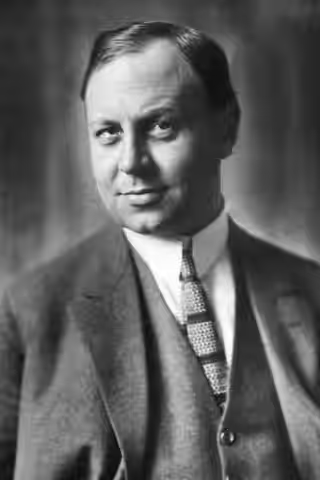
Jannings played proud men and let us watch them come apart, by age, love or humiliation, with a face that did what title cards could not. The 1920s German silents are the case for him; the one film of his we have reviewed is lost.
Fi1m perspective
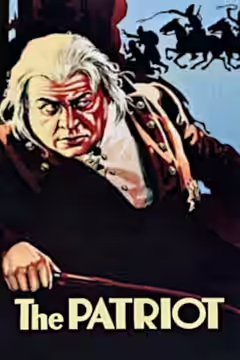
In the surviving trailer for The Patriot (1928) there are a few seconds of Emil Jannings as Czar Paul I: the body slumped and heavy, the eyes quick and frightened and somewhere else, a man listening for footsteps in a room where nobody is walking. It is almost all that is left of the film. It is also a fair summary of what he did for a living. Jannings played men with authority, a czar, a general, a professor, a hotel doorman, and then he let us watch the authority go. In a cinema without spoken lines, he showed what a man was thinking by what his body did while he thought it.
He came to film from Max Reinhardt's Berlin company, with a debut in 1914 and a breakthrough in 1919 as Louis XV in Ernst Lubitsch's Madame Dubarry. The 1920s in Germany were the great stretch. The Last Laugh (1924), as the doorman demoted and humiliated, made his name abroad; Variety (1925) gave him Boss Huller, jealous and tragic; Faust (1926) gave him Mephisto in a major Murnau production. He made three films with F. W. Murnau and three with Pola Negri. Paramount then took him to Hollywood from 1927 to 1929, where he worked three times with Josef von Sternberg, notably as a Russian general in The Last Command (1928), and where he made The Patriot with Lubitsch, one of their four films together. When sound arrived he went back to Germany and played Professor Immanuel Rath opposite Marlene Dietrich in The Blue Angel (1930).
The method was collapse played beneath a grand exterior, and at its best it was done quietly. The release notices for The Patriot describe a mad Czar played without ranting, and in the trailer you can see it. It did not always hold. Even in Faust he is found lapsing into the theatrical hamminess of the period, and an actor that large on screen has nowhere to hide when he overdoes it. We watched those few seconds of Paul twice and felt something close to bereavement, which is not what publicity material usually does to us. All three of the 1928 reviews we have read single him out above everything else in the film, and the film is gone. Our 72 is for what can be seen.
The pattern is clear enough without it. Give Jannings a man who has something to lose and a director, Murnau, Sternberg or Lubitsch, who will hold the shot while he loses it, and you get the performances his reputation rests on. We have reviewed one of his films and cannot watch it. The rest you can, and we would begin with the doorman.
Biography
Emil Jannings was a Swiss-born German actor. Born Theodor Friedrich Emil Janenz on 23 July 1884 in Rorschach, Switzerland, he began his career on the stage before moving into film in the 1910s. He appeared in silent films directed by F. W. Murnau, including The Last Laugh (1924) and Tartuffe (1925), and played Mephisto in Faust (1926).
Jannings worked in Hollywood from 1926 to 1929 under contract with Paramount. He received the first Academy Award for Best Actor in 1929 for his performances in The Way of All Flesh (1927) and The Last Command (1928). He also appeared as Czar Paul I in The Patriot (1928).
After returning to Germany, Jannings continued to act in films, including The Blue Angel (1930). During the Nazi period he took leading roles in state-commissioned films and was named an Artist of the State by Joseph Goebbels. His career ended after 1945 following denazification proceedings; he died on 2 January 1950 in Strobl, Austria.