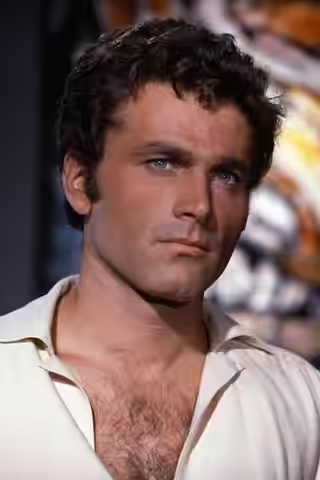
Nero's gift is stillness with good posture: he says the line as if he has said it a thousand times and never needed to raise his voice. In Italy that was the character; in Hollywood it has too often been the whole part.
Fi1m perspective
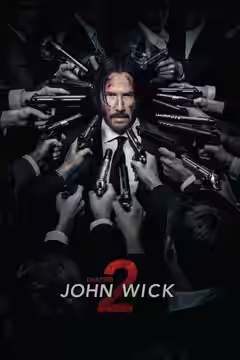
In John Wick: Chapter 2 (2017) Keanu Reeves walks into the Roman Continental and Franco Nero, as its manager Julius, asks whether he has come for the Pope. It is one line. Nero plays it as hotel management rather than menace: a man in a good suit who has had worse guests and would rather not have the trouble. We grinned, and for a moment we felt oddly safe in that lobby, which is what a hotelier is for. That is what he does now, in his eighties. He arrives, he is handsome and unbothered, he says the thing as if he has been saying it since 1966, and he leaves.
He has, more or less. Small parts from 1962 led to Django for Sergio Corbucci in 1966, and the next decade was dozens of Italian westerns, poliziotteschi and gialli, with Enzo G. Castellari and Damiano Damiani among the directors who kept calling him back. Between them he did other things. Camelot (1967) gave him Lancelot and his first major English-language part; The Day of the Owl (1968) put him in a police captain's uniform in an early mafia drama; Tristana (1970) put him in front of Buñuel. That is the career in miniature: a popular film, then something for a serious director, then back to the popular film, in two languages, for sixty years and more than two hundred credits.
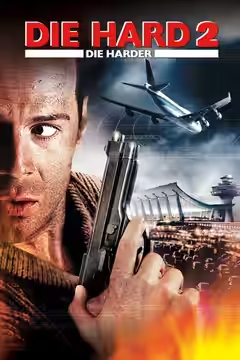
The English-language parts have been the thinner half. In Die Hard 2 (1990) his General Esperanza is a cigar and an accent, and the film never asks for more. His English was limited in the early international films, which cost him work, and once directors had decided what he was for they kept sending the same thing; Keoma (1976) and the westerns like it were the trade and the trap together. He has said that Laurence Olivier told him, "if you want to be an actor, change roles all the time, risk a lot in your career." The Italian filmography suggests he listened. The American one suggests nobody over there was told.
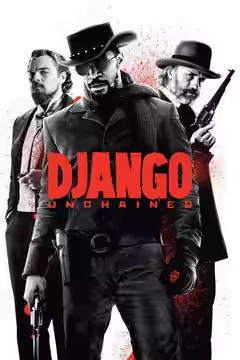
What survives is the face. The blue eyes and the athletic frame that made him a lead in the sixties have settled into a weathered authority, and directors now use him the way you would use an old building: put him in the shot and the shot is older and more serious. Quentin Tarantino knew it in Django Unchained (2012), where Nero appears as Amerigo Vessepi for a scene that exists so the first Django can look at the new one. He was still at it in The Pope's Exorcist (2023).
The Hollywood films use him as furniture, handsome and Italian and briefly present. If that is all you have seen of him, go back to Django and find out what the furniture used to do.
Biography
Franco Nero is an Italian actor born on 23 November 1941 in San Prospero Parmense, Emilia-Romagna. He made his film debut in the early 1960s and achieved international recognition with the title role in the Spaghetti Western Django (1966).
Over a career spanning more than six decades, Nero has appeared in over 200 films and television productions, including roles in Camelot (1967), The Mercenary (1968), Companeros (1970), Die Hard 2 (1990) as General Ramon Esperanza, Letters to Juliet (2010), Cars 2 (2011), John Wick: Chapter 2 (2017) as Julius, and The Pope's Exorcist (2023). He has also worked as a producer and director.
Nero has been in a relationship with actress Vanessa Redgrave since they met on the set of Camelot; they married in 2006 and have a son, actor Carlo Gabriel Nero.