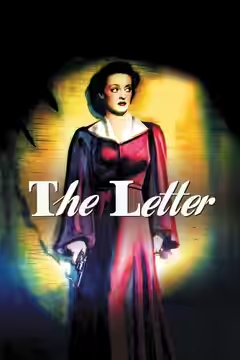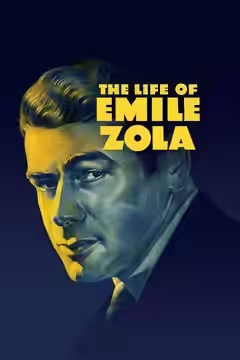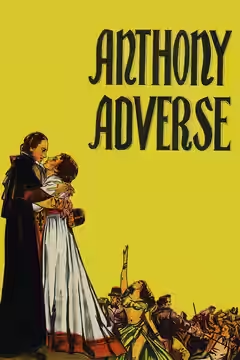
Sondergaard stood still and said little, and for a decade of studio pictures that was enough to make her the most watchable person in the frame. She was cast as the villainess so often that audiences forgot she could do anything else.
Fi1m perspective
In Anthony Adverse (1936), her first film, Sondergaard's Faith Paleologus stands still in doorways and says less than anyone else in the picture, and the eye goes to her anyway. That was the trick, and she kept it. Most screen villains of the period announce themselves; Sondergaard waits, watches and lets the other actors talk, so that by the time she speaks everyone else in the scene has already gone quiet for her. It is a stage actor's stillness, learned with the Theatre Guild and on Broadway before Hollywood found her.
Hollywood saw what she could do and then asked for one thing only. Through the late 1930s and the 1940s she played the exotic, the sinister and the cunning: the scheming wife, the woman in the corner who knows too much. The Letter (1940) has her as Mrs Hammond, silent and threatening opposite Bette Davis, and it is the performance people kept. The Spider Woman (1943) set her against Sherlock Holmes as Adrea Spedding and did well enough to get a follow-up. She was called the Queen of the Heavies, and the title stuck harder than the other parts did. She played Lucie Dreyfus, the loyal wife, opposite Paul Muni in The Life of Emile Zola (1937), and Lady Thiang in Anna and the King of Siam (1946). Those are the roles audiences forgot.
We will own up about Anthony Adverse. The film is a handsome muddle that keeps the furniture of the novel and loses the story, and we watched her whenever she was on and waited for her when she was not, because she was the only person in it who seemed to know something the rest of the cast did not. Claude Rains is the other reason to stay, and Korngold's score is grander than the picture under it, but Sondergaard is what makes the first act worth the evening. In Zola, by contrast, she is one good actor among many in a film cast well down to the smallest part, and Dieterle does not ask her to carry any of it. It is the better film. It is not where you go to watch her, and we mean that as a note, not a complaint.
Then, in the early 1950s, the work stopped. She was barely on screen for about twenty years, and when she returned, from the late 1960s until the early 1980s, it was in occasional film and television parts rather than the studio pictures that had made her name. Whatever the middle of that career might have held, we did not get it. Start with Anthony Adverse; give it your attention while she is on screen and let it wander when she is not. Then find The Letter, which is the one everybody remembers, and see whether they were right.
Biography
Gale Sondergaard was an American actress. She began her career in theatre before making her film debut in 1936.
She won the first Academy Award for Best Supporting Actress for her role as Faith Paleologus in Anthony Adverse (1936). She appeared in supporting roles in films including The Life of Emile Zola (1937), The Cat and the Canary (1939), The Mark of Zorro (1940) and The Letter (1940), and received a second Oscar nomination for Anna and the King of Siam (1946).
Married to director Herbert Biberman, she supported him during the Hollywood blacklist of the early 1950s, after which her film work was limited until occasional appearances from the late 1960s. She died on 14 August 1985.