Film review

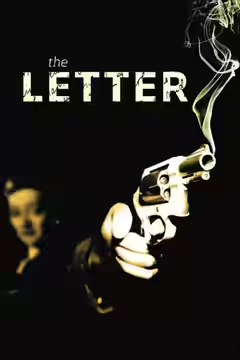
The Letter

1940 · Directed by William Wyler · 1h 35m · MPA NR

In a sentenceBette Davis empties a revolver before the credits have settled, then sits down quietly to her lace

CrimeDrama

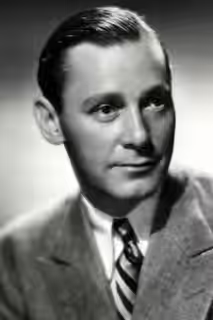
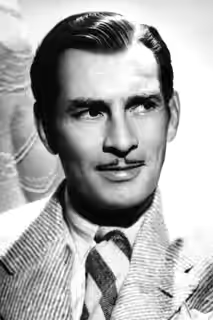
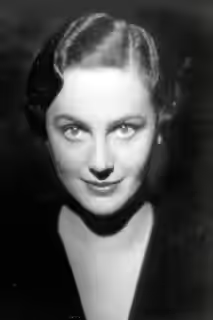
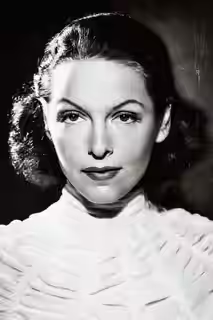
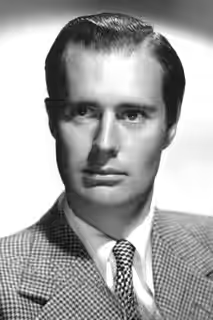
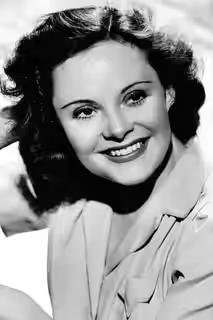
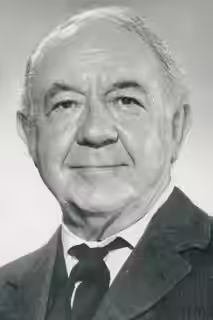
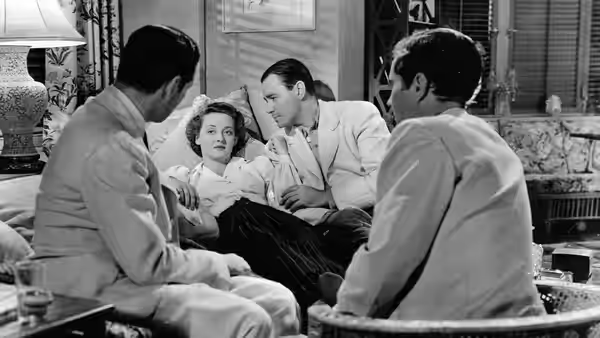
Malaya, on a rubber plantation outside Singapore. On a hot night with the moon behind cloud, Leslie Crosbie (Bette Davis) walks out onto her veranda and fires six shots into a planter named Hammond, the husband of Mrs. Hammond (Gale Sondergaard). Her account is simple: he came to the house drunk while her husband Robert (Herbert Marshall) was away and tried to force himself on her. Robert believes every word. So, at first, does the family lawyer Howard Joyce (James Stephenson), who takes the case expecting an easy acquittal. Then his clerk Ong Chi Seng (Victor Sen Yung) mentions, with great politeness, a letter in Leslie’s hand, written to Hammond on the day he died, asking him to come to her that night. The widow has it, and she is prepared to discuss terms.

Fi1m review

William Wyler’s adaptation of Maugham opens with one of the great first shots and keeps its nerve for most of 95 minutes. Bette Davis lies beautifully, James Stephenson carries the middle, and only the last few minutes let the studio in.

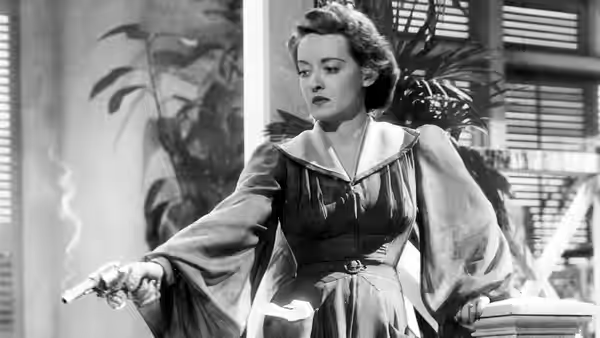
William Wyler opens The Letter with a shot we have never quite shaken. The camera drifts along a rubber plantation at night: sap dripping into a cup, workers asleep in hammocks, a cockatoo on a rail. A shot rings out, a man staggers onto a veranda, and Bette Davis follows him out and keeps firing until the gun is empty. The moon comes out from behind a cloud as if to see what she has done. Nobody has said a word. That is the murder, and the film is about the ninety minutes of talking that follow it. It is very good, and it is good in the way that Wyler’s best work is good: quiet, exact, and unimpressed by its own star.

The story is Somerset Maugham’s, from his play, and Howard Koch’s screenplay keeps its shape. Leslie Crosbie says a neighbour tried to rape her and she shot him in self-defence. Her husband Robert (Herbert Marshall), a decent, tired man who has been on the estate too long, believes her without needing to think about it. Their lawyer Howard Joyce (James Stephenson) believes her too, until a letter surfaces that she should not have written, and the dead man’s widow (Gale Sondergaard) turns out to own it. From there the film is a negotiation, and Wyler shoots negotiations better than most directors shoot gunfights.

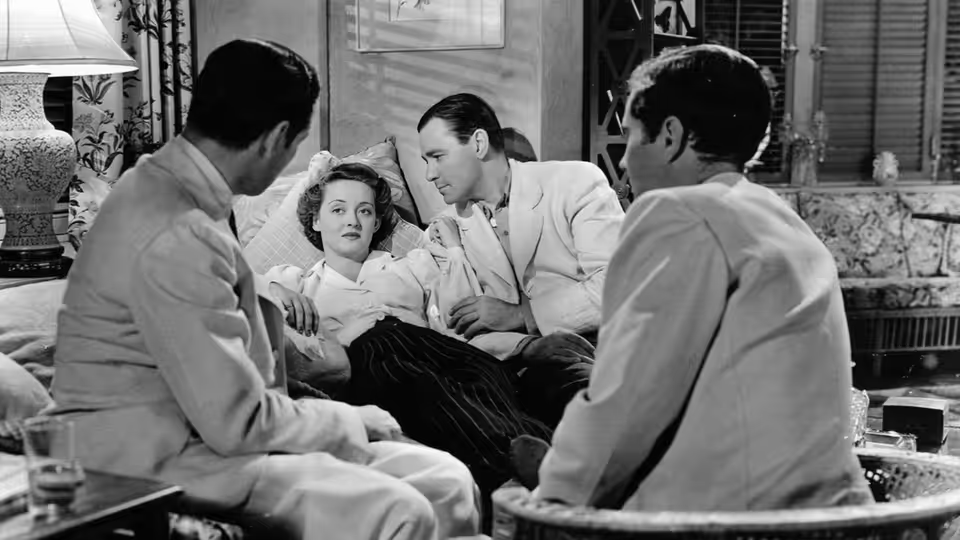
Tony Gaudio does the moonlight. It comes through slatted blinds and lies across Davis in bars, and whenever she is about to lie the light seems to find her face and hold it there. The plantation house is all shutters and shadow; the Chinese quarter, where Joyce goes to buy the letter back, is a beaded curtain, a smoky curio shop and Sondergaard waiting behind it. We found that scene properly unsettling, and it is almost silent: Mrs. Hammond makes Leslie stoop to pick the letter off the floor, and Gaudio lights only the widow’s eyes. Max Steiner’s score is at its best here, held down to a few notes. Elsewhere it swells every time Davis crosses a room, and the film would be stronger with half of it.

Davis is doing something difficult. Leslie is a woman who has rehearsed her story and knows it is being believed, and Davis plays the pleasure of that as well as the fear. Between scenes of testimony she sits and makes lace, and the lace becomes a way of not looking at anyone. Stephenson, though, is the surprise. Joyce is a lawyer who discovers his client is guilty and decides to help her anyway, and Stephenson plays the decision as a slow physical collapse: shoulders first, then voice. When he tells his wife Dorothy (Frieda Inescort) that everything is fine, we did not believe him either.

Marshall is asked to be dull and loyal and manages both without ever being boring. Victor Sen Yung, as the clerk Ong Chi Seng, is the film’s sharpest instrument, smiling through every sentence and never once saying what he means. Sondergaard, an American actress in heavy make-up as a Eurasian widow, has two scenes and almost no lines; it is period casting, and we note it plainly, and she is still the most frightening person on screen. Orry-Kelly dresses Leslie in white throughout, which is either a joke or a judgement.

The complaints are two. The middle stretch is talky, with Davis off screen for long runs while men in linen suits discuss her in offices; some critics have found this a failure of nerve, and it is fair to say the film is more interested in Joyce than in his client for a while. And the final minutes are arranged to satisfy the censors of 1940 rather than the story, which we will not describe except to say that Maugham did not end it that way and Wyler plainly knew it. Warren Low and George Amy cut the rest with patience; the ending they cut fast, as if to be done with it.

Wyler had directed Davis in Jezebel (1938) and would do so again in The Little Foxes (1941), and this is the tightest of the three. It runs 95 minutes and carries a PG, though there is a shooting before the title and a great deal of adult behaviour after it. Watch it late, with the lights off, and forgive it the last five minutes. The first one is worth it.
Critical consensus AI synthesised

69
Positive
5
Mixed
0
Negative
1

Most critics take to The Letter, and the praise gathers around two things: William Wyler’s direction and Bette Davis. The reviews describe a brooding, taut melodrama and credit Wyler’s control of atmosphere for holding the mystery together, with the production values noticed even by those who find it grim. Davis’s Leslie Crosbie is the performance singled out most often, and her confession scene is mentioned more than once as the point where the calculation and the passion meet. James Stephenson, as the lawyer, draws steady admiration too, and Gale Sondergaard is noticed.

The reservations concern the ending and the source. Two reviews, one of them written on release, find the finale weakened, with censorship named as the cause in one and the play’s contrivances in the other. The spread is wide: five positive verdicts against one, but that one, Slant Magazine, is firmly negative, arguing that the lawyer takes up too much of the running time and that Davis is sidelined for long stretches of talk.

Film Comment
1 January 2016 · Steven Mears
90*

The critic views Wyler's 1940 adaptation as the best-remembered moody, noirish melodrama, with Bette Davis at the peak of her powers as the duplicitous Leslie Crosbie. They single out the climactic confession scene, where Davis's performance conveys calculated cruelty and unrepentant passion.

Read the full review →
Time Out
10 September 2012 · TM
75*

A superbly crafted melodrama praised for Wyler's technical expertise and strong performances, particularly Bette Davis and James Stephenson, though it notes contrivances from the source play and a weakened finale, plus issues with the soundtrack.

Read the full review →
The New York Times
23 November 1940 · Bosley Crowther
70*

The critic praises William Wyler's direction for creating taut suspense and a brooding atmosphere in this melodrama about a woman who kills her lover. He singles out the strong performances, especially James Stephenson as the lawyer, but notes the weak ending imposed by censorship.

Read the full review →
Variety
31 December 1939 · Variety Staff
70*

Praises the production values, cast, and Wyler's direction, despite the grimness. Highlights the mystery plot and strong performances by Stephenson and Sondergaard.

Read the full review →
Slant Magazine
13 June 2005 · ★/4 · Jeremiah Kipp
25

The critic finds the film disappointing overall despite strong opening and closing sequences and a compelling Bette Davis performance. He singles out the excessive focus on the lawyer character and talky scenes that sideline Davis for much of the runtime.

Read the full review →
Collider
16 April 2025
90*

The piece presents The Letter as a haunting murder mystery with an ominous atmosphere and wild intensity, highlighting Bette Davis's alluring performance as a cold, calculated killer who is also a master manipulator.

Read the full review →

Cast

Awards

Academy Awards, 1941

Nominated
Best Actress
Nominated
Best Cinematography, Black-and-White
Nominated
Best Director
Nominated
Best Film Editing
Nominated
Best Original Score
Nominated
Best Picture
Nominated
Best Supporting Actor

If you liked this, try…

The Little Foxes poster

The Little Foxes

1941 · Wyler and Davis again, this time with a family worth killing for

Double Indemnity poster92

Double Indemnity

1944 · Another confession told in the dark by someone who enjoyed it

Black Narcissus poster88

Black Narcissus

1947 · Colonial heat, repression and one woman coming apart, in colour this time

Ossessione poster

Ossessione

1943 · Italian lovers, a murder and a marriage that will not stay buried

Leave Her to Heaven poster

Leave Her to Heaven

1945 · Gene Tierney lies as sweetly as Davis, in the brightest Technicolor