George Arliss brought a stage-trained pause to the first years of sound, playing statesmen who win by being amused. It is one trick, done with precision, and Disraeli (1929) shows both how well it works and how quickly the films around it date.
Fi1m perspective
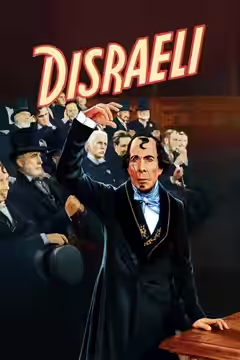
Watch what George Arliss does with a line he knows is good. The head tilts, the eyes half close, a hand comes up and waits, and the sentence arrives a beat after everyone around him expected it. He does not hit the epigram; he lets the other actors react to it and takes the credit afterwards. In Disraeli (1929), when he talks a reluctant banker round without raising his voice, we found ourselves leaning in, which is not something a fixed camera and a photographed play usually manage.
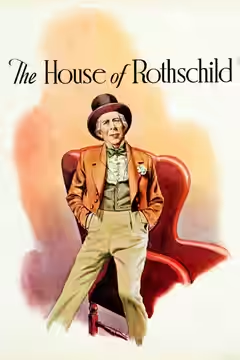
That trick was forty years in the making. Arliss started on the stage in 1887, reached the West End by 1900 and Broadway by 1902, and became a star in 1908 with The Devil. From 1911 he toured in the play Disraeli, so that by the time Warner Bros. put a microphone in front of him he had been placing those pauses for the better part of two decades. He had made silent films from 1921; sound found him at 61 and suited him, and he made roughly twenty talkies, mostly for Warner and later for 20th Century, until the mid-1930s. Nearly all of them were historical portraits or domestic comedies about wise, unhurried old men: The Green Goddess (1930), The House of Rothschild (1934), The Iron Duke (1934), Cardinal Richelieu (1935), with Voltaire among them.
The usual complaint is that he is hammy, all expansive gesture and stage-bound habit, and the usual praise is that his theatrical precision was exactly what early sound needed. We are closer to the second view. In Disraeli the gestures are small; the ring on his finger and the curl on his forehead are used as props, and the point of each scene is how little he does while everyone else does a great deal. The parts, though, were few and alike, and a man who is always the cleverest person present can start to seem pleased about it. Ivan Simpson turns up in support again and again, John G. Adolfi directed several of the later films, and Darryl F. Zanuck produced him at both studios, so the machine around him barely changed.
What surprised us was the marriage. Florence Arliss plays Lady Beaconsfield opposite her husband, and the two have the ease of people who have shared a breakfast table for decades; a late scene between them, played almost without gesture, moved us more than any of the statecraft, because for once nobody in the frame is performing. It is the one place the film stops being a stage. Come to Arliss for that scene and for the pauses. The films themselves, stiff in the legs and thin in the subplots, are the price of admission, and it is worth paying once.
Biography
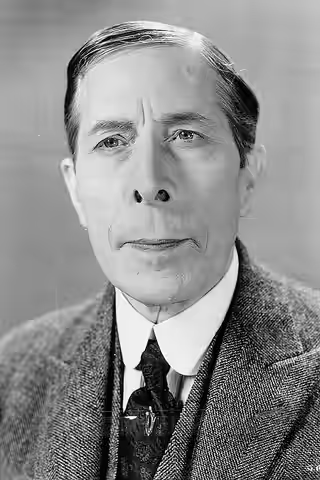
George Arliss (born Augustus George Andrews; 10 April 1868 – 5 February 1946) was an English actor, author, playwright and filmmaker. He began his career on the London stage in the late nineteenth century before moving to the United States, where he became a star of Broadway and later films.
Arliss is best known for playing Benjamin Disraeli in the 1929 Warner Bros. film Disraeli, a role he had originated on stage in 1911 and reprised in a 1921 silent version. He won the Academy Award for Best Actor for the sound film, the first British performer to receive the award. He appeared in other historical biopics such as Voltaire (1933) and Cardinal Richelieu (1935), as well as The House of Rothschild (1934). His wife, Florence Arliss, often acted opposite him.