A theatre director of long standing who films the way he stages: trust the actors, trust the words, keep the camera out of the argument. It gives us performances we remember and pictures we mostly do not.
Fi1m perspective
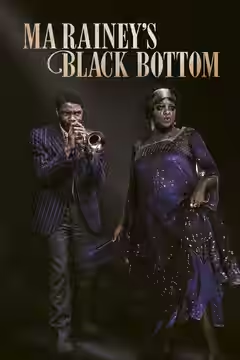
In Ma Rainey's Black Bottom (2020) the camera has a habit. An actor begins a speech, and the shot settles and waits for him to finish. Wolfe is not being lazy; he is being polite. He spent decades in the theatre learning that when the words are good enough the director's job is to stay out of their way, and August Wilson's words are good enough. The result is a film we gave 69: two great performances, one small room, and little that only a camera could have told us.
He was a man of the stage first and for a long time. He wrote The Colored Museum (1986), a satirical revue of Black American stereotypes that got him noticed and got him argued with; he wrote and directed Jelly's Last Jam (1992), about Jelly Roll Morton; he directed the first Broadway production of Angels in America: Millennium Approaches (1993); and he ran the Public Theater in New York from 1993 to 2004, where he made Bring in 'da Noise, Bring in 'da Funk (1996). Film arrived in his fifties, with Lackawanna Blues (2005), from Ruben Santiago-Hudson's play, then Nights in Rodanthe (2008), You're Not You (2014) and The Immortal Life of Henrietta Lacks (2017), which he also wrote. He went back to Santiago-Hudson, this time as screenwriter, for Ma Rainey's, and to Black history for Rustin (2023), about the civil rights organiser Bayard Rustin. He has never left the stage.
What he does well on screen is what he did well in a rehearsal room. He has said: "I love how people use language to reveal themselves. I also love how people use language to conceal who they really are." His films are built around long stretches of talk in which both happen at once, and actors respond to that attention. Chadwick Boseman and Viola Davis do two different kinds of great work in Ma Rainey's. The craft around them is sound and modest: Tobias A. Schliessler lights the basement yellow and close and the studio upstairs pale and cool, Mark Ricker builds a room that makes grown men feel like boys kept after school, and Ann Roth dresses them. The passages we remember are the recording takes, with Branford Marsalis's tight period brass, because they are really arguments about whose version gets made, and we were tenser through each of them than through any of the speeches.
His films are often described as more conventional than his stage work, and on the evidence we have we agree. Wolfe rarely finds a shot that says something the words have not. Going up the stairs in Ma Rainey's feels like surfacing, and that is close to the only image in the film that does its own talking. The rest waits. Nights in Rodanthe had a mixed reception and we have not reviewed it, so we will leave it there.
See him with actors and a text he respects, and do not expect the camera to join in. He has said he reduces everything to storytelling. We would like, once, to see him let the camera tell some of the story.
Biography
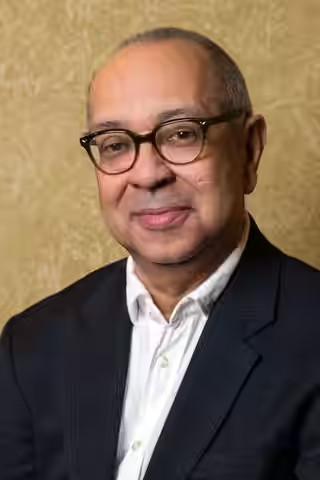
George C. Wolfe is an American director, playwright and producer of theatre and film. Born in Frankfort, Kentucky, he is known for his work on Broadway and for directing several feature films.
Wolfe won Tony Awards for directing Angels in America: Millennium Approaches in 1993 and Bring in 'da Noise, Bring in 'da Funk in 1996. His film credits include Ma Rainey's Black Bottom (2020), You're Not You (2014), Nights in Rodanthe (2008), Rustin (2023) and The Immortal Life of Henrietta Lacks (2017).