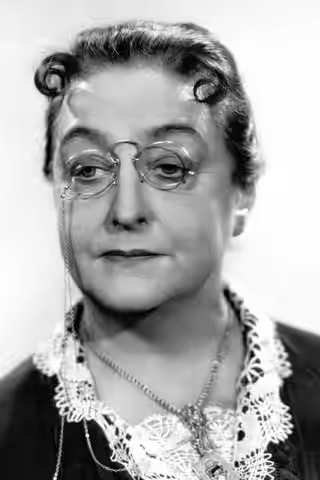
A stage lifer who came to Hollywood at 59 and was handed the same stern old woman nearly thirty times. She played her with more voice and more spite than the parts deserved, and in The House of Rothschild she is the one thing the casting got right.
Fi1m perspective
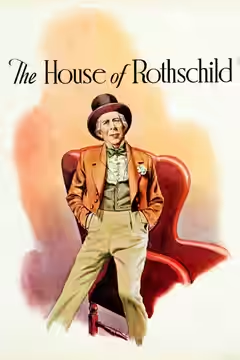
In The House of Rothschild (1934), George Arliss hides the family's coins under the floor and Helen Westley, as his wife Gudula, hurries the children into their places. It is a small piece of business and she does it as if she has done it a hundred times, because Gudula has. The rest of the Rothschilds are played as English gentry from the moment they leave Frankfurt; Westley keeps the ghetto in her voice for the whole picture, and we found ourselves watching her at the edge of the frame rather than the men in the middle of it, with something like relief. She was the only person on screen who seemed to remember who these people were supposed to be.
She was 59 when she made it, and it was more or less her first film. Behind her lay four decades of theatre: stock, vaudeville, a New York debut in 1897, and then the Washington Square Players and the Theatre Guild, which she helped found and sat on the board of for fifteen years while appearing in more than forty of its productions, Shaw and O'Neill and Chekhov among them. Hollywood took one look and saw a dowager. Over the next eight years, until her death in 1942, she made nearly thirty films, and in most of them she is somebody's aunt, mother-in-law or landlady, disapproving of the young.
The parts were mostly the same part. Parthy Hawkes in Show Boat (1936), the title role in Roberta (1935), Blind Anna in Heidi (1937) and three more films with Shirley Temple, Aunt Sophie in Alexander's Ragtime Band (1938): matriarchs and meddlers, with a softer centre permitted for the children's pictures. Our own review of Alexander's Ragtime Band does not mention her, which is fair to the film, since Alice Faye and Ethel Merman carry it and Berlin's songs carry them, and a little hard on Westley, whose job there was to be the stern aunt and keep out of the songs' way.
What she brought to these women was force, and a stage actor's refusal to be quiet at the back of the shot. The complaint about her, on stage and then on screen, was that she played hags and harridans, and the complaint is not wrong. But a harridan played with full conviction is worth more than a sweet old thing played with none, and the 1930s studio picture needed somebody in the corner who plainly did not approve of the plot. That is what she was for.
If you want to see what the theatre lost when the studios found her, The House of Rothschild is the place, for the Frankfurt scenes before the family goes respectable. After that she is mostly somebody's aunt. She is a good aunt.
Biography
Helen Westley (born Henrietta Remsen Meserole Manney) was an American character actress of stage and screen. She trained at the American Academy of Dramatic Arts and began her career in stock theatre and vaudeville before becoming one of the founders of the Theatre Guild, serving on its board for many years.
Westley appeared in original Broadway productions including Green Grow the Lilacs (1931) and Eugene O'Neill's Strange Interlude. She moved to film in 1934 and played supporting roles in The House of Rothschild (1934) as Gudula Rothschild, Death Takes a Holiday (1934), Roberta (1935), Show Boat (1936) as Parthenia Hawkes, Heidi (1937), and All This, and Heaven Too (1940). She retired in 1942 and died later that year.