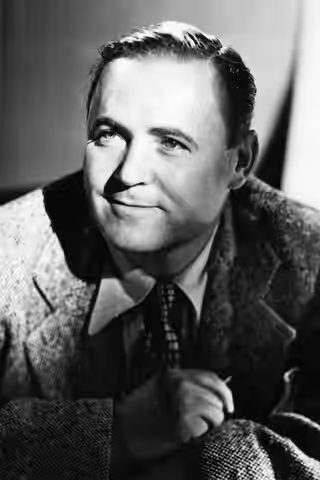
Hathaway made westerns, adventures and thrillers for four decades without fuss. The films are brisk, handsome and plainly told; the best are worth an evening, and none of them asks to be thought about afterwards.
Fi1m perspective
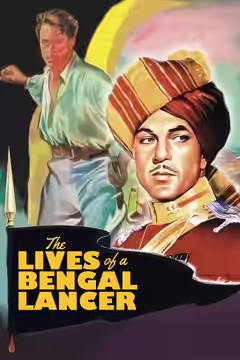
In The Lives of a Bengal Lancer (1935), three officers hold a fort on the North-West Frontier and a chieftain in the hills wants their ammunition. That is the whole film, and Hathaway tells it in that order, without a scene he does not need. Cooper and Tone squabble, the hills fill with riders, and it ends. We enjoyed the squabbling more than the fighting, because the two of them play officers who have been posted together too long and cannot leave each other alone, and it is the one thing in the picture that looks lived in rather than built. The Empire the fort is there to defend never comes into it. Hathaway did not look out of windows the script had not pointed at.
He learnt the trade the old way: a child actor under Allan Dwan, then property man and assistant director to Victor Fleming and Josef von Sternberg, and he began directing in 1932 with cheap Randolph Scott westerns at Paramount. Bengal Lancer was the breakthrough, and for the next two decades he moved between Paramount and Fox making westerns and adventures and, after the war, a run of thrillers shot in real places with an eye for how the work is actually done: The House on 92nd Street (1945), Call Northside 777 (1948) with James Stewart, Niagara (1953), which was Marilyn Monroe's breakthrough. From the late 1950s he was John Wayne's director as often as anyone's, six films in all, among them True Grit (1969), and he directed most of How the West Was Won (1962). His last film was Hangup (1974).
The habit ran the whole career. Hathaway liked big men in open country, and he cut a charge or a chase so that you always knew where everyone was, which sounds a small thing until you have sat through a film where you do not. Gary Cooper made five pictures with him, Tyrone Power four, Wayne six. After the war the plainness became a method: real streets, real offices, procedure followed to the letter, so that the thrillers of the late 1940s look like case files. It is the most distinctive thing he did, and the thing he is least often credited with.
The case against him is that he never complicated anything, and it is true. He has had little serious attention from critics, and we can see why: there is no theme to trace, no shot that announces itself, no film that turns on what its maker thought about the world. He was a journeyman, in the exact sense that he turned up and did the job, and that is a rarer skill than the word suggests. Start with Bengal Lancer, for Cooper and Tone, and do not expect it to ask what you think of the Empire.
Biography
Henry Hathaway (1898–1985) was an American film director and producer whose career spanned the 1930s to the 1970s. He began as a child actor in Westerns and later worked as an assistant director before making his feature debut with Heritage of the Desert (1932).
Hathaway directed numerous Westerns and adventure films, including The Lives of a Bengal Lancer (1935), for which he received an Academy Award nomination for Best Director; How the West Was Won (1962); True Grit (1969); The Sons of Katie Elder (1965); and Nevada Smith (1966). He frequently collaborated with actors such as John Wayne and Gary Cooper.