Jacques Demy repainted real French port towns in sweet-shop colours, had people sing about love and filling the tank, and made films about chance and separation that are sadder than they look. We rate him highly, and The Umbrellas of Cherbourg is where to start.
Fi1m perspective
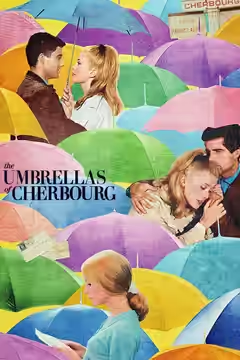
In The Umbrellas of Cherbourg (1964) a customer asks a mechanic to fill the tank, and he sings it. Nobody in the film finds this odd, and after a few minutes neither did we. That is Demy's method in one scene: take an ordinary Channel port, repaint the shopfronts so they match the wallpaper and the frocks, then let the people inside behave as if life really were this heightened. He told an interviewer in 1964, "I'm trying to create a world in my films," and it remains the plainest description of the work.
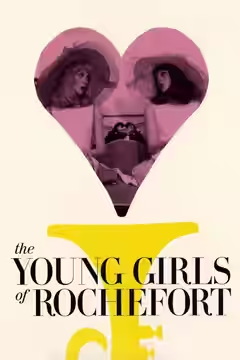
The world was built over three decades. Lola (1961), his first feature, set the pattern: a port town, a chance meeting, a woman waiting, and a character called Roland Cassard who would turn up again in later films. Umbrellas followed, every line sung, no dance numbers, no chorus. The Young Girls of Rochefort (1967) went the other way, with dance sequences, Gene Kelly and an open debt to the American musical. Then came a spell in America with Model Shop (1969), a fairy tale with Catherine Deneuve in Donkey Skin (1970), and A Room in Town (1982), an opera-melodrama set during a shipyard strike. His last musical was Three Places for the 26th (1988).
The look belonged as much to his regular team as to him. Bernard Evein designed the sets and Jean Rabier lit them, so that a street in Cherbourg or Rochefort could be a real street and a painted one at the same time, and the camera tracked through it in long takes rather than chopping it up. Anne-Marie Cotret cut for him across the career; in Umbrellas she and Monique Teisseire jump whole months in a single dissolve. Michel Legrand wrote the music for five of the films, and Deneuve appeared in four. Legrand's score for Umbrellas circles a few tunes for 93 minutes, which is our one reservation about it, and we still did not mind.
Umbrellas left us lower than a film that pretty has any right to. The reason is the singing: a girl telling her mother she is pregnant and a man saying goodbye at a station arrive in the same lilting voice as the shopping, so nothing is announced and everything lands late. The war that takes Guy away stays off screen, mentioned in the same breath as the bills. Some critics, then and since, have called that evasion, and have called Demy sentimental and unengaged next to the New Wave directors he started alongside. We think it is how a town talks, and the sadness in his films comes from the things people decline to say out loud.
Most critics find the films after 1970 uneven, and we have not reviewed them, so we will not argue either way. What we can say is that Umbrellas holds. If the singing puts you off in the first ten minutes, stay for the eleventh; by then you will have stopped hearing it as a device and started hearing it as the way these people live.
Biography
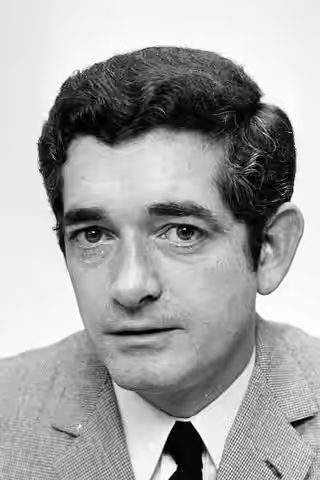
Jacques Demy (5 June 1931 – 27 October 1990) was a French film director and screenwriter. He studied at the Technical School of Photography and Cinematography in Paris, then assisted animator Paul Grimault and director Georges Rouquier. His first feature was Lola (1961).
Demy is best known for the musicals The Umbrellas of Cherbourg (1964) and The Young Girls of Rochefort (1967), both with music by Michel Legrand and starring Catherine Deneuve. Other films include Bay of Angels (1963), Donkey Skin (1970) and A Room in Town (1982). He was associated with the French New Wave.
He was married to director Agnès Varda from 1962 until his death in Paris.