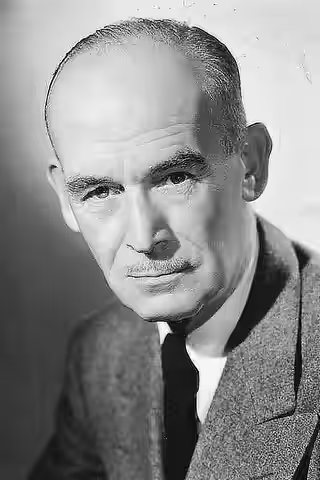
A balding, craggy-voiced New Yorker who spent thirty years playing managers, editors and drivers who talk tough and give in, James Gleason was a listener before he was anything else. Watch him hear something impossible and decide, slowly, to believe it.
Fi1m perspective
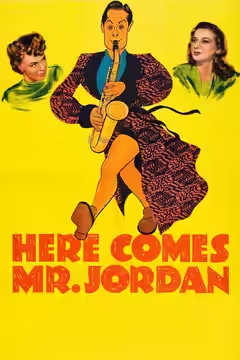
Watch what James Gleason does when someone tells him something he cannot believe. He does not react; he hears it, lets it sit, and then it lands, a beat late, on a face built for exactly this. In Here Comes Mr. Jordan (1941) he is Max Corkle, a boxing manager who has cremated his own fighter and is now being asked to accept that the millionaire in front of him is Joe, back from the dead, and then to hold conversations with an armchair in which Claude Rains is invisibly sitting. Gleason takes it in stages, disbelief, panic, drink and finally a sort of exhausted belief, and never once winks at us. When Joe proves who he is by playing the saxophone, Gleason listens like a man hearing a ghost, and we laughed out loud, more than once, because he was so plainly not trying to make us.
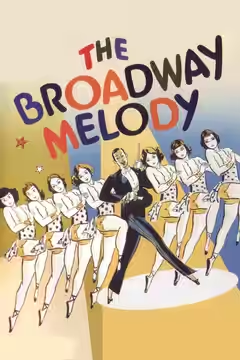
He came to that face by way of the typewriter. Gleason began in the theatre as an actor and a playwright, wrote dialogue for The Broadway Melody (1929) and took a small part in it, and by the end of the twenties had settled into the character work he would do for the next three decades. The parts were managers, editors and drivers, tough talkers from New York who softened in the last reel. He played the hardboiled editor Henry Connell in Frank Capra's Meet John Doe (1941), Lt. Rooney in Arsenic and Old Lace (1944), and ran the Higgins Family comedies from 1938 to 1940 with his wife Lucile and son Russell alongside him. His last role was in The Last Hurrah (1958).
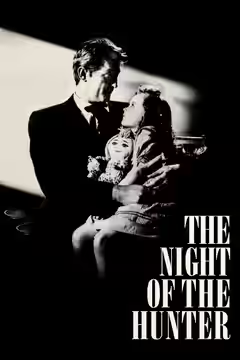
The reservation is the obvious one, and it is more the studios' doing than his. He was almost never the lead, and the type he was handed could have been played on autopilot by the fortieth time. It was not, and the reason is the writing he did first: Gleason spoke vernacular like a man who had put it on paper, so his cynics sound as if they mean the cynicism, which is why the softening costs something when it comes. In The Night of the Hunter (1955), which we rate as one of the strangest and best films fifties Hollywood made, he is Uncle Birdie Steptoe, the kind-hearted man in a picture full of Robert Mitchum's menace. Our review does not single him out, and we will not pretend the part is large. It is the film he is in that matters.
Alexander Hall got the best of him by giving him the most ridiculous thing to believe and all the time he needed to believe it. If you want to see Gleason at work, start with Here Comes Mr. Jordan, and watch the armchair scenes twice. He spent thirty years being the man who has to be told, and the pictures were better for having someone in them who listened.
Biography
James Gleason (1882–1959) was an American actor, playwright and screenwriter. Born in New York City, he began his career in theatre with stock companies in California and Oregon, and appeared on Broadway in plays including several of his own. He served in the US Army during the First World War.
Gleason made his film debut in the 1920s and became a prolific character actor in over 150 films, often in tough-talking roles. He received an Academy Award nomination for Best Supporting Actor for his performance as Max Corkle in Here Comes Mr. Jordan (1941). Other notable roles include Lt. Rooney in Arsenic and Old Lace (1944) and Uncle Birdie Steptoe in The Night of the Hunter (1955). He also wrote screenplays, including for The Broadway Melody (1929).
He was married to actress Lucile Webster Gleason until her death in 1947; their son Russell Gleason was also an actor.