Alexander Hall’s comedy imagines death as a clerical error and heaven as a well-run office, and Claude Rains makes the man in charge so courteous you would trust him with your soul. It is quick, kind and thin where its lovers should be.
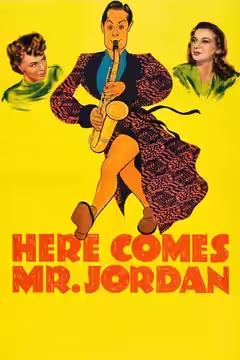
Here is a film that treats death as a clerical matter. Joe Pendleton, a boxer with a saxophone and a pilot’s licence, is lifted out of his crashing plane a moment too soon by a nervous heavenly messenger, and the rest of the picture is the paperwork. Alexander Hall’s comedy, from a script by Sidney Buchman and Seton I. Miller adapted from Harry Segall’s stage play, runs 94 minutes, and most of them are a pleasure. It is kindly, quick and beautifully cast in its supporting parts, and it is thinner in its romance and its lead than its reputation lets on. We recommend it, with those two caveats.
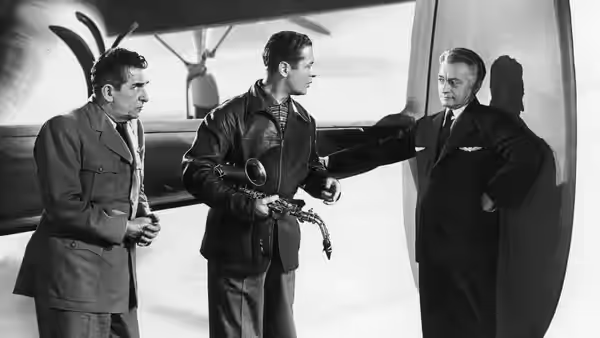
Joseph Walker shoots heaven as a fogbank with an airliner parked in it. There is no horizon, no wall, no floor you can see; the newly dead stand about in overcoats in a soft white glare and wait to board as though at an aerodrome with a delayed departure. It is cheaper than a staircase of clouds and it works better. Back on earth Walker gives the Farnsworth mansion the deep polish of a bank lobby, and Edith Head puts Rita Johnson’s Julia in gowns that gleam like the furniture. Friedrich Hollaender’s score is light and does not insist. Viola Lawrence cuts briskly; scenes end the moment they have made their joke.
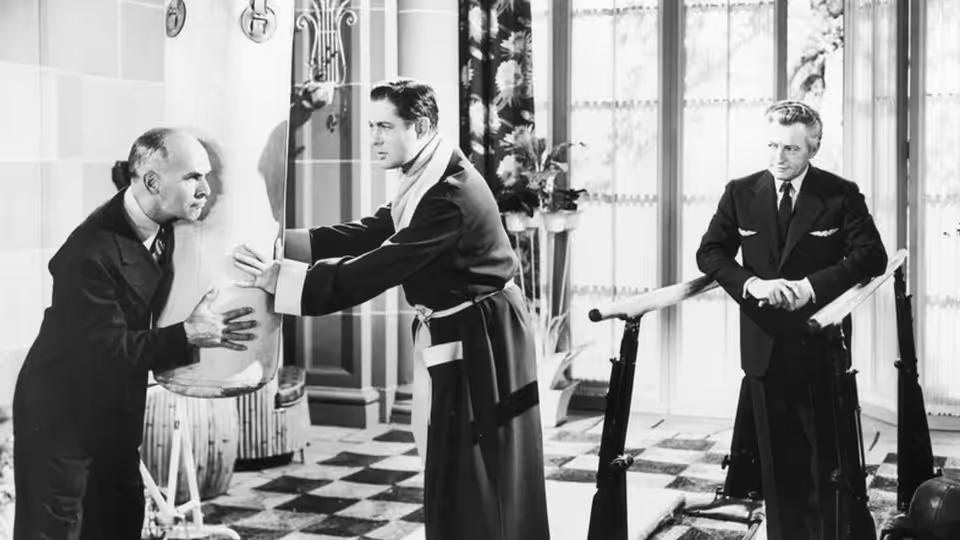
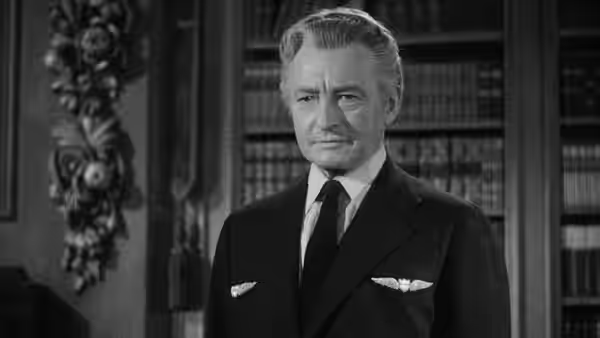
Claude Rains is the reason the film has lasted. Mr. Jordan runs the afterlife, and Rains plays him not as an angel but as the most courteous official you have ever met: unhurried, faintly amused, never once raising his voice, and entirely certain that everything will be put right in the end. He dresses like a bank manager and behaves like one. When he tells Joe that death is nothing to be frightened of, he says it the way a good doctor tells you a tooth will not hurt, and we found ourselves believing him. Not many comedies manage that.
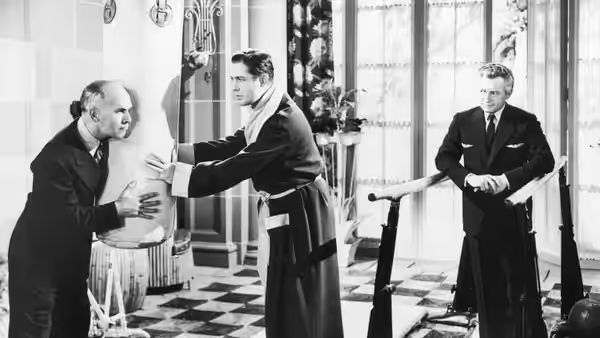
The laughs come from below. Edward Everett Horton’s Messenger 7013 is a fussing, wounded bureaucrat who has made one mistake in a very long career and cannot stop apologising for it. James Gleason’s Max Corkle, the manager who has cremated his own fighter, is asked to accept that the millionaire in front of him is Joe, and then to hold conversations with an armchair in which Mr. Jordan is invisibly sitting. Gleason plays every stage of this, disbelief, panic, drink and finally a sort of exhausted belief, without once winking at us. The scene in which Joe proves who he is by playing the saxophone is the funniest in the picture, and it works because Gleason listens to it like a man hearing a ghost. We laughed out loud, more than once.
Robert Montgomery is the difficulty. Hall’s best decision is that we see Montgomery throughout while everyone on screen sees Farnsworth; the whole joke depends on it. But Montgomery’s Joe is a soft-spoken, well-tailored man doing a Brooklyn accent, and the accent never settles. His catchphrase, “I’m in the pink”, is repeated until it stops being character and becomes a tic. Evelyn Keyes’s Bette Logan has less still: she is good, and worried, and grateful, and the script has no other notes for her. The romance is a matter of two people being told by Mr. Jordan that they belong together, and the film takes his word for it. So did we, mostly, but we noticed we were doing it.
The rules of the afterlife are also explained at length, and then explained again. Buchman and Miller are so anxious that nobody be confused that Jordan sets out the terms of the body swap three or four times, and the second half, which we will not describe, adds complications that need explaining all over again. Rita Johnson and John Emery, as the murderous wife and the secretary, are left to skulk in doorways while this goes on, and Donald MacBride’s Inspector Williams arrives late to be baffled on our behalf.
The film has been remade twice and imitated far more often, and most of its children are softer than it is. Here the dead are pushed about by clerks, a wife murders her husband in the first reel, and nobody upstairs seems especially bothered about any of it. That dryness is what keeps the sweetness from cloying. Watch it on a wet afternoon with someone who does not mind a slow start; it is over before the tea goes cold.