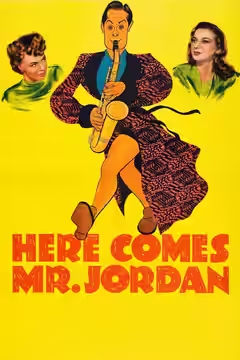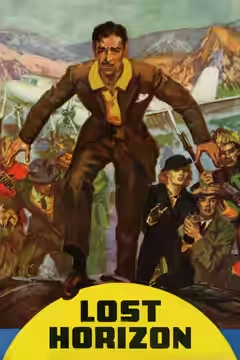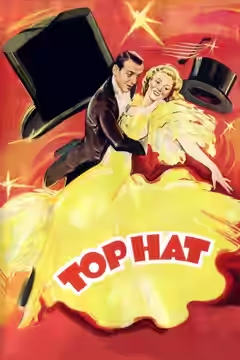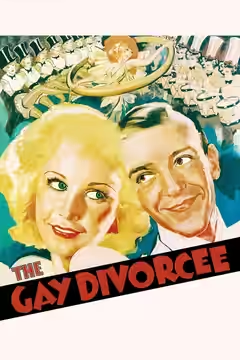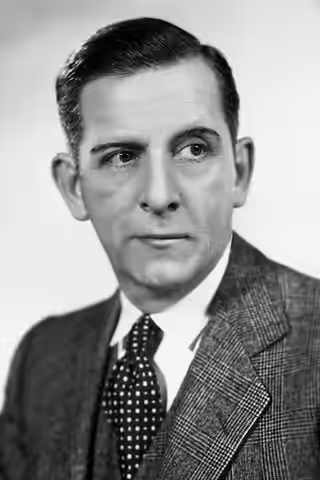
Horton made a career out of the moment a man realises he has been made a fool of, and he could stretch that moment across three separate looks. He never carried a picture and never needed to.
Fi1m perspective
Somebody tells Edward Everett Horton something he does not want to hear. He smiles, because he is an agreeable man and has not yet taken it in. He nods. Then the news arrives, in stages, and the face comes down like a blind. Sometimes there is a small strangled noise, an "Oh" that has been squeezed out of him. In Top Hat (1935) he does this whenever the plot turns on him, which is often, because he is Horace Hardwick, the producer whom Ginger Rogers has mistaken Fred Astaire for, and every misunderstanding in the film lands on his desk.
He had been doing it for a long time by then. He started on the stage in 1906, in vaudeville and on Broadway, went to Los Angeles in 1919 and was in silent comedies from 1922. Sound did not frighten him; the voice was half the act, a crackling, over-precise diction that made every line sound as if it had been ironed. The 1930s were his decade. Ernst Lubitsch used him in Trouble in Paradise (1932), Astaire and Rogers used him three times, starting with The Gay Divorcee (1934), Frank Capra put him in Lost Horizon (1937), and he played Nick Potter in George Cukor's Holiday (1938). Arsenic and Old Lace (1944) gave him Mr Witherspoon, and he went on working, in film, on television and in voice parts, into the 1960s.
The Astaire and Rogers films are where to find him, and they are the ones we have reviewed. In The Gay Divorcee his Egbert Fitzgerald flusters best when there is nobody else on screen to react to him; he is a man who can be embarrassed by furniture. In Top Hat the film gives him Eric Blore as his valet, a man who refers to himself as "we" and treats his employer as a job of work, and Horton plays the employer who has it coming. We laughed at that strangled "Oh" every time it arrived, and were faintly ashamed of how little he had to do to get it out of us. He knew exactly how long to hold the smile, and he never held it the same length twice.
The complaint against him was always the same: that he played one part, the mouse, and the studios kept ordering it. There is something in that. He wanted more serious work, and Summer Storm (1944) is the example people reach for, but the double take was what paid. He knew it. "It pays to be a mouse, or at least it pays me," he said. "And as long as it pays, I'm going on with my mousing, just as long as the producers ask for it."
They asked for it for forty years, and he never once looked as though it were beneath him. Start with Top Hat, where the plot lands on him more than on anyone else in the picture, and count the takes. Then watch The Gay Divorcee and notice that he is doing exactly the same thing a year earlier, in a weaker film, and getting the same laugh.
Biography
Edward Everett Horton was an American character actor and comedian. He began his stage career in 1906, performing in vaudeville and Broadway productions. In 1919 he moved to Los Angeles, where he started working in Hollywood films.
Horton appeared in numerous comedies, often in supporting roles. His credits include Trouble in Paradise (1932), Design for Living (1933), The Gay Divorcee (1934) as Egbert Fitzgerald, Top Hat (1935), Lost Horizon (1937), Holiday (1938), Arsenic and Old Lace (1944), Pocketful of Miracles (1961) and It's a Mad, Mad, Mad, Mad World (1963). He also worked in television, including a guest role in Batman (1966).
Horton died in Los Angeles in 1970.