Film review

Lost Horizon

1937 · Directed by Frank Capra · 2h 12m · MPA NR

In a sentenceA hijacked plane, a blizzard, a hidden valley, and then ninety minutes of kindly old men explaining moderation

AdventureFantasyDramaRomance

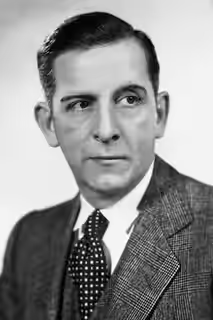
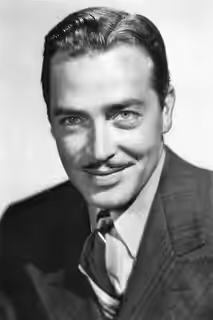
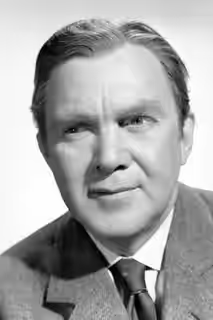
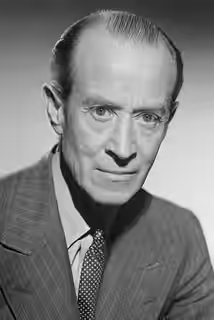
Baskul, China, 1935. Revolution has reached the airfield, and Robert Conway (Ronald Colman), a British diplomat, is loading the last Europeans onto the last plane out. Aboard with him are his younger brother George (John Howard), the fossil expert Alexander Lovett (Edward Everett Horton), Henry Barnard (Thomas Mitchell), who is not what his papers say, and Gloria Stone (Isabel Jewell), who is ill. In the air they discover that the pilot is a stranger and that the plane is heading west into the mountains rather than towards Shanghai. It runs out of fuel and comes down in the snow. A party led by Chang (H. B. Warner) finds them and walks them over a pass to a lamasery called Shangri-La, where Sondra Bizet (Jane Wyatt) is waiting and the High Lama (Sam Jaffe) has asked to see Conway.

Fi1m review

Frank Capra’s version of James Hilton’s novel opens with half an hour of riot, hijack and blizzard that still grips, then settles into a paradise where the plot sits down and listens. Ronald Colman keeps it civil; the speeches keep it long.

Frank Capra spent the mid-thirties making comedies about decent men in indecent towns, and then he turned to James Hilton’s novel about a valley where nobody grows old. Lost Horizon is his plea for peace, made in 1937 with the next war plainly in view, and it is two films. The first is a kidnapping adventure that still grips. The second is a long, soft-spoken argument for moderation, and the film loves the argument more than we did.

The opening half-hour is the best thing in it. Baskul is burning, a mob is at the airfield, and the diplomat Robert Conway (Ronald Colman) is getting the last of the Europeans onto the last plane out. Joseph Walker shoots the evacuation in hard night light, torches and headlamps and a propeller wash that flattens everyone who gets near it. Once the plane is up the passengers notice that the pilot is not their pilot, that the sun is on the wrong side, and that they are flying into mountains with no fuel to get back. Gene Milford and Gene Havlick cut this stretch tight, and Dimitri Tiomkin keeps the score down to a pulse under the engines. The crash and the walk through the snow that follows are properly cold; we could feel the wind, and we had stopped noticing the sets.

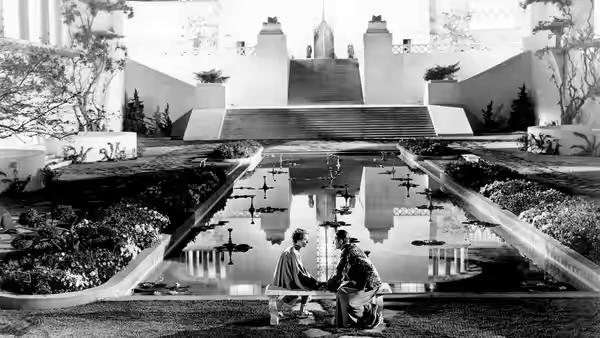
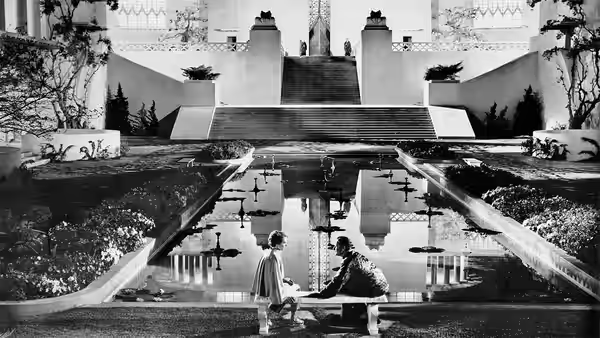
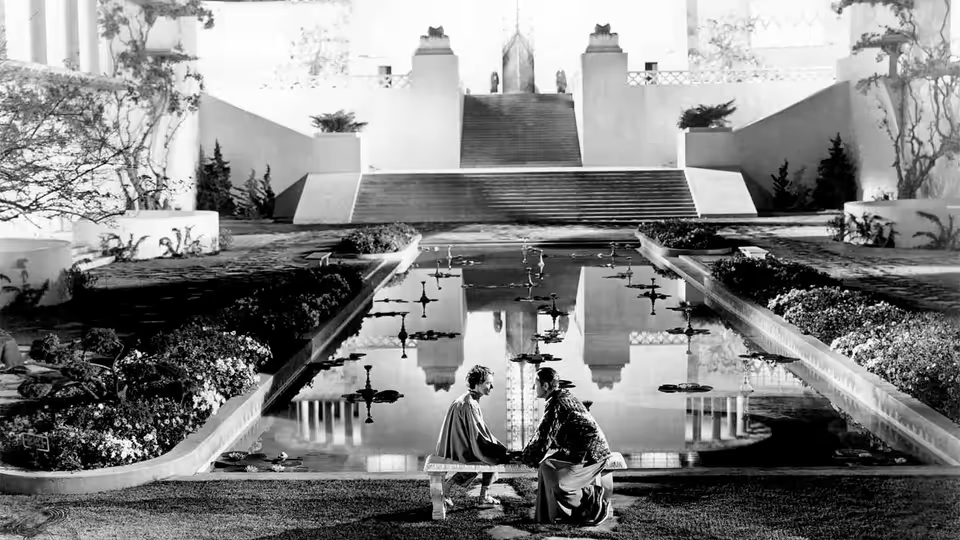
Then the wind stops and the film changes key. Chang (H. B. Warner) meets the survivors in a fur hat, leads them over a pass, and the clouds part on Shangri-La: white walls, long flights of steps, still pools, a lamasery that looks like a Californian resort built by someone who had read about Tibet. Walker lights it with the soft, high, shadowless glow that Hollywood kept for heaven and for women’s close-ups, and Ernest Dryden dresses the inhabitants in pale robes with nothing on them to catch the eye. It is lovely to look at and it is meant to be calming, and it calmed us more than a film should. Within twenty minutes of arrival we were working out how long was left.

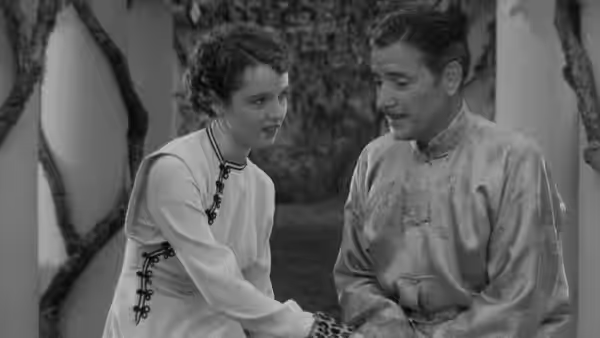
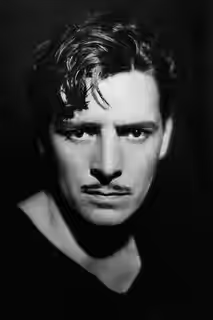
The people help. Colman does the whole of Conway with his voice, a tired, humorous instrument that makes even the daftest lines sound like something a sensible man might say after a drink. Edward Everett Horton, as the fossil expert Lovett, and Thomas Mitchell, as the wanted swindler Barnard, are the comedy, and they are the reason the middle hour is bearable: two men from opposite ends of respectability discovering they would rather stay where nobody can reach them. Isabel Jewell gives the dying Gloria a hard, cheap edge that softens without the film underlining it. John Howard, as the brother George, has the thankless job of being the one who wants to leave, and he plays it as a man shouting in a library. Jane Wyatt’s Sondra is mostly a smile and a flock of pigeons with flutes tied to their legs, though the smile is a good one, and Margo’s Maria is the only person in the valley who seems to want anything.

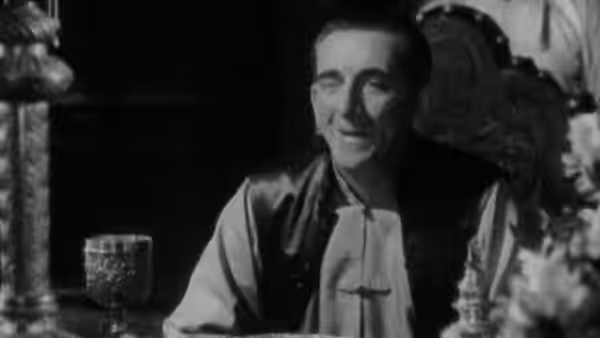
The trouble is the wisdom. Robert Riskin and Sidney Buchman’s screenplay hands Shangri-La’s philosophy to the High Lama (Sam Jaffe), an ancient man in a dim room who speaks in whole paragraphs about kindness, moderation and the storm coming for the world outside. Jaffe is made up to look two hundred and delivers every line at the pace of a man who has that long to live. Capra shoots these scenes as sermons, Colman listening in profile, and he plainly believes every word. So did we, more or less; the problem is that the film mistakes agreement for drama. A valley where nothing is at stake is a fine place to live and a poor place to set the second half of a picture, and the script knows it, because it keeps dragging George back in to argue.

Capra had just made Mr. Deeds Goes to Town (1936), which had the same faith in ordinary decency and put it in a courtroom, where somebody could lose. Here the faith has nowhere to go but into speeches. The version now shown runs 132 minutes, restored after decades of cuts, and a few of those minutes survive only as sound played over still photographs; we found we did not much miss the movement, which is a criticism. See it for the first half-hour, for Colman, and for Horton and Mitchell warming their hands at a fire they have decided not to leave. Sit near the door for the High Lama.
Critical consensus AI synthesised

64
Positive
5
Mixed
0
Negative
1

Most critics like Lost Horizon, and the praise gathers in the same places. Capra’s staging of the kidnapping and the flight into the mountains is singled out repeatedly, with the contrast between the storm outside and the calm of Shangri-La counted as the film’s strongest passage. Ronald Colman’s performance is admired across the reviews, and several find the romance still plays. The reviews treat it as a fantasy epic on a grand scale that mostly earns its size.

The reservations cluster once the party reaches the valley. The philosophical talk with the High Lama is thought to slacken the pace, the middle stretch to drag, and the sentiments to read as naive or dated; the sets are called kitsch. The spread is otherwise narrow, with one clear dissenter: The Guardian sees the whole as a failed personal project, its pacifism undone by a toothless High Lama and its utopia oddly sexless.

Empire
1 January 2000 · Kim Newman
70*

The critic finds it a remarkably effective Capra film with magical stretches and a sexy romance that still play well, but notes outdated awkward stretches in the philosophy and a dragging middle section.

Read the full review →
Sight and Sound
70*

The story is a grand-scale utopian fantasy with some disadvantages from its length. Philosophical dialogue after reaching Shangri-La does not match the excitement of the kidnapping sequence, though the contrast between storm and peace, sound effects, and several performances are praised; Capra struggles with the vast canvas but delivers an outstanding epic in parts.

Read the full review →
The New York Times
3 September 1986
70*

The article discusses the restoration of the 132-minute version of the 1937 Frank Capra film, highlighting the recovery of pacifist speeches by the High Lama and the efforts to present the more complete cut to audiences after decades of edits.

Read the full review →
Time Out
11 September 2012
70*

A classic fantasy epic based on James Hilton's novel about passengers ending up in Shangri-La. It is a full-blown weepie with kitschy sets and naïve sentiments but features fine acting from Ronald Colman; the reviewer notes such a film could not be made today, as shown by the poor 1973 remake.

Read the full review →
The Guardian
18 December 2010 · Michael Newton
30*

The critic finds Lost Horizon a flawed personal project that reveals Capra's deepest longings for a sexless, pure utopian world. It fails despite its mid-1930s pacifism, with wisdom delivered by a toothless High Lama.

Read the full review →
Collider
19 October 2024 · Bob May
80*

The critic praises Capra's unique fantasy adventure as a plea for peace and hope, highlighting its stylishness, stellar cast including Ronald Colman, and themes of war, peace, and choice. It notes the film's initial struggles but eventual acclaim and lasting appeal as a Capra favorite.

Read the full review →

Cast

Awards

Academy Awards, 1938

Nominated
Best Picture
Nominated
Best Score, Adaptation or Treatment
Nominated
Best Sound
Nominated
Best Supporting Actor
Won
Best Film Editing
Won
Best Production Design

If you liked this, try…

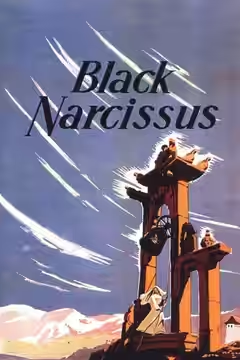
Black Narcissus poster88

Black Narcissus

1947 · The Himalayas again, in colour, and this time the mountain gets under everyone’s skin.

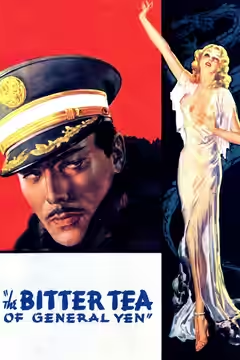
The Bitter Tea of General Yen poster

The Bitter Tea of General Yen

1933 · Capra’s earlier China, stranger and more dangerous, with nobody offering anyone peace.

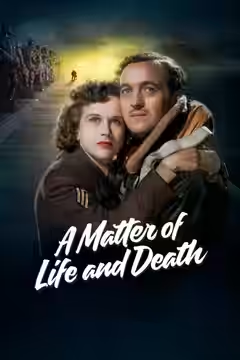
A Matter of Life and Death poster92

A Matter of Life and Death

1946 · Another well-lit afterlife with a bureaucracy, and a much better argument about staying.

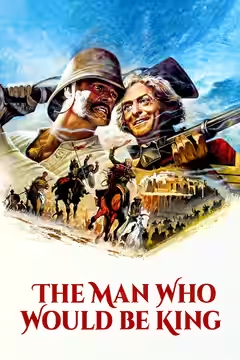
The Man Who Would Be King poster

The Man Who Would Be King

1975 · Two chancers find a hidden kingdom and prove exactly why Barnard should have stayed put.

Himalaya poster

Himalaya

1999 · A Tibetan valley shot on the spot, where the elders are wise and also get cold.