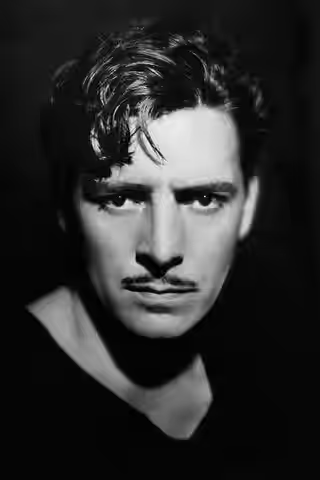
Ronald Colman is the finished English gentleman of early sound cinema, and the voice does half the work before he has moved. When the part is a gentleman with something to lose he is hard to beat; when it needs hunger, he gives us manners.
Fi1m perspective
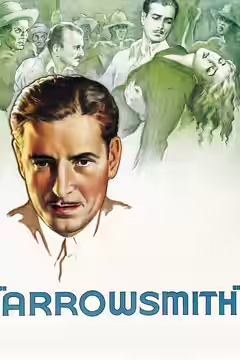
Watch where directors put him. In Arrowsmith (1931) John Ford and his cameraman Ray June stand Colman in doorways and at the far ends of rooms, and before he has crossed the floor you know he will be courteous when he arrives. The moustache is tidy, the collar is done up, and then the voice comes, low and unhurried, and the scene tilts towards him. He arrived in talking pictures with that voice already made, in Bulldog Drummond (1929), and for the next two decades it was the sound Hollywood reached for when it wanted an Englishman who had been to a good school.
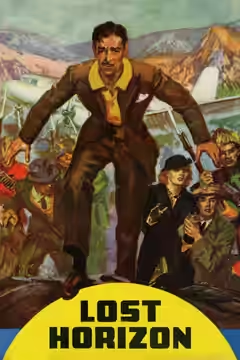
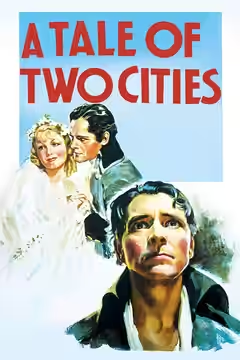
He had been a silent star first. He went to America in 1920, was a leading man opposite Lillian Gish in The White Sister (1923), and spent the rest of the decade under contract to Samuel Goldwyn, often paired with Vilma Bánky. Sound, which finished many of his contemporaries, made him. Through the 1930s and 1940s he worked freelance and took the parts the manner suited: Sydney Carton in A Tale of Two Cities (1935), Robert Conway in Frank Capra's Lost Horizon (1937), two men at once in The Prisoner of Zenda (1937), Charles Rainier in Random Harvest (1942), and an actor whose role gets into his life in A Double Life (1947). The self-sacrificing hero is the part that fits him best, because giving things up gracefully is what a gentleman is for.
The limit is Arrowsmith, and it is worth seeing for that reason. Martin Arrowsmith is a young doctor who has not yet worked out what he wants, and he should be raw. Colman plays him as a gentleman who has mislaid something. He is good in the institute scenes, where being a disappointed gentleman is the job, and he is good against Helen Hayes, who plays the wife with her eyes open and quietly takes the film. But we sat through the laboratory scenes waiting for him to forget himself for a minute, to look unfed while the culture grew, and he never did; the posture held, and the picture stayed politely cool where it needed to burn.
That smoothness is also why he has been undervalued. Nothing looks like effort, so it is easy to assume nothing is being done, and the double role in The Prisoner of Zenda is the usual example of work mistaken for ease. He is an actor of small adjustments, the head, the pause, the drop in the voice, and he trusted them when the fashion was for more. Start with Arrowsmith, to see exactly where the manner stops. Then go to 1937 and see how little that mattered when the part was built for it.
Biography
Ronald Colman was a British actor who became a leading man in Hollywood films. Born in Richmond, Surrey, England, he served in the First World War before pursuing a stage career. He moved to the United States in 1920 and made his breakthrough in the silent film The White Sister (1923).
Colman starred in numerous films including Arrowsmith (1931), A Tale of Two Cities (1935), Lost Horizon (1937), The Prisoner of Zenda (1937), Random Harvest (1942), The Talk of the Town (1942) and A Double Life (1947), for which he won the Academy Award for Best Actor. He also appeared in Around the World in 80 Days (1956).