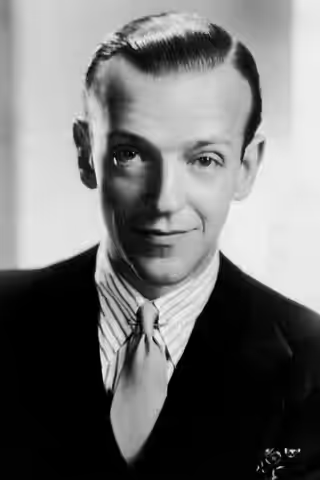
Fred Astaire made the camera stand still and watch. Full figure, long takes, nothing cut to hide a foot: he insisted a dance be seen whole, and from 1933 to 1957 the films around him were often thin and the dancing never was.
Fi1m perspective
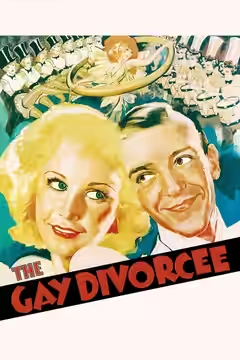
Watch what the camera does when Fred Astaire starts to dance. It stops. It shows him from hat to shoes and keeps showing him, and it does not cut to a face or a foot to hide a join, because there is no join. Tap, ballroom and whatever else he had picked up in a lifetime on the boards are run together into one line of movement, worked out with the choreographer Hermes Pan, and the point of the long take is that you can see it is all him. On the hotel terrace in The Gay Divorcee (1934), dancing 'Night and Day' with Ginger Rogers, he courts her without a word. We had gone in expecting a museum piece and found ourselves sitting forward, because the film had spent an hour failing to make the romance plausible and here it was, done in four minutes with nothing said.
He came to Hollywood in 1933 after a childhood in vaudeville and fifteen years on Broadway with his sister Adele, until she retired in 1932. RKO's first screen test found him unable to act or sing adequately. Flying Down to Rio (1933) put him beside Rogers, The Gay Divorcee made them a pair, and there were ten films together by 1939, five of them directed by Mark Sandrich, among them Top Hat (1935) and Swing Time (1936). In those films the dances are the plot; the couple fall in and out of love on the floor, and the dialogue scenes exist to get them there. He kept making musicals until 1957, and the later ones know their own history: The Band Wagon (1953) casts him as Tony Hunter, a dancer whose career looks a good deal like his own, and Funny Face (1957) puts him opposite Audrey Hepburn. From the late 1950s he took dramatic parts, in films such as The Towering Inferno (1974) and on television, and made his last film in 1981.
What does not work is nearly always the film around him. The Gay Divorcee is a farce with one misunderstanding stretched over an hour, and its finale, 'The Continental', breaks his own rule: William Hamilton cuts between overhead formations and the chorus until the number loses its way, and it is the one stretch where we stopped watching him and started looking at shoes. The scripts also lean on his manners to make doubtful behaviour bearable. Guy Holden follows a woman across two countries after she has asked him to stop, and Astaire's courtesy does most of the work of making that charming. It should not have to.
He said the thing that looks lightest about him was the hardest: "Dancing is a sweat job." The sweat never shows, and he kept the camera far enough back to prove it. Start with the terrace in The Gay Divorcee, then go to Top Hat, which has the tighter plot and the better songs. On a first viewing sit through the farce between the numbers; on a second, you have our permission to skip it.
Biography
Fred Astaire, born Frederick Austerlitz on 10 May 1899 in Omaha, Nebraska, USA, was an American dancer, singer and actor. He began performing in vaudeville as a child with his sister Adele and later achieved success on Broadway and in London's West End.
After Adele retired in 1932, Astaire moved to Hollywood. He appeared as Guy Holden in The Gay Divorcee (1934), the first of several films pairing him with Ginger Rogers. Other notable roles include Jerry Travers in Top Hat (1935), Lucky Garnett in Swing Time (1936) and Ted Hanover in Holiday Inn (1942). He continued working in film and television into the 1980s, with later credits including Harlee Claiborne in The Towering Inferno (1974) and Ricky Hawthorne in Ghost Story (1981).
Astaire died of pneumonia on 22 June 1987 in Los Angeles.