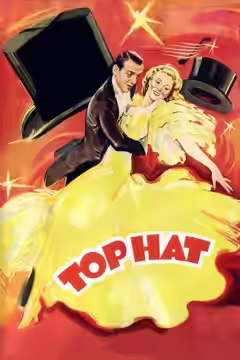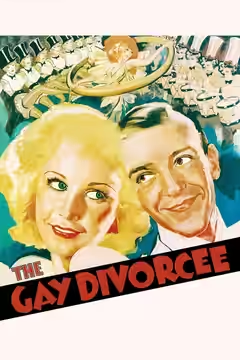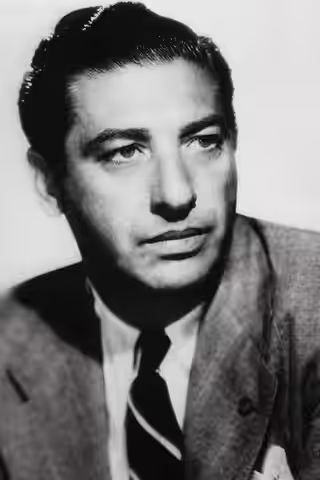
Sandrich pointed the camera at Fred Astaire and Ginger Rogers, kept it running, and cut as little as he could. He made six films with Astaire and gave the RKO musical its shape; whether the plots around the dances were ever as good as the dances is another matter.
Fi1m perspective
Somewhere in every Mark Sandrich musical the plot stops, two people stand up, and the camera does something most directors of the period would not have risked: it stays. It pulls back until both dancers are in frame from hat to shoe, tracks them across the floor, and cuts as little as it can get away with. The number is left to do the work that dialogue does elsewhere, telling us who wants whom and how much. In The Gay Divorcee (1934) it is Cole Porter's 'Night and Day' on a hotel terrace, and it is the reason the film is still watched.
He came to this by an odd road. Sandrich started in comedy shorts in 1927, made a first feature, Runaway Girls, in 1928, and went back to shorts when sound arrived. RKO gave him The Gay Divorcee, the first film to put Fred Astaire and Ginger Rogers in the leads, and he stayed with the pair for five musicals through 1938, with Pandro S. Berman producing five of his films: Top Hat (1935), Follow the Fleet (1936) and Shall We Dance (1937) among them. In 1939 he moved to Paramount as a director-producer, made Jack Benny comedies including Buck Benny Rides Again (1940), and put Astaire opposite Bing Crosby in Holiday Inn (1942), the Irving Berlin film that introduced 'White Christmas'. He died in 1945, in pre-production on Blue Skies.
What he did with the camera was not the same for each star. He kept his distance from Astaire and cut a little quicker; he moved in on Rogers when the scene was comedy rather than dance. The comedy itself he treated as a technical matter, and his timing with character actors and radio stars, in Buck Benny Rides Again especially, was exact. Our reservation is the one our review of The Gay Divorcee made: the farce is creaky, the misunderstandings go on, and the chorus work is filler. We sat through it in a state of polite patience, and then Astaire crossed the terrace, Rogers turned, and for four minutes we forgot there had been a plot at all. That is the shape of a Sandrich film. It is not a bad shape, but it means the pictures stand or fall on their dances.
The usual complaint is that these are talked about as Astaire and Rogers films rather than Sandrich films, and there is something in it. But somebody decided where the camera stood and how long it held, and that person was not dancing. Start with The Gay Divorcee, and do not judge it by its first half; the terrace is coming.
Biography
Mark Sandrich was an American film director, writer and producer. He began working in the film industry as a prop man after studying engineering at Columbia University, then directed comedy shorts from 1926 before moving to features.
He directed the Fred Astaire and Ginger Rogers musical The Gay Divorcee (1934), followed by Top Hat (1935), Follow the Fleet (1936), Shall We Dance (1937) and Carefree (1938). Later credits include Holiday Inn (1942) and So Proudly We Hail! (1943). He also directed the Academy Award-winning short So This Is Harris! (1933).
Sandrich died of a heart attack in 1945 while serving as president of the Directors Guild of America. His sister was photographer Ruth Harriet Louise; his sons Jay Sandrich and Mark Sandrich Jr. both became directors.