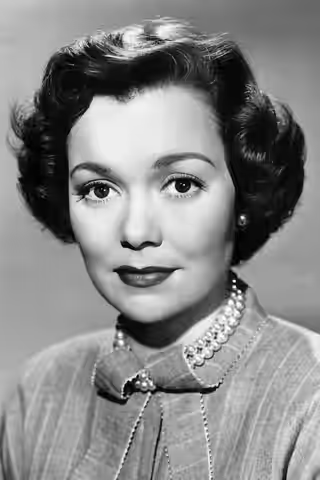
Jane Wyman was cast, again and again, as women who put up with things, and her gift was to make putting up with things look like a choice. Even in a part written to wait, in The Lost Weekend, she plays a mind at work.
Fi1m perspective
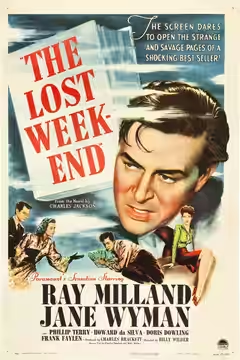
Helen St. James, in The Lost Weekend (1945), is not much of a part. She is the good woman who waits for Ray Milland's drunk, and Billy Wilder gives her a flashback about a mix-up at an opera cloakroom that is charming and stops the film dead. Jane Wyman plays her intelligence anyway. That is her method, and she used it for a decade: take the woman the script has written as patient and show us that the patience is something she is doing, on purpose, at a cost.
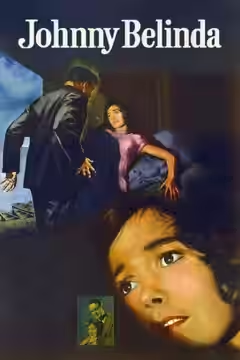
She had been at Warner Bros since 1936, a chorus girl and radio singer turned contract player, working through comedies and musicals without anyone paying much attention. The Lost Weekend was the turn. After it came The Yearling (1946), as Orry Baxter, and Johnny Belinda (1948), in which she played Belinda MacDonald without a line of spoken dialogue, having studied at a school for the deaf and acted with her ears plugged. Then the melodramas of the 1950s: Hitchcock's Stage Fright (1950), and two for Douglas Sirk, Magnificent Obsession (1954) and All That Heaven Allows (1955), which fixed the screen persona she carried from then on.
We have not reviewed the Sirk films and will not pretend to. What we can speak to is The Lost Weekend, where we sat down expecting Helen to be the film's dull patch and found ourselves watching her instead of the bottle. The reason is that Wyman never plays waiting as an empty space. Helen is thinking, weighing Don up, deciding in each scene whether to stay, and Wyman lets that show while the writing insists she is simply devoted. It is the harder thing to do with a small part: not to make it bigger, but to make it a person.
The limit is the type. The studios found one thing she did well, the resilient woman in the emotional drama, and asked for it until the mid-1950s, and when the film offers thinned after that the ones that came were, by most accounts, not worth taking. She went to television, hosting and starring in her own anthology series from 1955 to 1958, and then more or less retired.
The last act is the surprising one. In 1981 she came back as Angela Channing in Falcon Crest, a ruthless matriarch, and stayed nine years. "I always did four-handkerchief roles. Until now," she said, and there is a lesson in it about how long an actor can be filed under the wrong heading. Start with The Lost Weekend, watch Helen rather than Don for one scene, and see what she does with a part that asks her to do nothing.
Biography
Jane Wyman was an American actress. Born Sarah Jane Mayfield on 5 January 1917 in Saint Joseph, Missouri, she began her career in the early 1930s as a chorus girl and radio singer before appearing in bit parts in films. She signed a contract with Warner Bros. in 1936 and took the professional name Jane Wyman.
She gained prominence with her role as Helen St. James in The Lost Weekend (1945). Wyman received an Academy Award for Best Actress for her performance in Johnny Belinda (1948) and earned further nominations for The Yearling (1946), The Blue Veil (1951) and Magnificent Obsession (1954). Other notable film roles include Stage Fright (1950), All That Heaven Allows (1955) and Pollyanna (1960).
In television she starred as Angela Channing in the series Falcon Crest (1981–1990) and appeared in Dr. Quinn, Medicine Woman (1993). She was married to actor Ronald Reagan from 1940 to 1948. Wyman died on 10 September 2007 in Rancho Mirage, California.