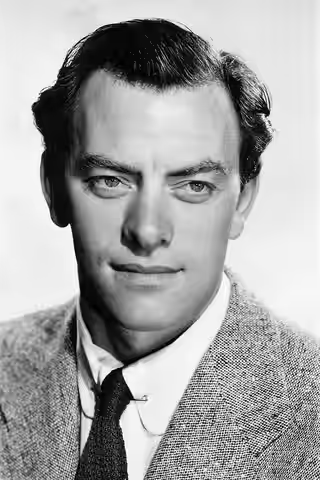
John Ireland spent a long career a little to one side of the frame: the dark, watchful tough in Westerns whose loyalty was the open question. He was good at it, and the one film that put him at its centre never quite let him use it.
Fi1m perspective
Watch where John Ireland stands. In the Westerns that made his name he is rarely in the middle of the shot; he is at the bar, at the edge of the group, looking at the hero with a face that has already decided something and is not saying what. Dark brows, a set mouth, a stillness that reads as threat until it reads as doubt. Directors cast him as the tough who might change his mind, the sidekick whose allegiance is the question, and he could hold that question for an hour without answering it.
He came to films from the stage, arriving in 1945 with A Walk in the Sun, and within three years had worked for two of the best Western directors in the business: Billy Clanton for John Ford in My Darling Clementine (1946) and Cherry Valance for Howard Hawks in Red River (1948), where he squares off against Montgomery Clift and the confrontations are his to win. Then came All the King's Men (1949), the largest part he would have, and after it, from the early 1950s, a long run of B pictures and supporting turns in bigger films: Johnny Ringo in Gunfight at the O.K. Corral (1957), Crixus in Spartacus (1960), then decades of television guest work. He directed and produced a few features of his own.
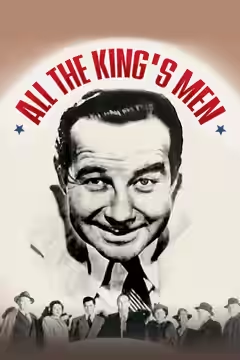
All the King's Men is the film to start with, and it is also where the limits show. Robert Rossen casts him as Jack Burden, the reporter who signs on with Willie Stark and slowly sees what he has signed on for, and the turn from believer to something colder is there when the script reaches it. The difficulty is that Burden on the page has a mind we can hear, and Burden on screen has a face at the edge of a frame that Broderick Crawford fills to the edges. We kept waiting for Rossen to cut to Ireland and let the watching do something, and he mostly does not; whole scenes go by with Ireland present and unused. We came away admiring him and wishing the picture had been on his side.
That is his career in small. Ireland's gift was for the man who thinks before he acts, and the pictures he ended up in from the 1950s on were mostly built for men who act. The Western heavy suited him because the genre lets a villain stand still and stare, and he did that as well as anyone; the low-budget work that followed asked for less and got it.
If you want him, take Red River for the stare and All the King's Men for what he could do when a script gave him a mind to go with it, and do not be surprised when the camera looks away.
Biography
John Ireland (1914–1992) was a Canadian-born American actor and occasional director. Born in Vancouver, British Columbia, he was raised in New York City. He began his career on the stage, making his Broadway debut in a 1941 production of Macbeth, before entering films with a role in A Walk in the Sun (1945).
Ireland appeared in supporting roles in several Westerns, including My Darling Clementine (1946), Red River (1948) and Gunfight at the O.K. Corral (1957). He received an Academy Award nomination for Best Supporting Actor for his performance as Jack Burden in All the King's Men (1949). Other film credits include Spartacus (1960), 55 Days at Peking (1963) and Farewell, My Lovely (1975).
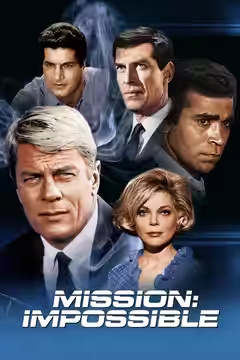
On television he had recurring or guest roles in series such as The Cheaters (1960–1962), Bonanza (1959), Little House on the Prairie (1974), Magnum, P.I. (1980), Murder, She Wrote (1984) and Airwolf (1984). He received a star on the Hollywood Walk of Fame for his contributions to television.