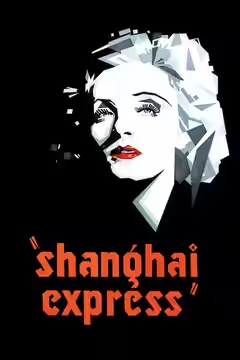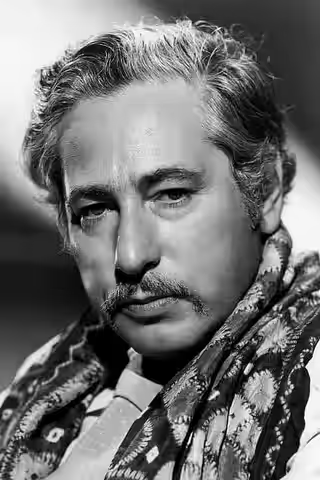
Josef von Sternberg lit Marlene Dietrich like a cathedral and treated the story as a nuisance. When the plot kept pace with the pictures, as in Shanghai Express, the pair made something handsome and fast; when it did not, the frame filled up and the film stalled.
Fi1m perspective
A woman stands still in a crowded frame and lets the light find her. Around her there is smoke, a veil, too much furniture, other people half in shadow. Nobody moves for a moment and nothing needs to, because the picture is the event. That is a Josef von Sternberg shot, and he made hundreds of them. He said as much himself: "I care nothing about the story, only how it is photographed and presented." Most directors who talk like that are bluffing. He meant it.
He came up through the cutting room, patching and editing film from 1911, and it shows: he thought in shots before he thought in scenes. The silent Underworld (1927) helped set the shape of the gangster film. Then The Blue Angel (1930), made in Germany, gave him Marlene Dietrich, and they spent the next five years at Paramount on a cycle of pictures: Morocco (1930), Dishonored, Shanghai Express (1932), The Scarlet Empress (1934) and The Devil Is a Woman (1935). Hans Dreier built the rooms, Travis Banton dressed her, Lee Garmes shot three of his films, and Jules Furthman wrote stories that von Sternberg then photographed around.
The films live or die by whether the story can keep up. Morocco has the look and none of the pace. The Scarlet Empress has so much look that the story cannot breathe under it. Shanghai Express is the one where the train has to arrive, and the timetable disciplines him; it is the best-looking of the Dietrich films and the most fun. It is also the clearest case of what his method costs and what it buys. Clive Brook stands in it, stiff and clipped, saying his lines about honour, and we did not believe his love story for a minute; and we did not mind, because von Sternberg keeps the camera on Dietrich while Brook talks, and what she does while listening is the scene. That is the trick, and it is also the limit. When there is nobody like her in the frame to listen, the décor is only décor.
After Paramount dismissed him the work thinned out. He co-directed Duel in the Sun (1946) and finished with The Saga of Anatahan (1953), shot in Japan with a Japanese cast, which he wrote, produced, photographed and narrated himself. By then critics had decided the mannerisms were the whole man: feathers and fog with nothing under them. That is unfair to the good films and fair to some of the others. Start with Shanghai Express, at home with the lights off. If you want more, The Blue Angel is where the partnership began, and The Scarlet Empress is where it went to die of its own beauty.
Biography
Josef von Sternberg was an Austrian-born film director. Born Jonas Sternberg on 29 May 1894 in Vienna, he emigrated to the United States as a child and began working in the film industry in New York around 1911, initially in editing and titling before moving into direction.
He is best known for his seven films with Marlene Dietrich, including The Blue Angel (1930), Morocco (1930), Shanghai Express (1932), Blonde Venus (1932) and The Scarlet Empress (1934). Other notable works include Underworld (1927), The Docks of New York (1928) and The Last Command (1928). He was twice nominated for the Academy Award for Best Director.
Sternberg also worked as a writer, cinematographer and editor on many of his films. He died on 22 December 1969 in Hollywood, California.