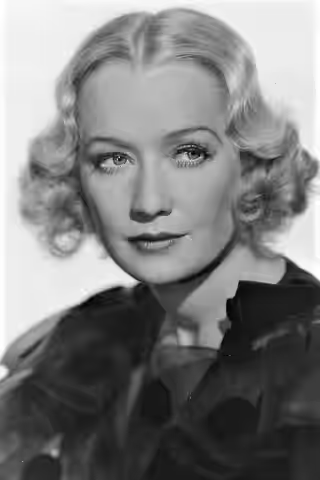
Miriam Hopkins played women who were meant to be the joke as though nobody had told them: husky voice, restless hands, disdain that passes for charm. In the early 1930s it was the sharpest thing in Ernst Lubitsch's comedies; later the manner sometimes outlasted the parts.
Fi1m perspective
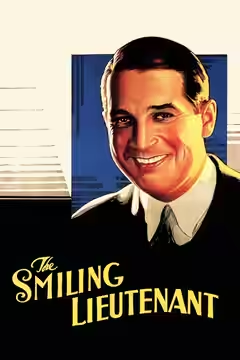
In The Smiling Lieutenant (1931) Miriam Hopkins arrives under a hat that could shelter a family, in a dress her grandmother would have called dowdy, sulking through games of draughts with her father. For a minute she looks like the film's joke. Then a lieutenant's wink meant for another woman lands on her, she decides she has been looked at, and her certainty is alarming. We laughed at the hat, and we had stopped laughing by the time she raised her eyes. She did that for a decade: took the woman the script had marked down as ridiculous and played her as if she had not been told.
The reputation rests on about three years. She came to Paramount in 1930 from Broadway, where she had started in the chorus, and by 1933 she had made three films with Ernst Lubitsch: this one, Trouble in Paradise (1932), in which she is the pickpocket Lily, and Design for Living (1933), which puts her in a flat with two men and declines to apologise. In between, for Rouben Mamoulian, she was Ivy Pearson in Dr. Jekyll and Mr. Hyde (1931), and then the title part in the Faulkner adaptation The Story of Temple Drake (1933). These were the last years before the Production Code was enforced in earnest, and she spent them playing women who wanted things, said so, and were not made dull for it. The husky voice, the hands that never stop, the Georgia that never quite left the vowels: all of it was in place by then.
What she does best is disdain played as charm, and she leaves it to us to decide which it is. Critics have called it ladylike bitchiness for decades, and it is not unfair. It works when the director is quicker than she is. With Lubitsch the scenes move fast enough that the hands read as punctuation; William Wyler, who made four films with her beginning with These Three (1936), held her stiller and got something harder. Left to herself the brittleness stiffens into mannerism, and the usual exhibit is Old Acquaintance (1943), where the complaint was one note held for the length of a feature. She also had a name for taking scenes off her co-stars, and the evidence is on screen: watch what she does to Maurice Chevalier's grin.
She once said, "I have never hesitated about playing unsympathetic roles — as long as they were good roles," and that is the sentence to keep in mind. It explains Ivy and Temple and Princess Anna, and it explains why, when the leads gave way to supporting parts, she was still worth casting: her Lavinia Penniman in The Heiress (1949), back with Wyler, is a part in somebody else's film, and she takes exactly what is hers. Start with the three Lubitsch films, in order, and do not let the hat put you off.
Biography
Miriam Hopkins was an American actress. Born in Savannah, Georgia, she began her career on stage as a chorus girl in New York and appeared on Broadway in the 1920s before making her feature film debut in Fast and Loose (1930).
She signed with Paramount Pictures and gained prominence in early 1930s pre-Code films, including The Smiling Lieutenant (1931) as Princess Anna, Dr. Jekyll and Mr. Hyde (1931) and Ernst Lubitsch's Trouble in Paradise (1932). She received an Academy Award nomination for Best Actress for Becky Sharp (1935).
Hopkins later appeared in supporting roles in films such as The Heiress (1949), The Children's Hour (1961) and The Chase (1966), and worked in television. She died in New York City in 1972.